What Ireland's 1926 census release means for Irish Bostonians

Add Axios as your preferred source to
see more of our stories on Google.
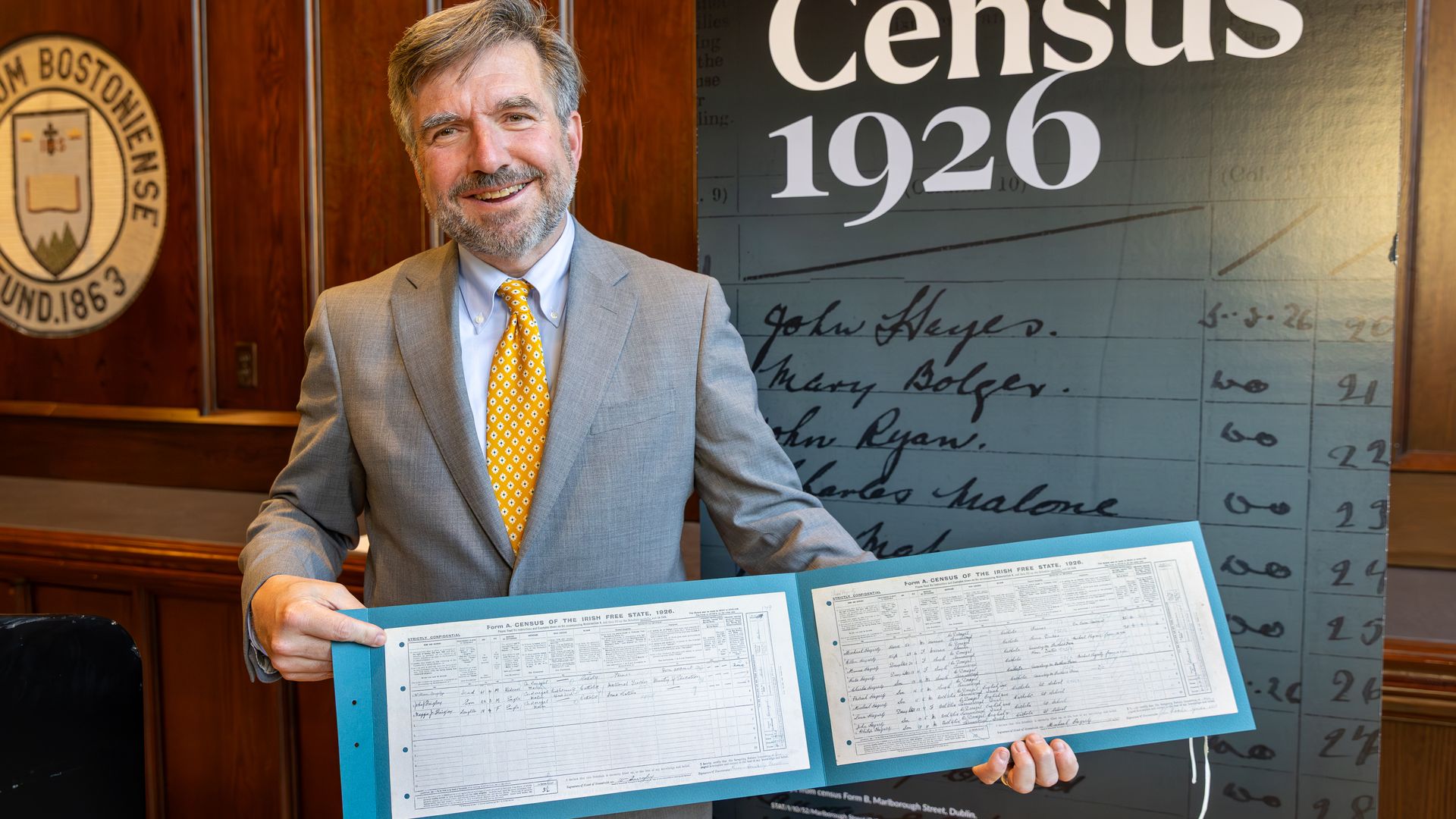
Boston College provost David Quigley. Photo: Courtesy of Margot Murphy/The National Archives of Ireland
A century after Ireland's first census as a free state, Boston College provost David Quigley got his hands on copies of census forms his relatives filled out.
- They were among the 2.9 million people who participated in 1926 and whose records were recently made public.
Why it matters: Massachusetts is home to more than 1.3 million people of Irish descent, per U.S. Census Bureau data.
- While thousands have arrived in recent years, the vast majority in the state are Irish descendants like Quigley, who could use the Irish census to learn more about their ancestors who participated in 1926.
Catch up quick: The National Archives of Ireland published data from the 1926 census online last month.
- About 1,200 people who appeared on the Irish Free State's first census are still alive, said Orlaith McBride, Ireland's National Archives director. (None live in Massachusetts.)
State of play: The Irish National Archives on Wednesday opened an exhibition on the census at Boston College.
- The free exhibition, located in Burns Library, runs through Sept. 9.
Zoom in: Quigley's grandparents grew up only 7 miles apart in Ireland, but they met decades later in the South Bronx.
- Ireland's National Archives surprised Quigley with copies of his grandparents' census records.
What they're saying: "You don't find me speechless on this campus too often," Quigley said when presented with the records at a preview Tuesday night.
Zoom in: The census shows a waning Protestant population after Ireland gained its independence, with 92% of the nation identifying as Roman Catholic.
- Records show a 32% drop in the number of Protestants between the British census of 1911 and the 1926 count, McBride said.
- Although 18% of the population spoke Gaeilge, only 1% filled out the form in the language, suggesting that most of the population was illiterate or lived in rural areas with limited access to education.
Between the lines: Quigley, a 19th-century American history scholar, said the exhibition is not only a commemoration of Irish identity and pride, but also of Irish immigrants and their descendants' part in U.S. history.
- Meanwhile, the U.S. enters its 250th year politically divided.
- "There's a lot of discussion of who the 'us' is," he said.
- "The documents on display in the Exhibition Hall and online make the case for a broader, more expansive sense of who fits into the national family, on both sides of the Atlantic."