Harvard votes on limiting "A" grades

Add Axios as your preferred source to
see more of our stories on Google.
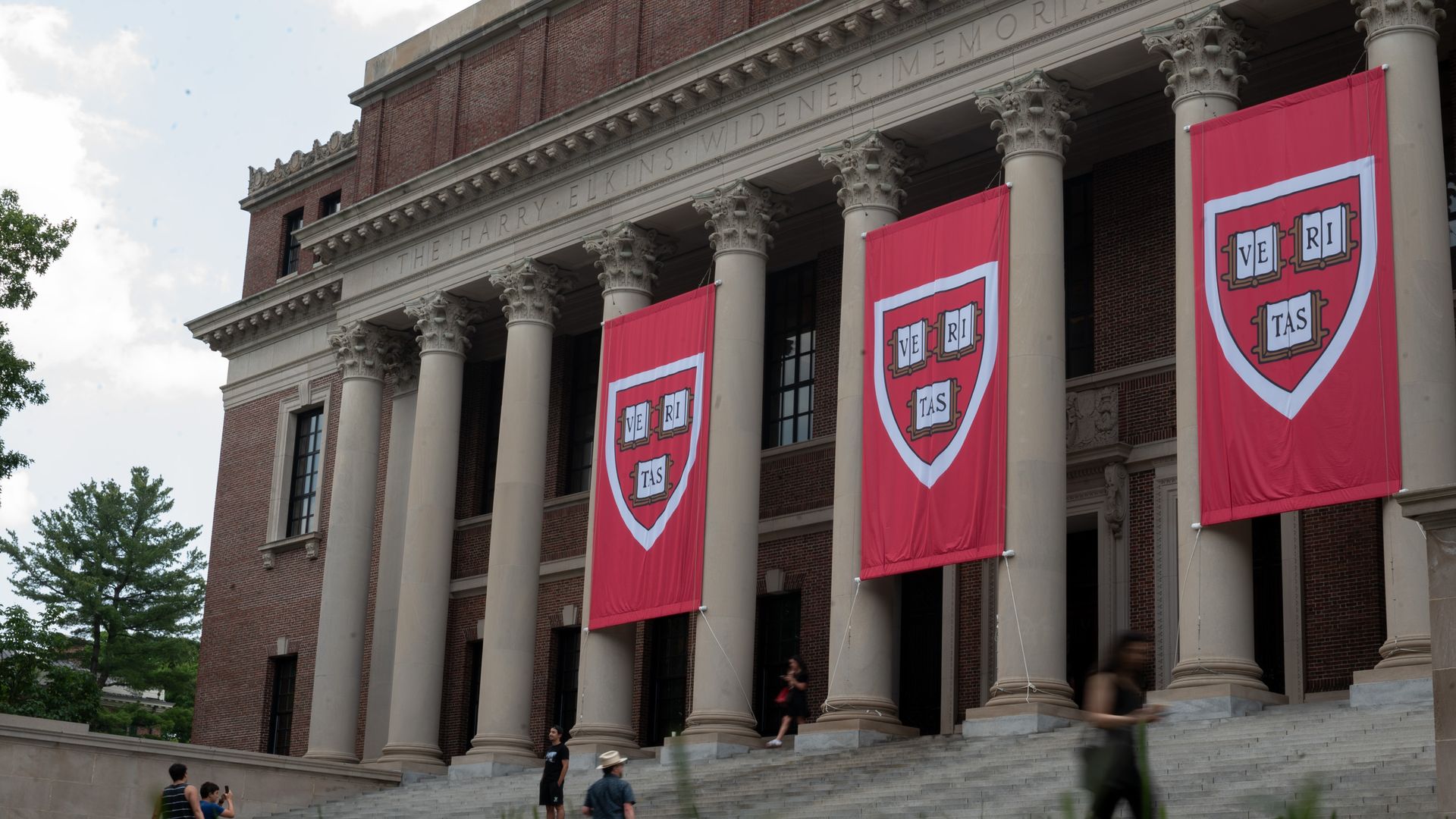
Harvard faculty are considering cracking down on grade inflation. Photo: Heather Diehl/The Boston Globe via Getty Images
Harvard's faculty begins voting Tuesday on limiting the number of top grades professors can award students.
Why it matters: Grade inflation is at a tipping point at Harvard.
- A move to make A grades harder to come by at one of the world's leading universities could influence grading debates at peer institutions.
By the numbers: Solid A's account for nearly two-thirds of all undergraduate letter grades. That's up from roughly a quarter 20 years ago.
- More than 50 members of last year's class graduated with perfect GPAs.
State of play: An online ballot for the Faculty of Arts and Sciences opens Tuesday and closes in one week, with results announced May 20.
The big picture: The steady rise of A and B grades at elite universities since the early 2000s has reduced university GPAs as a screening tool for employers and graduate admissions offices.
- In 2010, A's accounted for one-third of all marks, according to an internal Harvard report. By 2025, that number doubled to over 60%.
Faculty are voting on three separate provisions. Each requires a simple majority to pass.
- A cap to limit solid-A grades to 20% of enrolled students in a class, plus four additional A's per course.
- Changes to how internal honors are calculated, moving from traditional grade point average scoring to an average percentile rank.
- Allowing courses to use new "satisfactory" or "unsatisfactory" marks with a "satisfactory-plus" distinction.
What we're watching: A pre-vote faculty poll showed around 60% of the 205 respondents favored the 20-plus-four formula over an alternative.
Between the lines: Supporters of the cap argue it's intentionally modest as it places no restrictions on A-minuses.
- The four-grade buffer is designed to protect small seminars where a higher proportion of students may succeed.
Yes, but: Critics insist that any restrictions or quota systems undermine academic freedom.
- They say a capped system at Harvard may disadvantage students competing for graduate placements against peers from schools without restrictions.
- Princeton and Wellesley previously adopted anti-grade-inflation policies and later rolled them back amid concerns about student stress, perceptions of quotas and other unintended consequences.
- Princeton's review, however, found no measurable harm to graduates' competitiveness.
What's next: If passed, changes would take effect in fall 2027, followed by a mandatory three-year review.
- As a higher education leader, Harvard's decision could pressure other institutions to revisit their own grading norms.