Boston restaurants, stores often flout captions ordinance

Add Axios as your preferred source to
see more of our stories on Google.

Illustration: Tiffany Herring/Axios
Boston businesses often violate the city's ordinance requiring captions on TVs, more than three years after the law's passage.
- And the city rarely enforces the law, according to records reviewed by Axios.
Why it matters: A simple change to a business' TV settings makes spaces more inclusive for Deaf and hard-of-hearing people, who make up roughly 2% of Boston's population, disability rights advocates say.
Flashback: Boston passed its captions ordinance in 2022, joining cities like Portland, Oregon, and states like Maryland.
Driving the news: An Axios review of 108 Boston businesses with TVs found that over half didn't have captions turned on.
- 40 restaurants had captions on their TVs, including six that had a mix of TVs with and without captions.
Friction point: The city's Disabilities Commission, a staff of nine, looks into noncompliance complaints.
- The city doesn't routinely inspect businesses for compliance or impose penalties for violations, which advocates say makes it harder to enforce the law.
- Another caveat, advocates say, is that it exempts entertainment venues.
- To date, the commission has recorded seven complaints since the law took effect — most recently in July 2024, per public records.
What they're saying: "It's 2026, and we're still talking about something so minor," Darian Gambrell, executive director at DEAF, Inc., noted with an interpreter in an interview.
- "At the end of the day, it's really about inclusive access."
- Both Gambrell and Wesley Ireland, who advocated for the 2022 ordinance, added that Boston should impose fines for businesses that violate the law. (Ireland is part of the commission's advisory board, but isn't commenting on behalf of any organization.)
- Gambrell also wants to see the licensing board, other city officials and industry groups regularly reminding business owners about the ordinance. (The Massachusetts Restaurant Association said it regularly reminds restaurants of accessibility requirements, including Boston's captions ordinance.)
How it works: When Boston's Disabilities Commission gets a complaint, the staff informs the business owner of the captions ordinance, followed by reminders and training offers, said commissioner Kristen McCosh.
- The city's website says repeated violations could get referred to the city's licensing board, but McCosh said the city hasn't escalated any violations to that level.
Yes, but: "We did a really robust outreach effort when it first passed, and I think it is time for us to revisit that," McCosh said.
- "We definitely need to step it back up ... which we will definitely do."
Penalties versus outreach
Boston offers businesses accessibility training that covers the captions ordinance.
- But many retailers might still not know about it because they haven't interacted closely with city officials in recent years, McCosh said.
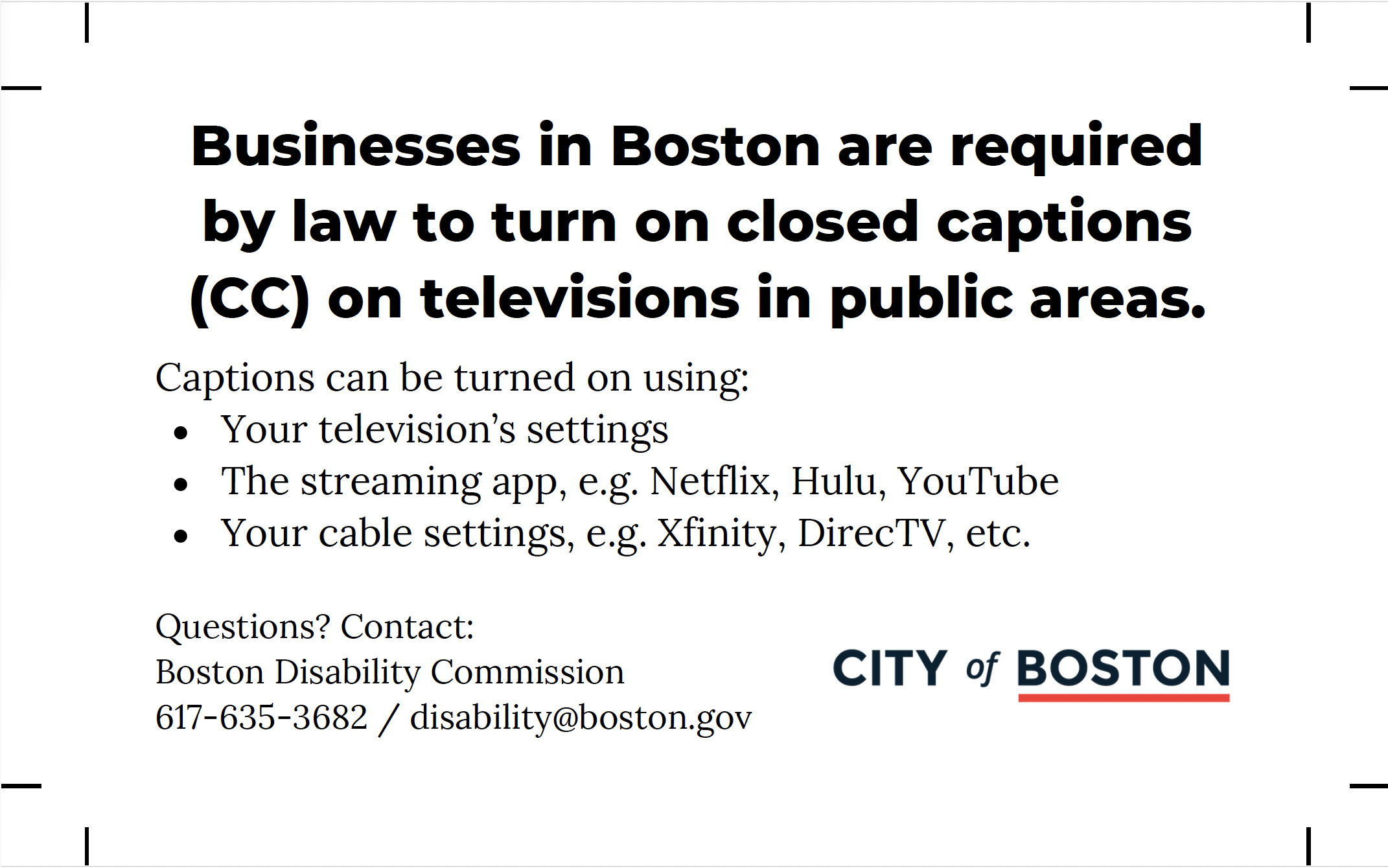
- She pointed to a card that patrons can pull up on their phone or print out to give restaurant workers and ask them to turn on captions.
Zoom in: Business owners say enforcement can be tricky when there's high staff turnover or technological snafus.
- The Greatest Bar in the West End, which got a complaint in 2023, didn't have captions on their screen when Axios visited last month.
- Julie O'Brien Fairweather, the owner, said in an email that the bar does turn on captions, but sometimes a TV's caption settings can reset when an employee changes the channel.
- The captions are set at one cable box area for dozens of TVs across multiple floors, Fairweather said.
Context: McCosh says outreach helps get buy-in from business owners and avoids saddling them with fines — especially as businesses face rising costs.
Zoom out: San Francisco, Portland, Seattle and other cities have their own laws requiring captions in movie theaters, hospitals, restaurants and other spaces.
- They impose fees, while other cities, like Watertown, don't.
What's next: Boston is hosting a public disability community forum on Tuesday to get input on disability access and inclusion.