Greater Boston's sewage problem may continue through 2050

Add Axios as your preferred source to
see more of our stories on Google.
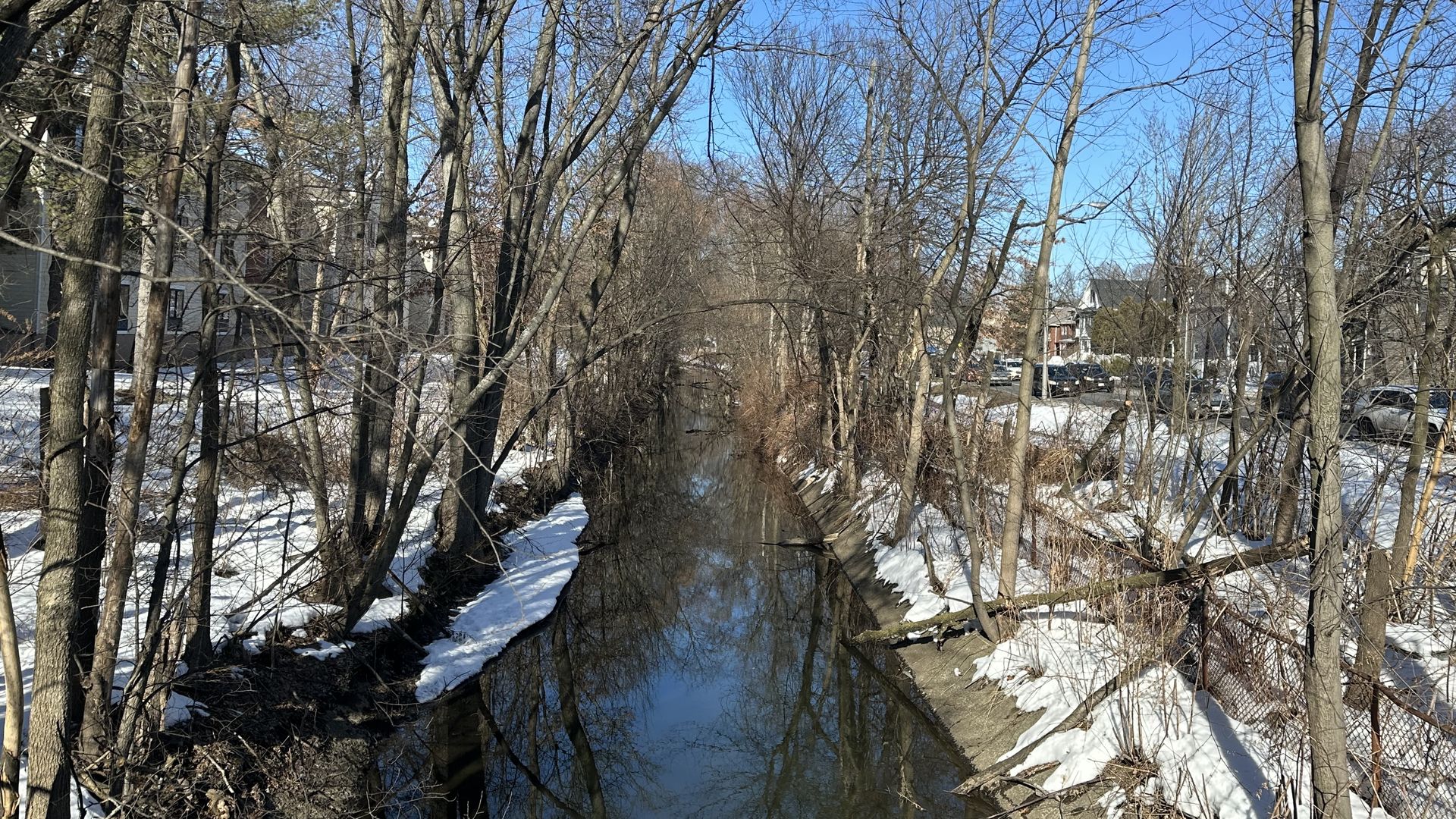
The Alewife Brook Reservation at the border of Cambridge and Arlington. Photo: Steph Solis/Axios
Cambridge and Arlington residents find themselves running and pushing strollers through sewage-tainted waters every time heavy rains flood the Alewife Brook Reservation.
- A state proposal would reduce, but not eliminate, the amount of sewage overflow from certain pipes into Boston-area waterways by 2050.
Why it matters: Greater Boston has come a long way since The Strandells released "Dirty Water" in 1966, calling out the polluted Charles River, but tons of sewage still pour into the Charles, the Mystic River and the Alewife Brook each year.
- The gains made so far and plans to reduce future overflows will fall short if climate experts who predict more frequent, intense storms hitting the region are right, environmental groups say.
Catch up quick: The Massachusetts Water Resources Authority last fall proposed a far less aggressive sewer control plan affecting the Charles River, Mystic River and Alewife Brook.
- After widespread backlash, the MWRA released a new $764 million plan on Feb. 4.
- The MWRA's board approved the proposal draft on Wednesday. Now, it goes to the state Department of Environmental Protection and federal Environmental Protection Agency for review.
State of play: At the center of the debate are Greater Boston's aging combined sewers — which mix stormwater and often untreated sewage — that spill into waterways during heavy rains, and the costs of reducing the overflows.
- The latest proposal calls for improvements that would result in zero overflows from combined sewers by 2050, assuming it's a "typical year" in terms of precipitation.
- The problem, environmental groups say, is that Greater Boston likely won't see a "typical year" of precipitation because of climate change.
Friction point: Massachusetts water regulators are trying to reduce the sewage discharge without taking on too much debt or spiking household sewer bills.
- Their latest proposal, which would take effect in 2029, calls for building storage tanks, "micro tunnels" and green infrastructure, as well as separating some of the combined sewer overflow (CSO) pipes.
- Environmental groups want them to entirely separate the remaining pipes, which would prevent discharge during most storms, but at three-to-four times the cost.
What they're saying: Emily Norton, executive director of the Charles River Watershed Association, called the board's vote a missed opportunity.
- Instead of an "ambitious and forward-looking" plan, she says, "they voted to invest millions of ratepayer dollars in an outdated system that will continue to dump untreated sewage into our beloved Charles River."
The other side: In a statement to Axios, a MWRA spokesperson said, "this plan represents a responsible investment of rate payer dollars that balances real environmental benefits with actual water quality improvements."
Reality check: Even the most aggressive approach wouldn't fully eliminate harmful bacteria from our waterways.
- State officials would have to tackle stormwater runoff to achieve that — another, potentially more complicated challenge.
- What environmental groups and state officials seem to agree on, so far, is that combined sewers are just part of the problem.

How we got here
It's easy to see people swimming in the Charles River and forget that sewage spills into it at times.
- The spillage is legal, thanks to variances the state DEP has issued since the 1990s.
How it works: These combined sewers typically send waste to treatment plants, like the one on Deer Island, and let stormwater flow into local waterways.
- The variances allow for "limited CSO discharges" during heavy rains while regulators work on their long-term efforts to reduce the overflows.
Yes, but: When major storms (or even just brief but intense rains) overwhelm the system, several million gallons of sewage and stormwater spill into the Charles River, the Mystic River and the Alewife Brook.
- That's why public health officials warn people to stay away from waterways after a storm, to avoid exposure to harmful bacteria, viruses, excess nutrients and PFAS compounds.
The big picture: The MWRA and other agencies have reduced overflows by 88% over the past 36 years, under the plan that will soon expire.
- They treat 94% of the remaining overflows.
- Despite these gains, the MWRA is out of compliance with the goals of the current control plan, with sewage discharge still exceeding their projections in several waterways, per a 2024 report as part of a decades-long lawsuit.
- The MWRA did not comment when asked about the report on Monday.
Zoom in: The Alewife Brook
The Alewife Brook consistently gets the largest volume of raw sewage in Greater Boston.
1 stunning stat: In 2024, it got 19 million gallons of dirty water from combined sewage overflows into the Alewife Brook.
- That amounts to almost 39 Olympic-sized swimming pools.
What they're saying: "It's beyond horrific," says Kristin Anderson, a former abutter who lives near the brook and a founding member of Save the Alewife Brook.
- "There's a reason we have wastewater treatment plants, and it's because of public health."


Under the state proposal, the brook would get nearly as much sewage if a single 5-year storm rolled through over the next 25 years.
- That wouldn't even include smaller, back-to-back storms that could strain sewers and water storage systems at other times.
The MWRA similarly predicts that several million gallons of dirty water would spill into the Charles River and Upper Mystic River in the event of a 5-year or 25-year storm.
Meanwhile, residents and activists near the brook developed their own plan.
- They propose separating all combined sewers in north Cambridge and some in Somerville, as well as building green infrastructure, dredging and other changes to prevent overflows in the event of a 25-year storm in 2050.
- That project would cost $405 million, while the MWRA's draft plan's improvements for the brook would cost $340 million. (The MWRA estimates that full sewer separation for the brook would cost $1.7 billion.)
Running the numbers

The MWRA and environmental activists are engaged in a battle of competing facts and figures.
By the numbers: One estimate from the MWRA suggests its plan would cost $1 billion over the next two decades when factoring in inflation.
- The MWRA projects a more ambitious plan that some activists support (which would lead to zero sewage spillage in a 25-year storm) would cost three times as much.
- The agency didn't estimate how much full sewer separation would cost in future dollars, but it projected the cost at $4.3 billion in today's dollars.
The fine print: A separate MWRA analysis estimates that full sewer separation would lead to an average annual cost of $1,125 per household in present-day dollars.
- That analysis suggests that a plan that prevents sewage overflows in a "typical year" in 2050, as MWRA recommends, would cost $1,053.