Immigrants held for weeks in solitary confinement at Mass. jails, report says

Add Axios as your preferred source to
see more of our stories on Google.
Massachusetts jails that have held immigrant detainees have isolated people for weeks at a time, a new report states.
The big picture: An increasing number of solitary confinement placements in the U.S. drag on for 15 days or longer, which the United Nations says constitutes psychological torture, according to the report by Harvard University researchers and Physicians for Human Rights.
- Harvard researchers focused on immigrant detention centers, which experts say are primarily focused on holding immigrants to ensure they make their court hearings and check-ins — not to punish them for immigration violations.
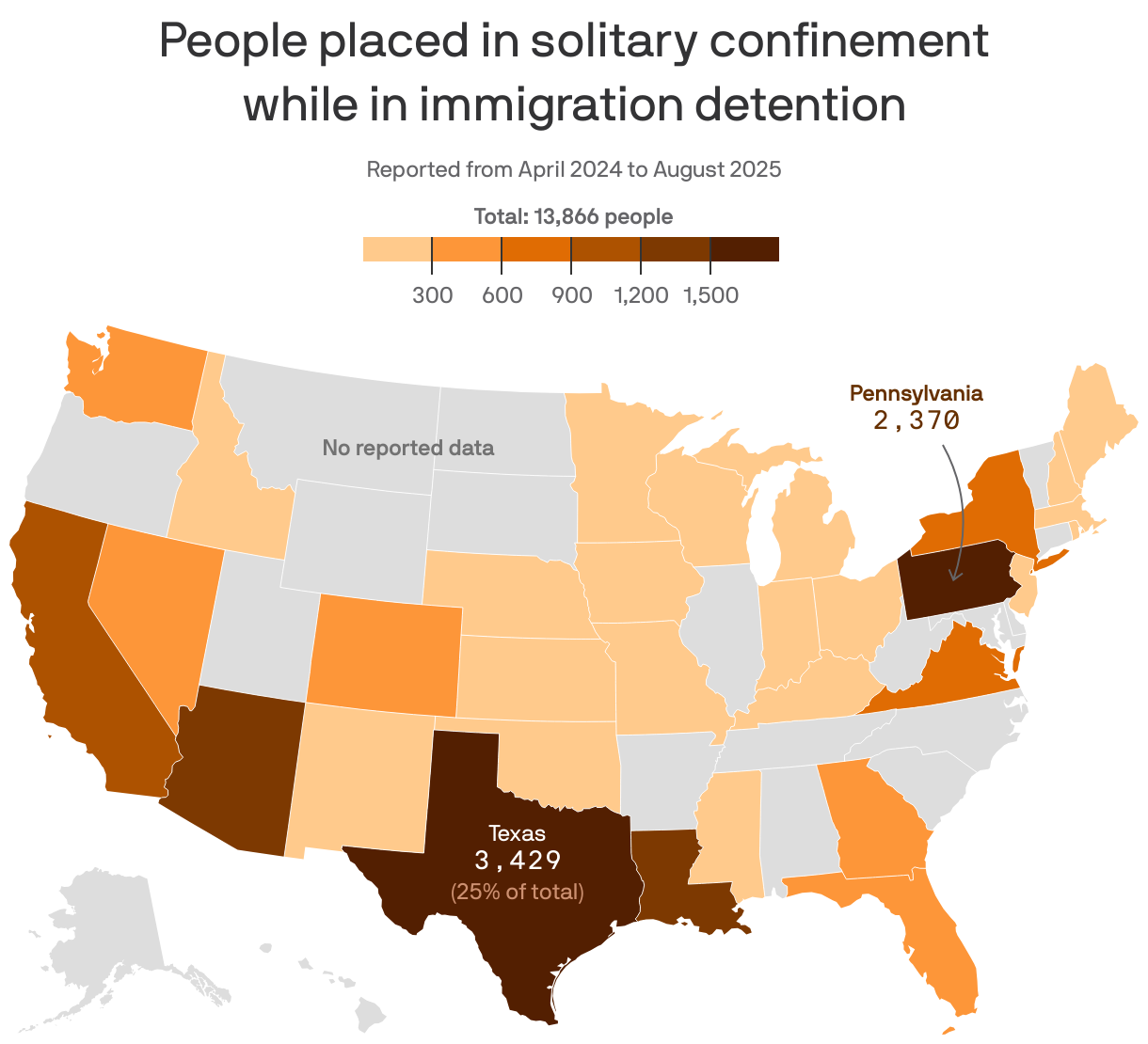
Driving the news: Researchers found that nearly 14,000 people were placed in solitary confinement in immigrant detention centers nationwide between April 2024 and August 2025, per data provided exclusively to Axios.
- This often happened in state and county jails that contract with Immigration and Customs Enforcement to hold detainees, including in Massachusetts jails.
- There were 117 instances of detainees being separated from the general population at the Plymouth County Correctional Facility, the lone jail in Massachusetts with active ICE detention contracts.
What they're saying: "We are torturing people simply because they want a better life in the U.S.," says Sam Zarifi, executive director of Physicians for Human Rights.
- It's not only horrific treatment of people, he added, but it violates U.S. and international law.
The other side: Karen Barry, director of external affairs for the Plymouth County Sheriff's Office, says correction officers practice "administrative segregation," not solitary confinement, meaning those detainees still interact with staff, mental health clinicians and sometimes other inmates daily.
- Barry declined to comment on the report, but she cited state regulations that say officers may segregate a detainee who poses a substantial threat to safety, a threat of damaging property, or a threat to "the operation of a state correction facility."
- Segregation can only happen for administrative, not disciplinary, reasons, per state regulations.
Yes, but: A 2024 report by the advocacy group Prisoners' Legal Services says inmates reported little differences between solitary confinement and administrative segregation practices at Plymouth County Correctional Facility.
Zoom in: The report also analyzed solitary confinement placements in New England between 2018 and 2023, finding 186 placements across six facilities lasting well over 15 days.
- The reasons for solitary confinement ranged from "seemingly trivial violations" like kicking a cell door or smoking to filing grievances, requesting basic needs like showers, or reporting sexual assault, the report states.
- Barry also said detainees in Plymouth County are never isolated in retaliation for filing grievances or reporting incidents.
By the numbers: Between 2018 and 2023, Plymouth reported 82 placements lasting on average 25 days.
- Bristol County Correctional Facility, which ended its contract in 2021, reported 47 placements, lasting on average 36 days.
- Suffolk County Corrections, which ended its contract in 2019, reported nine placements, lasting on average 27 days.
- Representatives of Suffolk and Bristol county jails did not respond to inquiries from Axios.
The fine print: ICE's own directives suggest using solitary confinement on people with mental health conditions only as a last resort.
- Yet almost half of solitary confinement placements in the New England detention centers involved people with reported mental health conditions, according to the report.
Caveat: The federal government started requiring more rigorous documentation of solitary confinement placements starting in December 2024, so the number of incidents before may be severely undercounted.
- But researchers say even the estimates after 2024 may be undercounted because ICE has historically published incomplete data.