How Mass. CO2 emissions changed in 18 years

Add Axios as your preferred source to
see more of our stories on Google.
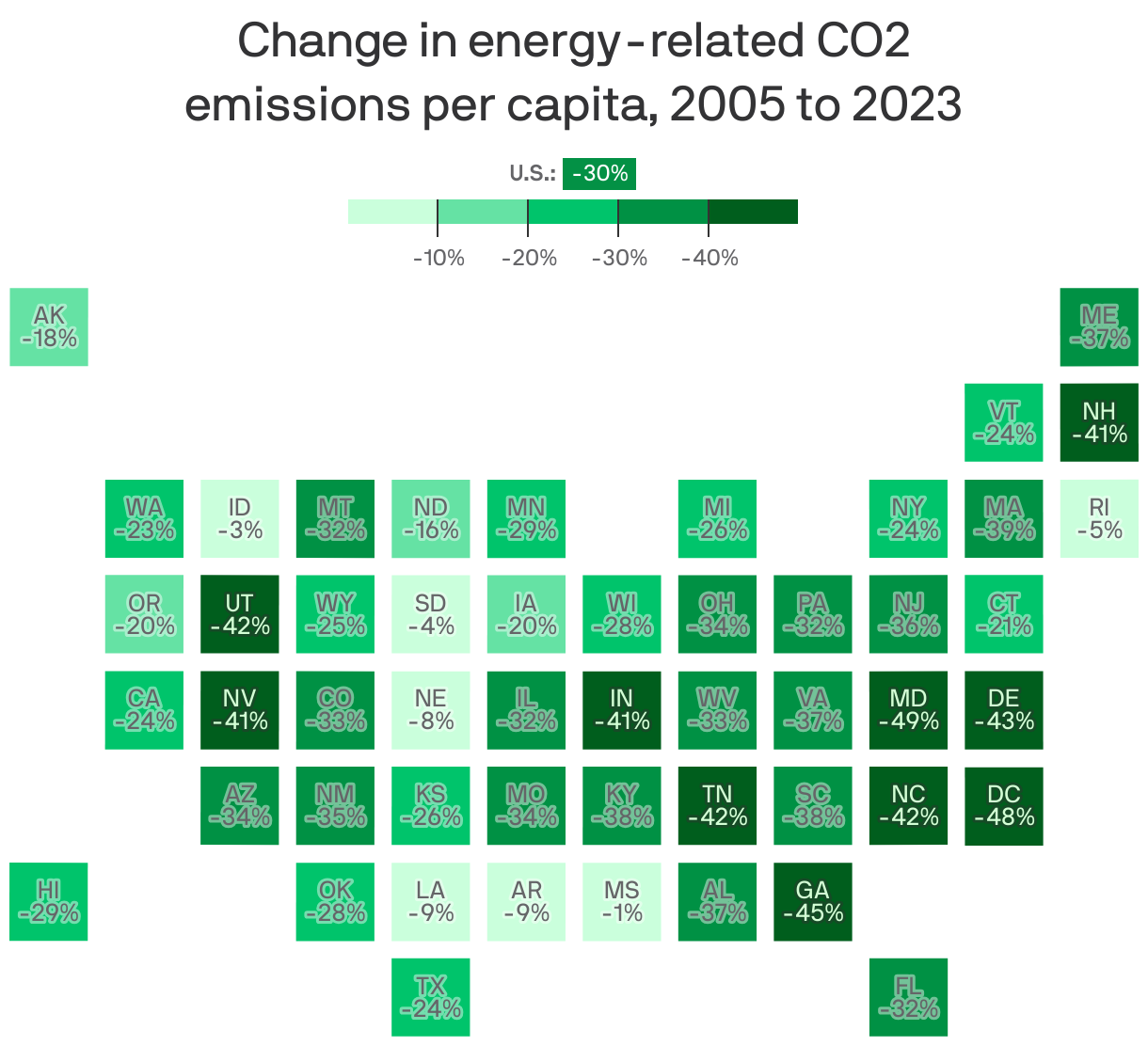
Massachusetts slashed its energy-related CO₂ emissions per capita by more than one-third over 18 years, but it's still far from transitioning to clean energy.
Why it matters: The state's efforts to reduce its carbon footprint are working, but the Trump administration's cuts to wind and solar energy production may keep the state from reaching its climate goals for 2030 and beyond.
Driving the news: Energy-related emissions per capita fell 39% in Massachusetts between 2005 and 2023, according to U.S. Energy Information Administration (EIA) figures.
- The decline comes from the state becoming coal-free — the last coal-burning power plant closed in 2017 — and reducing its petroleum-related emissions.
Zoom in: Massachusetts used, on average, eight metric tons per person in 2023.
- That's like someone using 368 propane cylinders for home barbecues or charging 646,774 smartphones in a year, per the Environmental Protection Agency's greenhouse gas equivalencies calculator.
Zoom out: CO₂ emissions per capita fell in every state between 2005 and 2023, with emissions per capita falling 30% nationwide in that time frame.
- Maryland (-49%), Washington, D.C. (-48%) and Georgia (-45%) saw the biggest decreases in energy-related emissions per capita.
Between the lines: There's no single reason for the petroleum-related emissions decline.
- Petroleum-related emissions have fallen in every sector in Massachusetts: transportation, industrial, residential, commercial and electric power, per the EIA.
- The largest declines were in the transportation and electric power sectors.
Caveat: The EIA didn't break down transportation emissions by vehicle in this report, but the agency does track how much petroleum consumers have used for transportation.
- By those metrics, motor gasoline was by far the most commonly used form of petroleum in 2023.
- Jet fuel consumption increased between 2005 and 2023, but it's still a fraction of the state's petroleum consumption. Diesel consumption, which went down, was also far less common.
Yes, but: Massachusetts has imported higher levels of electricity from other states and regions to make up for the loss of coal- and petroleum-burned electricity over the past two decades.
- The state's output of solar and wind energy has increased, but not enough yet to significantly reduce electricity imports.
Threat level: The Trump administration's cuts to funds for offshore wind projects and the construction of an offshore wind terminal in Salem come as the state planned to rely more on wind and solar power to meet its 2030 climate goals.