"Big beautiful" tax cuts mean savings in Mass.

Add Axios as your preferred source to
see more of our stories on Google.
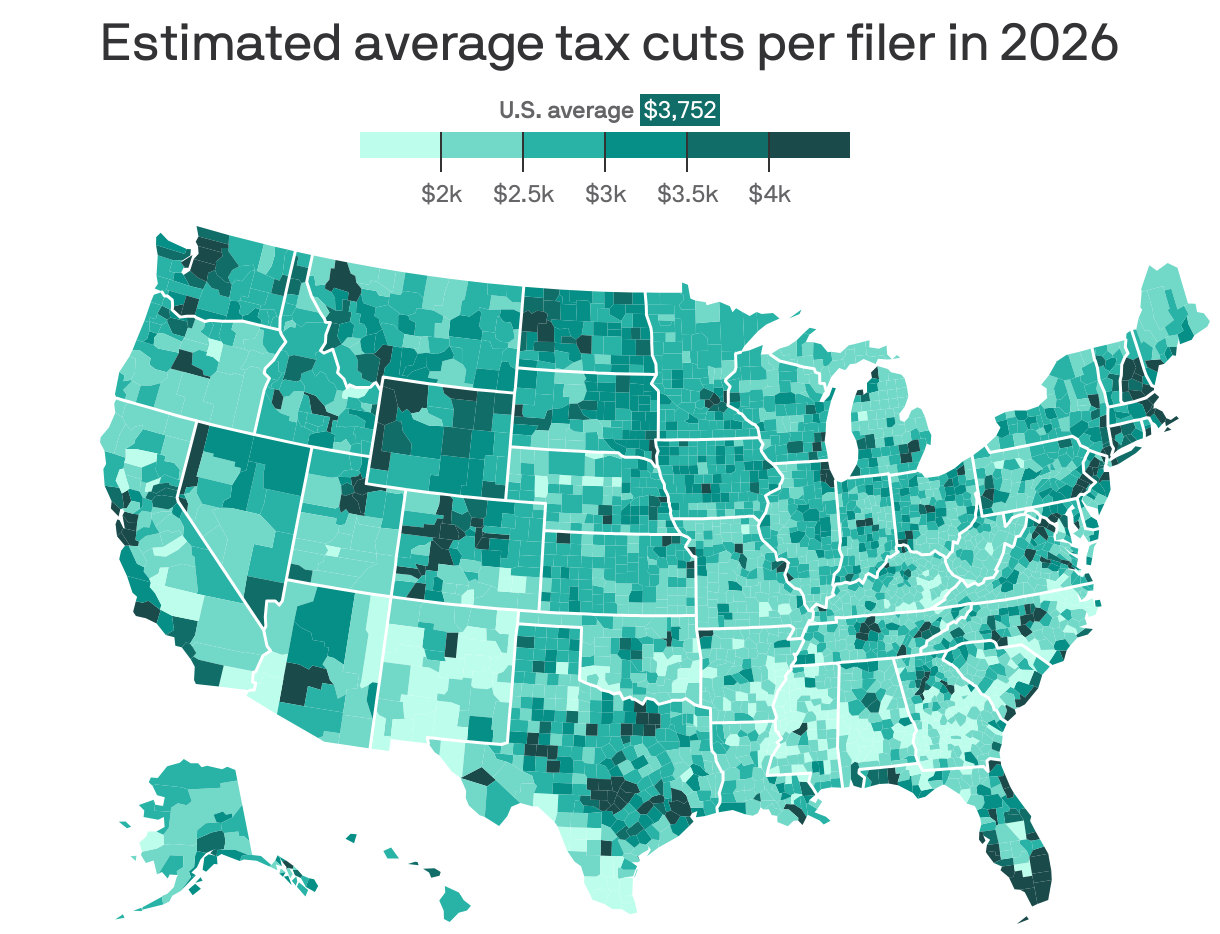
Massachusetts residents are in line for some of the biggest federal tax cuts in the nation starting next year, with some taxpayers in Greater Boston set to save more than $7,000 on average under Republicans' new tax law.
Why it matters: The One Big Beautiful Bill Act makes permanent the 2017 Trump-era tax cuts and adds new ones — offering meaningful relief to households even as rising prices and interest rates continue to strain budgets, Axios' Emily Peck and Jason Lalljee report.
State of play: The tax law expands deductions for tipped and overtime workers, increases the child tax credit and makes write-offs for business research and equipment purchases permanent.
- The law also caps the state and local tax (SALT) deduction at $40,000 through 2029 — a significant boost for high-tax states like Massachusetts.
By the numbers: Massachusetts taxpayers will see an average tax cut of $5,138 in 2026 — the third highest in the U.S., behind only Wyoming and Washington, according to the Tax Foundation, a nonpartisan research group usually in support of lower taxes.
- In Middlesex County, home to tech hubs and affluent suburbs, the average tax cut comes in at $7,085.
- Norfolk County, which includes Quincy and Brookline, gets a $7,004 average cut.
- Boston's Suffolk County will see an average of $5,750 in savings.
- Areas with relatively lower incomes, like Essex County ($4,965) and Barnstable County on Cape Cod ($4,470) will see less savings from the law.
Zoom out: Higher-income communities with more capital income and itemized deductions tend to see bigger benefits under Trump's tax law.
- Adjustments tied to SALT, mortgage interest and the alternative minimum tax combine to boost the savings for wealthier communities.
- Business owners are also big winners thanks to extended tax breaks for R&D and equipment.
Reality check: Part of the tax savings trade-off is slashes to services for the poor, like future spending on food assistance and Medicaid.
- Those kick in in 2027 and could outweigh whatever tax benefits low-income Americans see from the new law.
What's next: Unless Congress extends them, some Trump tax breaks, like those on tips, overtime and the child tax credit, are set to expire by 2030.