Radio silence after Tufts student's arrest by ICE agents creates legal hurdles

Add Axios as your preferred source to
see more of our stories on Google.
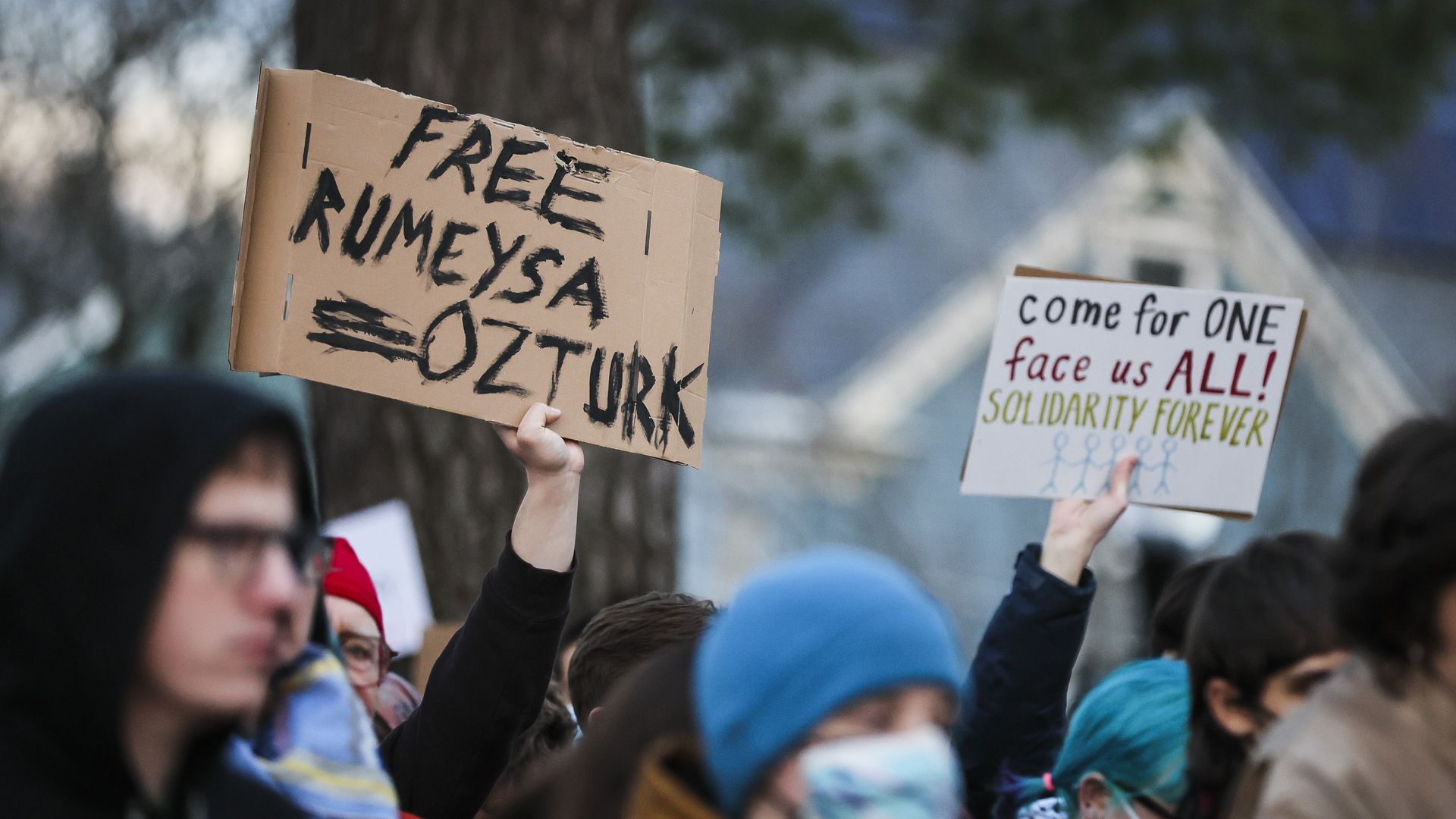
Protesters demonstrate against the detention of Rumeysa Ozturk at Powder House Park. Photo: Erin Clark/The Boston Globe via Getty Images
The mystery surrounding Tufts University student Rumeysa Ozturk's whereabouts after she was picked up by federal immigration agents has shocked many — and is now complicating her legal proceedings.
Why it matters: The case's question about jurisdiction — typically a granular area of court proceedings — could affect how ICE detains foreign-born residents and how it communicates about detentions in the future.
Catch up quick: Masked ICE agents arrested Ozturk, a doctoral candidate from Turkey, in broad daylight in Somerville last week, and she was shuttled through multiple states that night.
- It's still unclear when Ozturk left the state, but her attorney Mahsa Khanbabai said she couldn't reach her for hours or get an answer from government officials about her whereabouts.
- Khanbabai filed a lawsuit to get Ozturk released and prevent her from being moved out of state, but nearly a day later, Khanbabai learned that Ozturk had been taken to a Louisiana detention center.
Now a federal judge in Boston must decide whether Ozturk's lawsuit against the Trump administration, alleging unconstitutional detainment, should proceed in Massachusetts, where she was picked up by ICE, or in Louisiana, where she ended up at an undisclosed time.
Friction point: Ozturk's lawyers argued the lack of communication over Ozturk's whereabouts, keeping other government attorneys in the dark, was part of ICE's plan to "forum shop," or get Ozturk to a jurisdiction likely to side with the Trump administration.
- Assistant U.S. Attorney Mark Sauter said Ozturk was already out-of-state when the federal judge ordered that she be kept in Massachusetts and that ICE had already notified parties within 24 hours of Ozturk's arrest, which is standard under ICE policy.
- Just because Ozturk's attorney didn't know where she was the day of her arrest doesn't mean the federal government failed to be forthcoming, Sauter said.
Between the lines: This is separate from Ozturk's immigration case, in which she's facing deportation after having her student visa revoked for allegedly supporting Hamas.
- Khanbabai says she's being targeted for co-authoring a pro-Palestinian op-ed.
- Federal authorities did not specify what Ozturk did that constitutes pro-Hamas activity, but Secretary of State Marco Rubio's comments to reporters last week suggest her visa was revoked over pro-Palestinian activism.
- "They're here to study. They're here to go to class. They're not here to lead activist movements that are disruptive and undermine our universities," Rubio said at the time. "I think it's lunacy to continue to allow that."
Ozturk said in a statement Thursday she uses writing as a non-violent way to address systemic inequities.
- "I believe the world is a more beautiful and peaceful place when we listen to each other and allow different perspectives to be in the room ... Efforts to target me because of my op-ed in the Tufts Daily calling for the equal dignity and humanity of all people will not deter me from my commitment to advocate for the rights of youth and children," Ozturk said.
Threat level: Immigration advocates and some experts say the arrest of Ozturk and other international students serves to chill protected political speech.
- "There is a concern here that we may be moving in that direction in terms of fascist ideology if people are not afforded the rule of law," Anthony DiMaggio, author of "Rising Fascism in America: It Can Happen Here," told Axios after Ozturk's arrest.
What's next: Ozturk remains detained at an ICE facility in Louisiana and is expected to go before an immigration court Monday.
Mike Deehan contributed reporting.