Massachusetts sees drop in new Black medical students

Add Axios as your preferred source to
see more of our stories on Google.
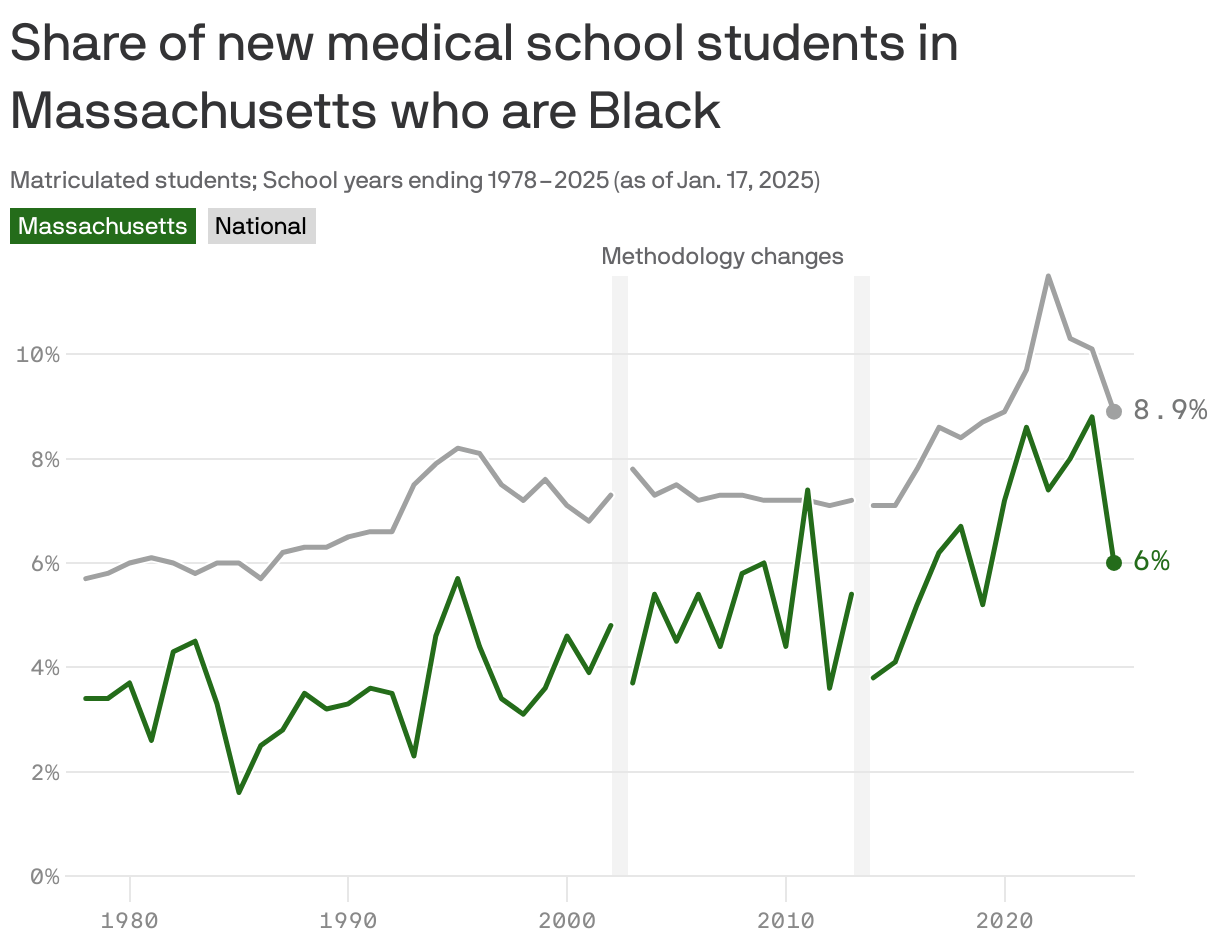
Massachusetts, home to world-renowned hospitals and medical programs, last year saw the number of first-year Black medical students decline to its lowest level since 2018.
Why it matters: Having doctors who resemble the patients they're serving can improve health outcomes and enable patients to feel more comfortable voicing health concerns, multiple studies suggest.
- Black patients being treated by Black doctors may experience less medical racism, whether that means better treatment in the emergency room or not having pain or other risk factors dismissed.
State of play: There was a nearly 3% drop in first-year Black medical students enrolling in Massachusetts programs in 2024, per the Association of American Medical Colleges (AAMC).
- Just 44 new Black medical students matriculated last year, 6% of the state's new cohort of medical students.
Zoom out: Only 5% of doctors in the U.S. are Black, even though Black Americans comprise 14% of the general population.
Reality check: The number of new Black medical students in Massachusetts has stayed in the two-digit range for decades, surpassing 40 for the first time in 2016.
- But the number was increasing during and after the pandemic, peaking at 60 first-year Black students, or 8.8%, in 2023.
Context: The recent national dip in Black medical school student enrollment follows the Supreme Court decision striking down affirmative action in higher education.
- The declines are "much larger than we would expect," even taking the Supreme Court decision into account, says Norma Poll-Hunter, senior director of the Association of American Medical Colleges' human capital portfolio.
Flashback: Over the years, factors that may have impacted Black med school student admission rates include:
- The influential 1910 Flexner Report: Without it, 29% more African American physicians would've graduated in 2019 alone, one JAMA study estimates.
- The Civil Rights Act of 1964: It banned segregation in hospitals and higher education.
- The 1972 federal Health Careers Opportunity Program (HCOP): It led to a 70% increase in minority students in health professions between its launch and 1980, according to CDC data.
- The 2020 pandemic: That's when there was a national spotlight on the Black Lives Matter movement (and racism in medical institutions), health care was particularly top of mind, and there was a reduction in med school admission costs. The next year, there was an uptick in the number of Black med school students.
Threat level: Implicit bias can also affect the well-being of expectant Black mothers and their fetuses.
- The pregnancy-related death rate for Black women is more than three times the rate for mothers of other racial and ethnic groups.
- Theirs is the only racial or ethnic group whose maternal mortality rate did not decline between 2022 and 2023, per the CDC.
What they're saying: "There's implicit bias" when you're a Black patient and you have a non-Black provider, says LaTasha Seliby Perkins, an assistant professor at the Georgetown University School of Medicine.
- Perkins, who is African American, says she experienced it during a previous pregnancy, when a doctor overlooked the fact that she was of advanced maternal age because she didn't appear to be over 35.