Boston integration fight is a testament to grassroots power

Add Axios as your preferred source to
see more of our stories on Google.
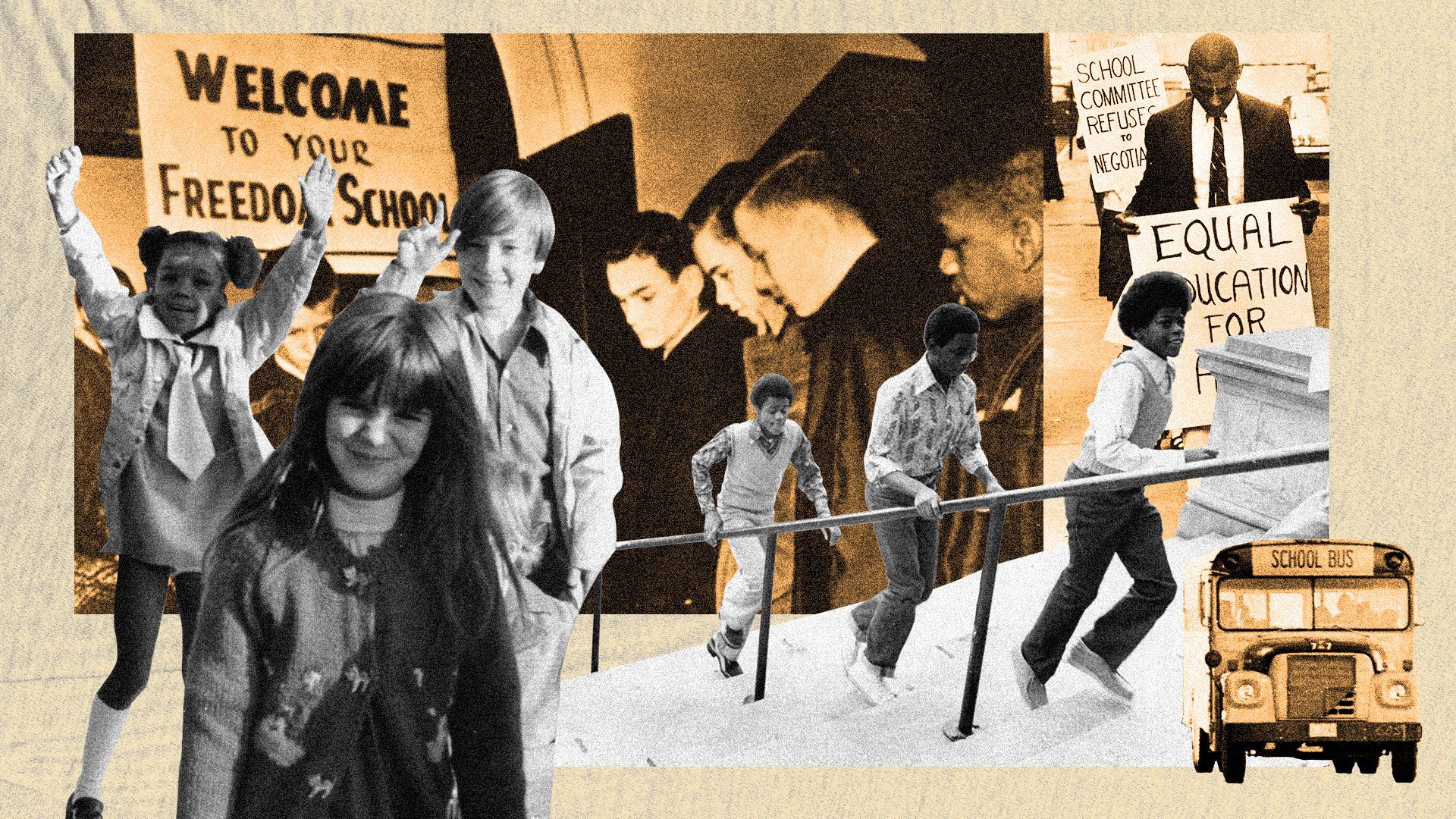
Photo illustration: Lindsey Bailey/Axios. Photos: Boston Globe/Getty Images
Fifty years ago, Black families and white allies who fought for equal education scored a major victory when a federal judge ordered Boston Public Schools to desegregate.
Why it matters: The success of Boston's grassroots integration push is often overshadowed by the controversial implementation of busing.
What they're saying: There's a lesson to be learned in "the power of community organizing and advocacy … not waiting for elected officials to take action," says Tanisha Sullivan, president of the NAACP Boston branch.
- Boston's desegregation fight illustrated the power of communities using their voices to create an inclusive culture through demonstrations and initiatives like the integrated Freedom Schools.
Flashback: In 1963, nearly a decade after the Brown v. Board of Education ruling, a Boston parent named Ruth Batson made her case for equal education to the BPS committee.
- Batson, chair of the local NAACP's education committee, read the organization's 14-point proposal to end de facto segregation in BPS, per GBH News archives.
- School committee member Louise Day Hicks replied saying the district didn't segregate schools; it just assigned students based on where they lived.
Black parents and allies sought to prove that was wrong.
📚 Stay Out for Freedom Day on June 18, 1963: Thousands of Black junior and senior high school students in Boston attended Freedom Schools instead of their public school.
- The temporary schools, created in protest by civil rights leaders, educated Black students on politics, civics and other topics.
📊 NAACP research found 13 BPS schools were predominantly Black.
- Those schools were in old buildings and overcrowded. Four had been condemned.
📚 Stay Out for Freedom Day on Feb. 26, 1964: More than 10,000 Black and white children attended Freedom Schools across Boston, per GBH News archives.
- There were 35 Freedom Schools citywide.
- By that point, similar demonstrations were happening in New York, Chicago, Milwaukee and Cleveland.
🪧 Racial Imbalance Law
State Rep. Royal Bolling, a Black community activist, introduced the Racial Imbalance Bill in 1963.
- The proposal would withhold state funds from schools where over 50% of the school population were racial minorities.
- It passed in August 1965, months after the state's Kiernan Report confirmed that segregation in public schools harmed students.
Yes, but: The Boston School Committee refused to comply with the law, losing millions in state funding.
- The committee was finally working toward complying when lawmakers repealed it in 1974.
- Gov. Francis Sargent vetoed the repeal but amended the law so no more funds would be withheld from schools out of compliance.
⚖️ Federal court
Black parents and advocates took their cause to the courts with 15 parents, supported by the NAACP, suing BPS committee members in 1972.
- The parents accused the school committee of failing to comply with the 1965 Racial Imbalance law.
- The lawsuit led to Judge Wendell Garrity's ruling in favor of the parents and ordering the schools to implement the state's busing plan.