Boston's sluggish downtown recovery



Add Axios as your preferred source to
see more of our stories on Google.
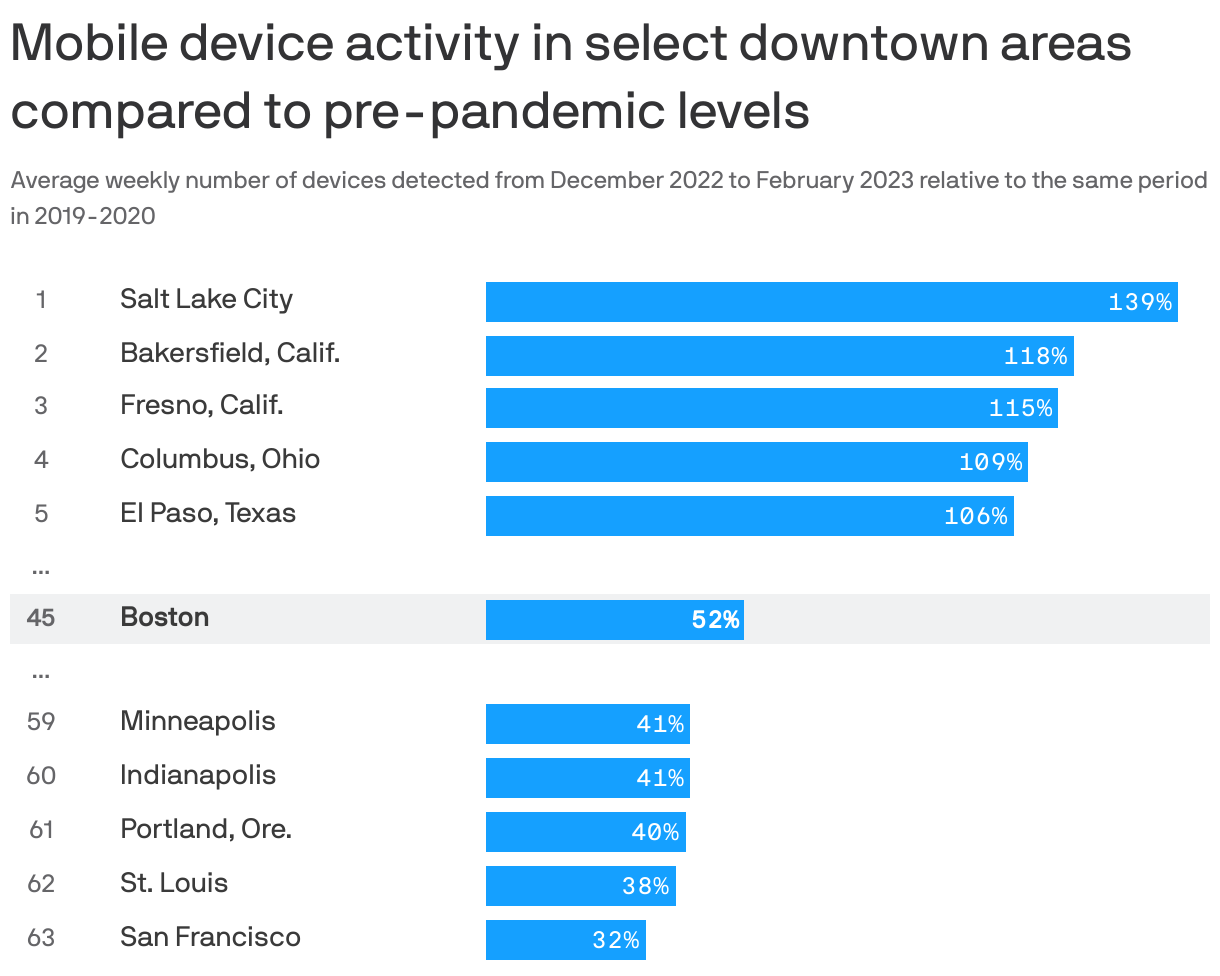
Foot traffic around Boston’s Financial District is barely half of what it was pre-pandemic.
- That's according to anonymized mobile device connectivity data analyzed by researchers at the University of Toronto's School of Cities.
The big picture: Boston’s sluggish recovery is partly due to its heavy concentration of workers in financial services and tech — many of whom decamped elsewhere during the pandemic — and a shortage of affordable housing, especially downtown.
Why it matters: Downtowns became ghost towns during the height of the pandemic as people sought to "flatten the curve" by staying home as much as possible.
- Even as the pandemic ebbs, the era of remote and hybrid work it ushered in means fewer people visiting restaurants, bars and shops.
- That has big implications for downtown economies, which have historically relied on commuting workers who spend money before, during and after their daily 9–5s.
Yes, but: Businesses and political leaders are increasingly trying to curtail remote and hybrid work, which could boost downtown recovery levels.
- Mayor Wu tried to bring crowds downtown last year with a series of block parties and has continued the trend with sports watch parties, beer gardens and other outdoor events.
How it works: The researchers essentially treated smartphones and other mobile devices as a proxy for their owners — if a device pings a nearby cell tower, it's a good bet that's where the device's owner is.
- Of note: For this analysis, "downtown" is defined as areas of a given city with the highest employment density.
Worth noting: The Boston data in UToronto’s findings don’t reflect all downtown foot traffic.
- UToronto’s data included two ZIP codes within Boston’s downtown area. The research offers a detailed look at cell phone activity in the Financial District — perhaps the hardest-hit neighborhood in terms of foot traffic — and the waterfront, but not much elsewhere.
Reality check: While downtown activity is one indicator of a city's economic health, it doesn't paint a full picture on its own.
- The lure of springtime weather, meanwhile, might convince more people to head back into the city — to enjoy dinner and drinks al fresco, for instance.