Why Dems would (or wouldn't) pick Talarico for VP in '28

Add Axios as your preferred source to
see more of our stories on Google.
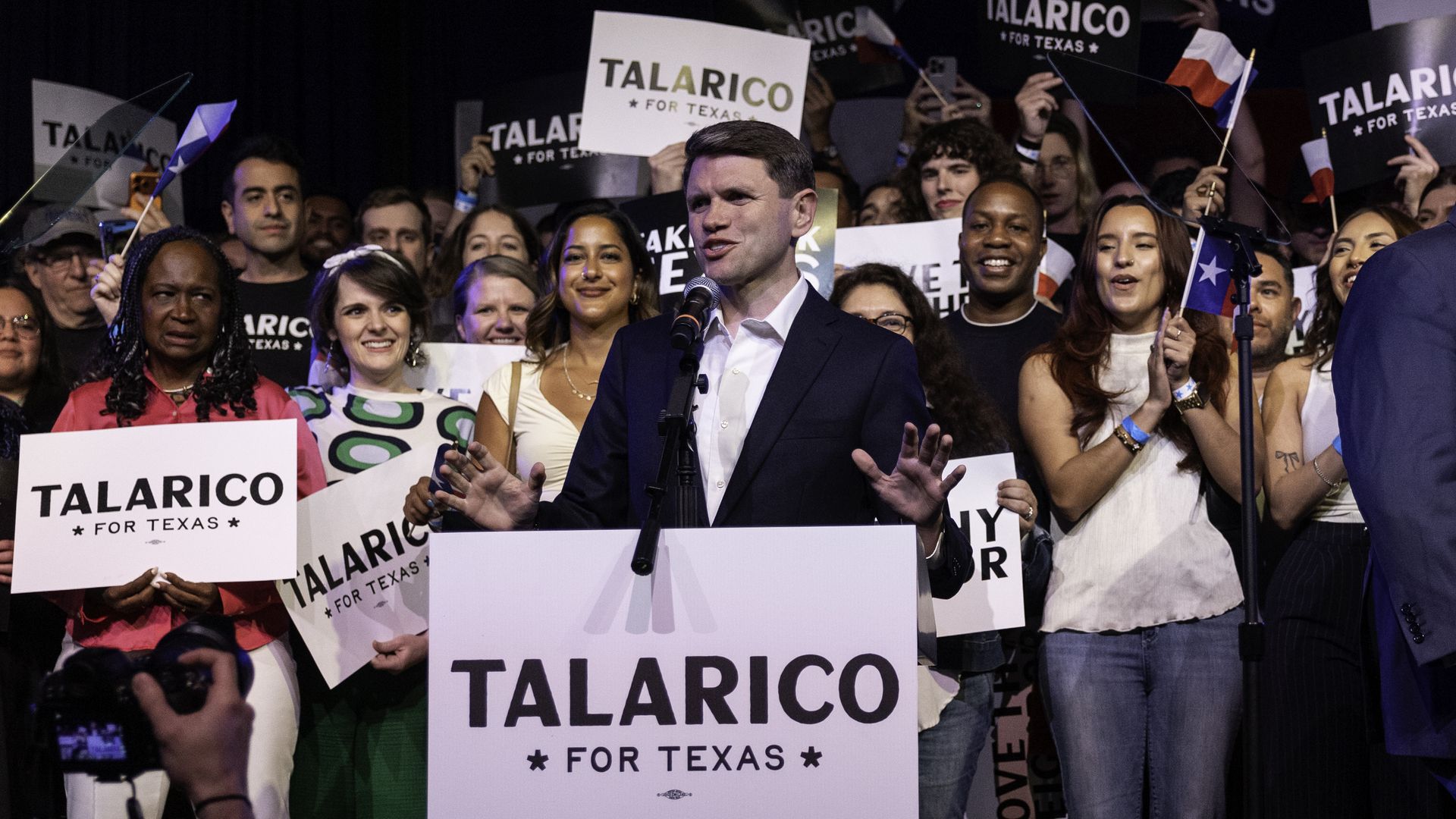
James Talarico addresses supporters on election night on March 3 in Austin. Photo: John Moore/Getty Images
Texas legislator James Talarico is an underdog for U.S. Senate, but his name is already being whispered as a potential 2028 vice presidential candidate.
Why it matters: The mere suggestion reflects just how stratospheric Talarico's rise has been — and how desperate Democrats are to win Texas' electoral votes.
What they're saying: "If Talarico wins the seat against the Republican nominee, I think he's likely or very likely to be the vice presidential pick in 2028," NYU marketing professor Scott Galloway said on "Pivot," the podcast he co-hosts with journalist Kara Swisher, following Talarico's March primary victory.
- Last year, influential podcaster Joe Rogan suggested the Austin Democrat should aim for the White House.
Flashback: Barack Obama's Senate run in 2004 — including a galvanizing keynote address at the Democratic National Convention that summer — established his national profile ahead of a successful presidential run in 2008.
- Current Vice President Vance had not served two years in the U.S. Senate before Donald Trump named him as his running mate in the 2024 election.
Zoom in: Talarico's campaign declined an Axios request for comment.
- Talarico beat U.S. Rep. Jasmine Crockett (D-Dallas) in the Democratic primary in March and his campaign has been hauling in record amounts of cash — with far more in the bank than U.S. Sen. John Cornyn and Texas Attorney General Ken Paxton, who are vying for the GOP nomination in a May 26 runoff.
- The former public school teacher and seminarian is running ahead of both Republicans, according to two polls released last week.
Between the lines: Selecting Talarico as a running mate — should he win in November — would "send a message that whoever was the presidential candidate ... would be reaching out and cares about the electorate that Talarico had resonated with," Joel Goldstein, a scholar of the vice presidency, tells Axios.
- "It's about who's picking and what they see their needs are. He would certainly be in the conversation," Goldstein adds.
Context: Talarico has carved out a new lane in Texas politics: a Christian Democrat who in the primary appealed to Hispanic voters and suburbanites — both key constituencies.
Follow the money: Through his campaign — he raised more in the first quarter of an election year than any U.S. Senate candidate in history —Talarico also has built a donor base around the country, one attractive to any White House run.
The intrigue: A Talarico Senate win would immediately raise the question of whether he could help deliver Texas' 40 electoral votes to Democrats in 2028.
- But Goldstein says "it's sort of a myth in American politics that presidential candidates pick a running mate to win a state with a lot of electoral votes."
- Instead, Goldstein says the selection is often meant to complement or amplify an attribute of the presidential candidate.
- Choosing Texas running mates (U.S. Sens. Lyndon Baines Johnson in 1960; Lloyd Bentsen in 1988) has been a way for northern Democrats to reach into the South as they aim for regional ticket balance.
How it works: If Talarico wins the Senate race and if he's subsequently named to a White House ticket and if that ticket wins — a string of big "ifs" — he would resign his Senate seat before being sworn in as vice president.
- LBJ, for example, resigned his U.S. Senate seat in early January 1961.
- The governor would then be empowered to appoint his successor, who could be of either party.
Reality check: No Democrat has won a statewide election in Texas since 1994.
- If Talarico does manage to pull off an upset in Texas, national Democrats will be reluctant to give up his seat with a (likely) Republican governor appointing his successor. (Gov. Greg Abbott is running for reelection and has far more campaign funds than his Democratic opponent.)
- "If Talarico can get over that hump, to break the drought, then it's almost certain that would almost immediately generate buzz about what a high ceiling he has," Adam Schiffer, a scholar of American politics at TCU who has examined presidential nomination contests, tells Axios.
- But if he has to resign his seat — and assuming Texas still has a Republican governor, "when push comes to shove in those conversations, that's often a decisive factor — you don't want to mess with a 50-50 Senate or one that's 51-49. You don't want to shake that up with other viable (running mate) options available, which there will be," Schiffer says.