The future of Austin's Oak Hill highway project

Add Axios as your preferred source to
see more of our stories on Google.

Illustration: Sarah Grillo/Axios
We're launching an occasional look at planned and ongoing road projects around Austin.
Why it matters: We all have somewhere to get to, and the seemingly inexorable expansion of highways speaks to our city sprawl.
- As well as to the clout of engineers and the national love of concrete.
Plus: The construction can be noisy for neighbors — jackhammering, anyone? — and confusing for drivers to navigate, what with all those squiggly painted lane changes and narrow shoulders.
Between the lines: Previously, we've written about the future of I-35, the lightning rod of Central Texas highway projects.
In this edition, we look at the Oak Hill Parkway in southwest Austin.
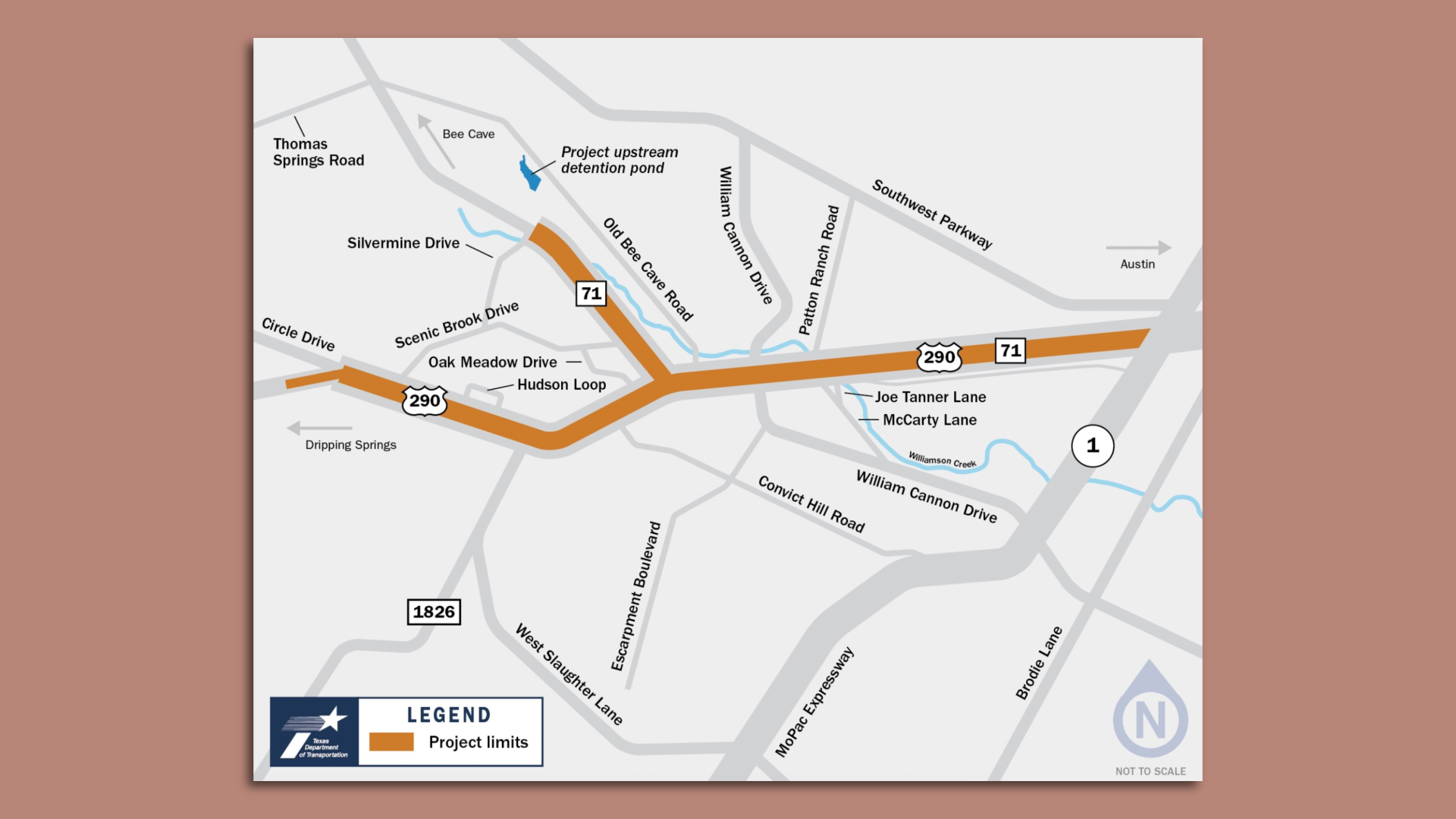
Details: The Texas Department of Transportation is building as many as six U.S. 290 lanes and adding frontage roads and flyovers at U.S. 290 to Texas 71 at a cost of $674 million. Also included in the project, which broke ground in 2021:
- An overpass for U.S. 290 over William Cannon Drive.
- New intersections where U.S. 290 meets Convict Hill Road, RM 1826, Scenic Brook Drive and Circle Drive (South View Road).
- Roughly 15 miles of bike paths and sidewalks.
The big picture: The "Y" in Oak Hill reached capacity in 1995, per TxDOT, and the population kept expanding, leading to congestion that can back up for miles.
- As with most roadway expansion projects, TxDOT officials say Oak Hill is an unreliable route for transit and emergency vehicles.
Flashback: Local environmentalists tried unsuccessfully to stop the project, arguing in federal court that the state had failed to adequately consider the environmental ramifications of the project — another theme of the grappling over road projects.
- "The proposed highway remains too big, too expensive, and too destructive for the community and the environment," Brian Zabcik, a Save Barton Creek Association member and a plaintiff in the federal case, said in 2021, per Community Impact.
- Environmentalists had argued the project would pollute the Barton Springs portion of the Edwards Aquifer — and rob it of water.
When will it all end: 2026, per TxDOT.