Friday's health stories

The golden age of health insurance may be over

Health insurance — and its associated business lines — has been a highly lucrative business for the past decade or so. But that golden pre-pandemic era may be gone for good.
Why it matters: If insurers make less money, they could pass more costs on to enrollees or cut benefits, which could cause patients pain. Alternatively, they could be forced to take harsher steps to control costs. Regardless, shareholders may simply not have it as good going forward.
Driving the news: Both Moody's and S&P Global Ratings recently changed their outlook on the health insurance sector to negative, whereas before it was stable.
- Moody's cited quickly rising medical costs, the inability to fully offset those costs through premium increases and pharmacy benefit manager scrutiny as drivers of the change.
- S&P pointed to "recent and projected strain in operating performance," especially in Medicare Advantage and Medicaid markets, and higher legislative and regulatory risks.
By the numbers: In mid-2020, the industry's profit margin was 5.3%, according to a report by the National Association of Insurance Commissioners. In mid-2024, it was 2.7%.
The big picture: Insurers keep reporting higher-than-expected medical loss ratios in their earnings calls, meaning that enrollees are still spending more than expected on care years after the acute phase of the pandemic ended.
- The all-out war with providers doesn't seem close to ending, with both sides now having become highly concentrated partially to gain leverage in contract negotiations. Plus, some employers are considering bypassing insurers altogether and contracting directly with providers.
- America's population is aging and living longer, which will put ever-more upward pressure on health care costs. So will technological and scientific advances, including more widespread use of expensive drugs like GLP-1s.
- And perhaps most importantly, health insurance has become highly dependent on the federal government for its revenue, and there's good reason to think at least some of those revenue streams are threatened under the Trump administration.
Yes, but: Insurers' acute financial pain is likely time-limited, and they'll likely be able to successfully renegotiate contracts with providers or receive updated government reimbursement rates that offset their rise in costs. The "long-term sector fundamentals remain solid," per the S&P report.
- The Trump administration could end up making favorable Medicare Advantage policy while failing to carry out some of its threats to the Medicaid and Affordable Care Act markets.
- "I think what's going to happen over time is the industry is going to adjust, the health insurance industry is going to align the benefits with what they need to achieve some level of profitability. That could take a couple of years," said Dean Ungar, an author of the Moody's report on the industry.
- The question is how profitable.
My thought bubble: The Trump-MA optimism is overhyped.
- "I think insurers have been too profitable at the expense of the government for Medicare Advantage, for Medicaid and for Obamacare, across the board," said Brian Blase, president of the Paragon Health Institute. Blase was also the HHS policy lead for the Trump administration's transition, coordinating the new administration's changeover into the sprawling health department.
- "There are significant efficiencies that should be made in all three of those programs that would reduce subsidies to health insurers."
- That would mean insurers wouldn't make as much money from the government, he added.
The bottom line: There are plenty of reasons to believe the insurance market will get back to being able to better predict costs and boost profitability. What's in doubt is whether their margins return to the same level as before.
- "I think the insurers doing well is a safe bet, and I think it's a safe bet that they won't likely get back to those really elevated values they had," said economist Paul Hughes-Cromwick.

Maternal deaths drop — except for Black women
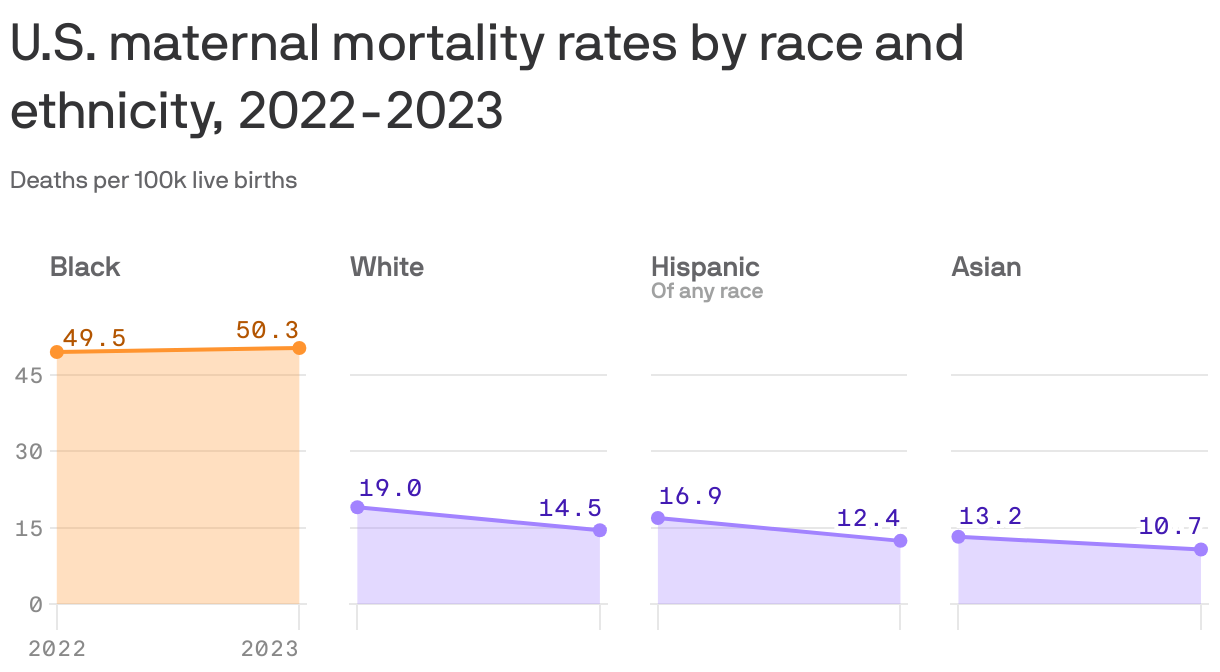
The mortality rate for Black mothers in the U.S. has not improved, per data released Wednesday by the Centers for Disease Control and Prevention.
Why it matters: The pregnancy-related death rate for Black women is more than three times the rate for mothers of other racial and ethnic groups.

Academic journals push back on Trump's changes to health data

The scientific community is showing signs of pushing back against President Trump's blackout and selective changes to federal health websites and datasets.
Why it matters: That data has long been considered the gold standard in public health. But the lack of visibility into to what's been altered is raising questions about the integrity of government reports.
Musk's team accesses Medicare, Medicaid records

Elon Musk's Department of Government Efficiency has gained access to the inner workings of Health and Human Services, including data systems of the agency that manages a nearly $2 trillion budget, handles Medicare and Medicaid benefits and runs the National Institutes of Health, the world's biggest biomedical research institution.
Why it matters: As they march through the federal bureaucracy, Musk and his team now have a seemingly unfiltered view of the sensitive inner workings of much of U.S. health care.