Oil giants' pace of clean energy deals has slowed greatly as oil prices have collapsed, the research firm BloombergNEF said in a tally of activity by ExxonMobil, Chevron, Shell, BP and others.
What they found: "Up to 14 deals were announced in 1Q 2020, with only three reaching completion. This compares with 17 deals closed in 1Q 2019," the firm said in a brief note.
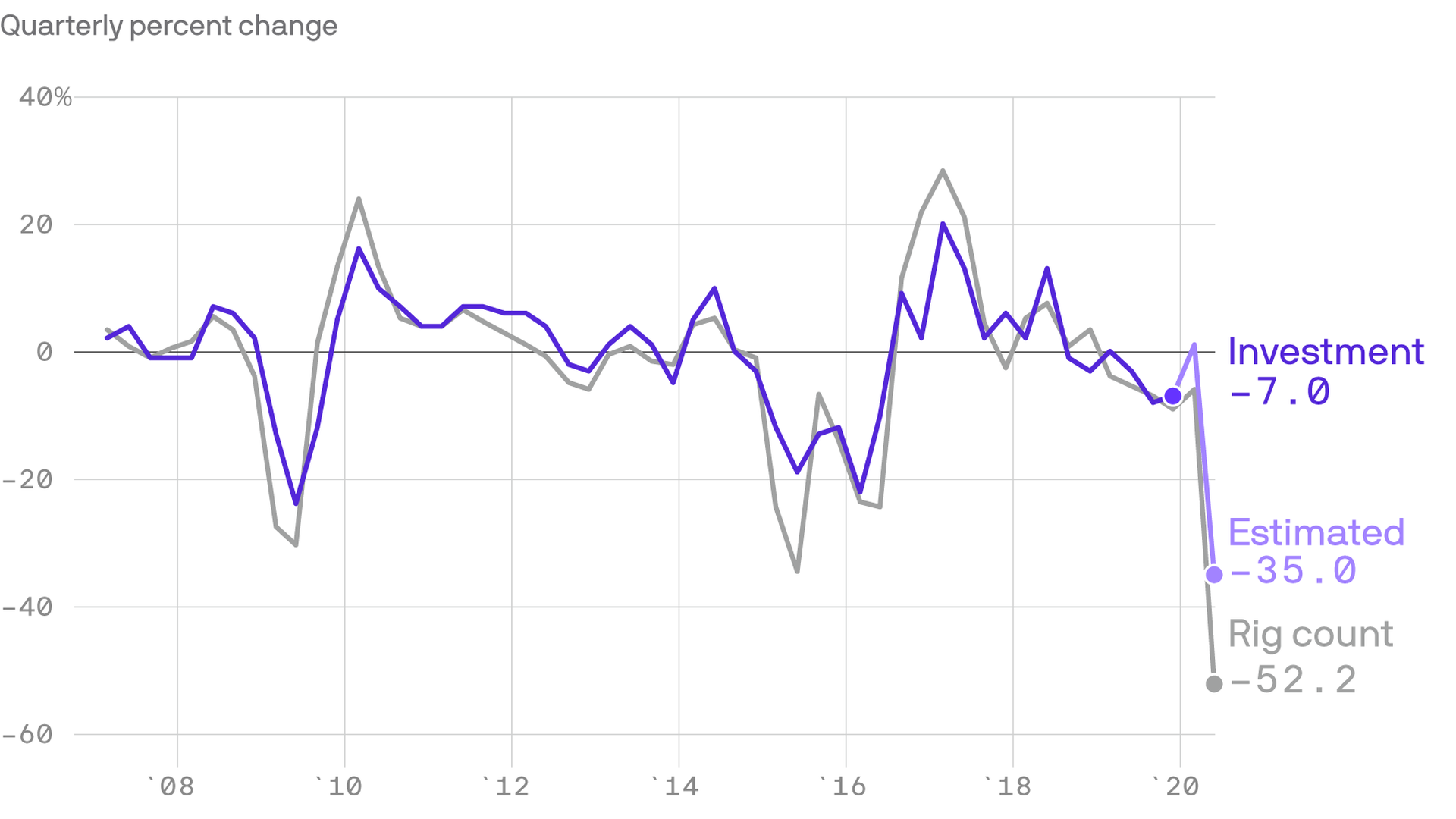
A Dallas Fed report helps put the oil industry's response to the price and demand collapse into historical context. They find that U.S. producers' capital spending will decline by at least 35% in the second quarter en route to an even steeper annual decline.
Why it matters: That's bigger than declines in the 2008-2009 financial crisis and the oil price collapse in the mid-2010s (check out the chart above).
A new analysis finds that the steep U.S. greenhouse gas emissions decline stemming from the COVID-19 pandemic will have little effect on long-term trends under current policies.
What they did: The firm Energy Innovation modeled the emissions and energy demand effects of the pandemic using gross domestic product estimates from Goldman Sachs, the International Monetary Fund and the Energy Information Administration.
Oil prices are recovering as producers slash output and demand starts coming back, but analysts warn there's a big asterisk next to the trend: the trajectory of the coronavirus pandemic.
Driving the news: Brent crude is trading around $31.97 this morning compared to its April trough below $20, while prices for the U.S. benchmark WTI have roughly doubled over the last two weeks to around $28.62.
Western Nevada was hit with a 6.4 magnitude earthquake early Friday morning, and the area could still experience some smaller quakes, according to the U.S. Geological Survey.
The state of play: The earthquake struck about 4.7 miles deep near Tonopah, which is halfway between Reno and Las Vegas. At least six aftershocks were recorded, and the shaking was reported felt in California The Los Angeles Times reports. The last time the region saw an earthquake with a magnitude higher than 6 was in January 1934.
The Environmental Protection Agency will no longer impose limits on perchlorate, a toxic chemical compound linked to fetal and infant brain damage, the New York Times reports.
Where it stands: “The agency has determined that perchlorate does not occur with a frequency and at levels of public health concern, and that regulation of perchlorate does not present a meaningful opportunity for health risk reduction for persons served by public water systems,” the draft policy reads, the NYT reported according to unnamed EPA staff members.
There are certainly more riveting terms than "task force," but it'll be fascinating to see what comes of the climate task force announced yesterday by former Vice President Joe Biden and Sen. Bernie Sanders.
Catch up fast: Sanders' representatives include high-profile progressive Rep. Alexandria Ocasio-Cortez, who will co-chair the group, and the co-founder of the upstart Sunrise Movement, which hasn't been shy about attacking Biden's climate plan.
Global oil production is dropping faster than expected as companies in North America and elsewhere curb output in response to the pandemic that has caused demand and prices to crater, the International Energy Agency said.
Why it matters: The monthly report this morning sounds guardedly optimistic notes about the stabilization of oil markets, noting that in addition to the production cuts, collapse in demand is slightly less dire than earlier predictions.
Renewable energy production in the United States is set to overtake coal in 2020 for the first time, according to new projections from the Energy Information Administration.
Why it matters: Coal was historically the dominant source of electricity for the country, and renewable energy's rise comes despite the Trump administration’s attempts to revive the coal industry by pollution and coal-burning power plant regulations, per the New York Times.