Friday's energy & climate stories

How giant hands in Venice combat climate change
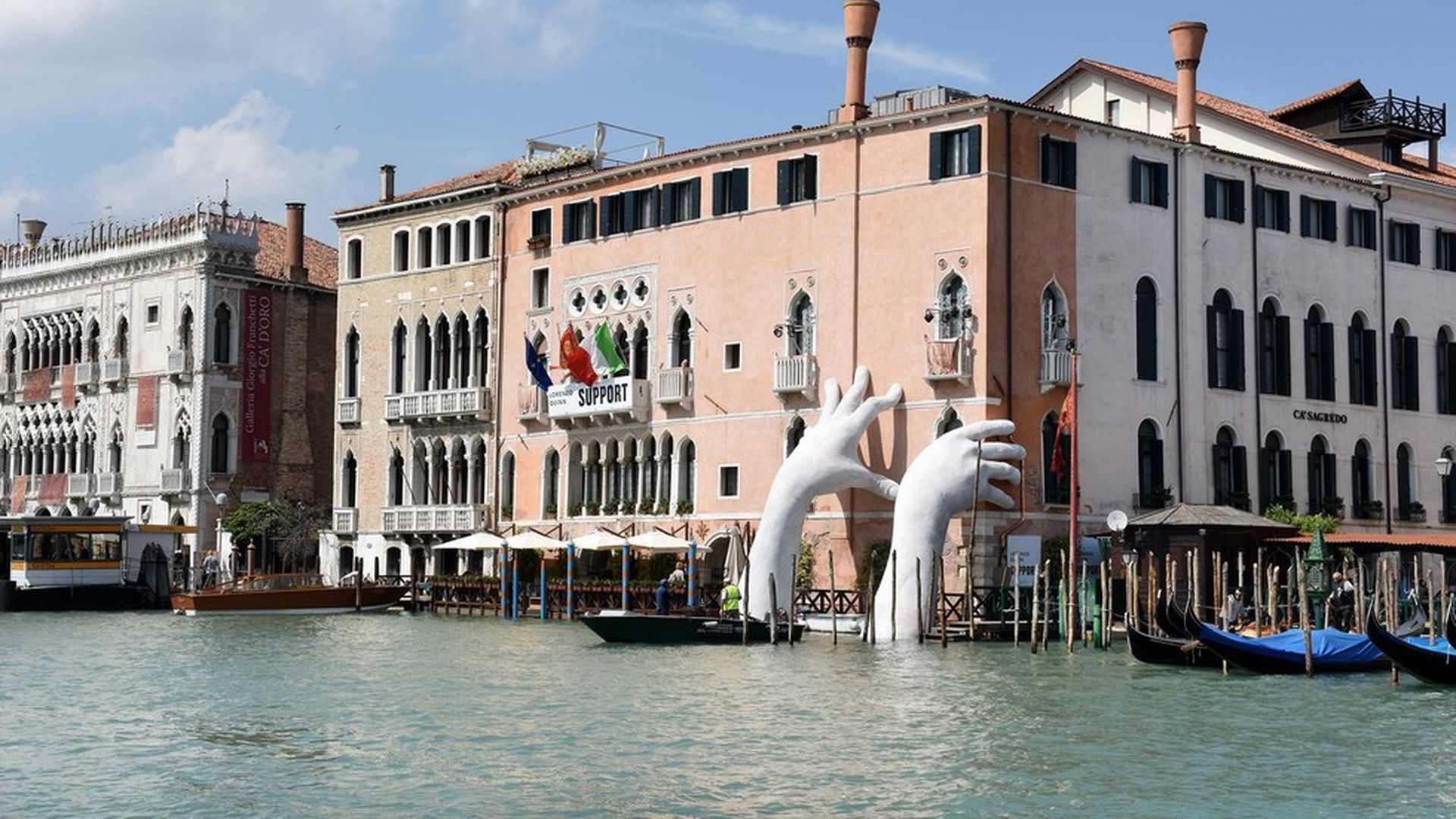
If you visit Venice any time before Nov. 26 you'll get a lesson in climate change. No, the city won't be submerged under water, as some have feared, but you will see what one artist views as the cause of global warming: hands.
Artist Lorenzo Quinn's "Support" installation is a PSA against the dangers of what he views as man-made climate change and its effects on Venice. Quinn "wants to speak to the people in a clear, simple and direct way through the innocent hands of a child," he writes on his Instagram.
Why it matters: Venice is a UNESCO World Heritage site and the city, which spreads across 118 small islands, has suffered from consistently rising sea levels over the past few decades. In the 1950s, the city's historic St. Marks Square flooded 20 times per year, but now it floods around 60 times a year. And climate scientists have found that global ocean levels could increase 0.6 feet to 1.1 feet if the earth's temperature rises just two degrees celsius.

We asked five experts about engineering the climate

In the face of rising global temperatures, deploying technologies to change Earth's climate has gone from thought experiment to reality. We already capture carbon and store it underground. Now some researchers are suggesting we should spray the clouds with particles to reflect sunlight, fertilize the oceans to promote carbon-absorbing plankton growth, or build a gigantic shade that orbits Earth and opens as needed to shield the planet from the sun. Welcome to the Anthropocene — the era of humans engineering the world in unprecedented ways.
What do we need to know before someone pushes start on a large-scale geoengineering attempt? And what Earth-altering experiment should we try first?
Five leading researchers answered those questions and gave us their take on the risks, as well as the thorny ethical and legal issues that come with unleashing a technology that could span countries, cultures, and generations.
- Janos Pasztor, climate policy expert and executive director, Carnegie Climate Geoengineering Governance Initiative: We aren't ready to engineer the climate
- David Dana, legal scholar, Northwestern University: Talking about geoengineering is distracting
- Jane Long, energy and climate scientist: It's time to investigate geoengineering technologies
- David Keith, climate and energy researcher, Harvard University: Solar geoengineering needs at least another decade of research
- Matthew Watson, geoengineering researcher, University of Bristol: We need to be sure the geoengineering cure isn't worse than the disease

We need to ensure a geoengineering cure isn't worse than the disease
Our Axios Voices conversation on geoengineering.
There may come a time where it would be immoral not to intervene to stop the Earth's temperature from rising. But engineering the climate by injecting particles into the stratosphere to reflect the sun's light is ambitious and risky. Before we do this, it would be important to know that the cure is not worse than the disease.
How to test the unknowns: The Earth system is complex. A path forward might include a series of experiments, with appropriate governance, that start at a very small (meter, kilogram) scale. Early work should not perturb the climate but rather teach us about, for example, potential chemical effects of injection.