The 31 races that could shift the legal fight against Trump

Add Axios as your preferred source to
see more of our stories on Google.
Illustration: Lindsey Bailey/Axios
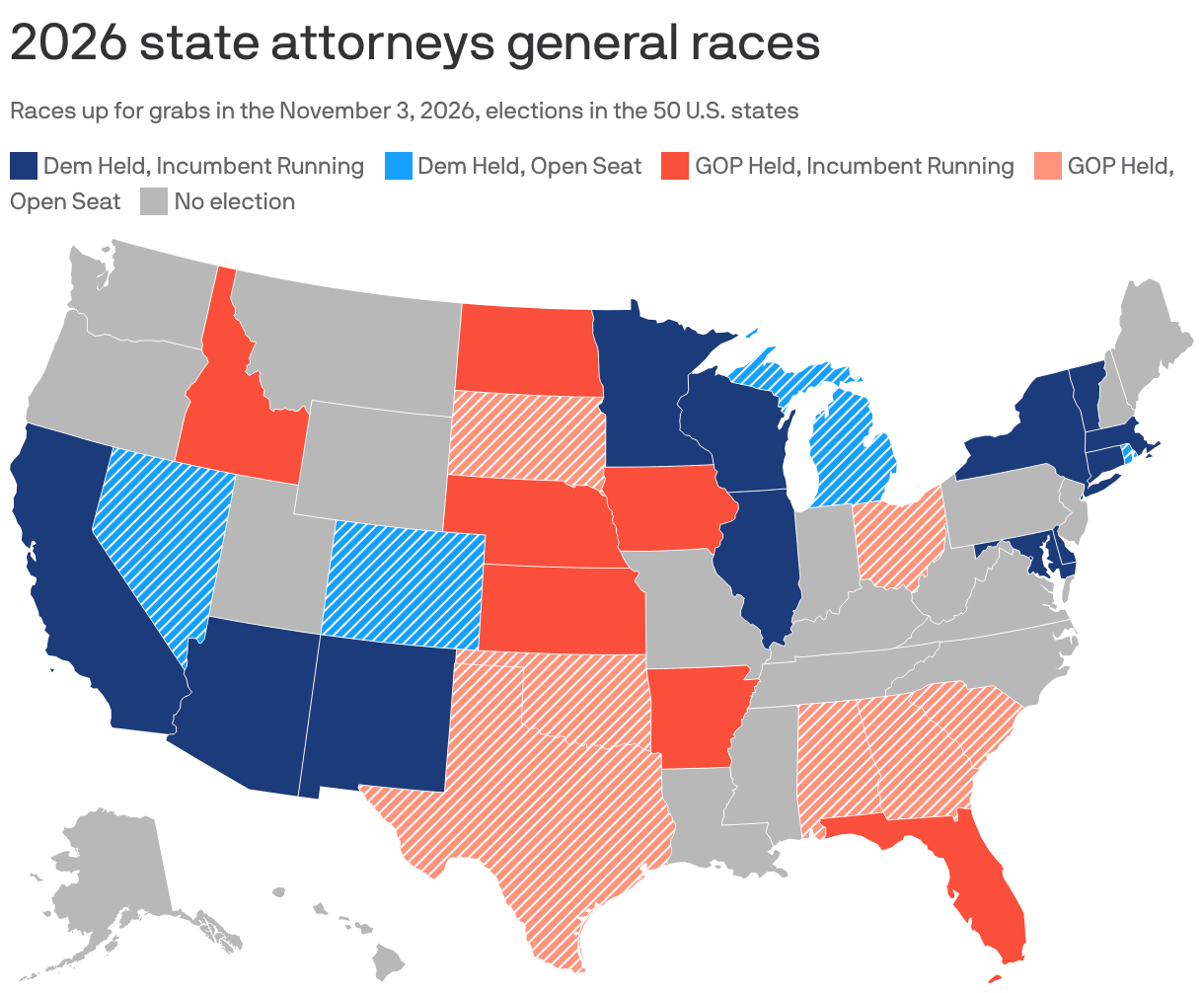
Thirty-one attorney general races could reshape who challenges President Trump in court and who holds some of America's biggest corporations accountable.
Why it matters: With Republicans controlling Washington, Democratic attorneys general have become some of the most powerful challengers curtailing the Trump administration's policies on elections, tariffs, federal funding, National Guard deployments and more.
- Resistance litigation goes both ways: Republican state AGs helped block the Biden administration's student loan agenda and Title IX expansions — and now act largely as friends to the Trump administration in court.
Driving the news: Attorney general offices are on the ballot in 30 states plus D.C. and two territories next week, including 17 held by Democrats and 14 by Republicans.
- Minnesota's Keith Ellison also faces a competitive reelection contest, while Arizona's Kris Mayes is defending the office she won by just 280 votes in 2022 and a tight race is unfolding in Michigan to replace Democratic AG Dana Nessel.
- Meanwhile, Democrats are targeting Republican-held offices in states like Kansas, Iowa and Georgia, and the Democratic Attorneys General Association just announced a $5 million investment in Florida's race this month.
The big picture: Attorneys general of both parties have become key policymakers, ones that have coordinated to not only challenge Washington, but also to regulate industry and protect consumers.
- "Today, attorneys general, if they agree … they then can function as a single law firm," says James Tierney, Maine's former Attorney General and a Harvard law lecturer.
- "There's no more important elected official on the ballot than attorneys general," DAGA President Sean Rankin says. "This is the people's lawyer."
Case in point: A change in party control can quickly alter a state's legal strategy.
- When Democrat Jay Jones took office as Virginia's attorney general this year, he immediately reviewed which lawsuits his state should join or withdraw from, after pledging to challenge the Trump administration more vigorously than his Republican predecessor.
By the numbers: Less than two years into Trump's second term, Democratic state attorneys general have brought nearly 150 cases against the administration, according to a tally by the Progressive State Leaders Committee.
State of play: The torrent of litigation against the federal government parallels the expansion of executive branch power and the escalating use executive orders, explains Rob McKenna, the former attorney general of Washington.
- "I think the AGs feel it's important for … the states to stand up and push back against an overreaching federal government," he says. "It's just what you view as overreach depends on your political point of view."
Another key culprit behind the onslaught of cases under Trump, Tierney explains, is Trump himself.
- "If someone breaks the law, [AGs are] going to go after them. That's their instinct," he says, adding, "If you have more law breaking from the president in the second term than you do in the first term, you're going to have more lawsuits. It's not because they're activist AGs."
- States have also stepped up, he says, as the Trump administration has gutted federal agencies and kneecapped anti-corruption measures.
Flashback: The importance of state AGs predates Trump. Republican AGs challenged former President Obama's immigration and health policies, while Democratic AGs sued former President George W. Bush over environmental regulations.
- As Gov. Greg Abbott, then Texas' attorney general, said during the Obama administration: "I go to the office. I sue the federal government. And then I go home."
Between the lines: "It was really the first Trump administration that it just started going off the charts," says Paul Nolette, the director of Marquette University's Les Aspin Center for Government who has tracked multistate lawsuits against the federal government.
- "You have these lawsuits that are challenging not just environmental cases, not just financial cases, but the whole range of things from healthcare to transgender rights to privacy … all sorts of different issues on a very partisan, polarized basis," he said.
- With broader, more organized coalitions, AGs are "central national policymakers" via "resistance litigation," says BYU Law's Elysa Dishman, who has mapped the increasingly partisan nature of multistate litigation.
Reality check: AGs from both parties still join forces to regulate major industries and protect consumers.
- A bipartisan coalition secured a landmark settlement with Meta in August worth up to roughly $17B, along with sweeping new child-safety restrictions on Facebook and Instagram, a historic moment similar to the Big Tobacco lawsuits of the '90s.
- "States are stepping into some of the newest and important policy areas that we're talking about today, like AI and social media, and it's incredibly consequential for setting a regulatory agenda nationwide," Dishman says.
The bottom line: Whoever wins next week will join the team deciding which Trump policies face legal challenges and how aggressively states police some of the nations most powerful corps.
Go deeper: State AGs play antitrust cops
