State AGs play antitrust cops

Add Axios as your preferred source to
see more of our stories on Google.
State attorneys general are moving aggressively to sue corporate giants in an attempt to fill a void they argue is being left by federal antitrust regulators.
Why it matters: Recent examples show states can be effective in blocking big mergers, especially when they band together.
- Kroger's $25 billion takeover attempt of rival Albertsons was successfully thwarted by state lawsuits in Oregon and Washington in 2024.
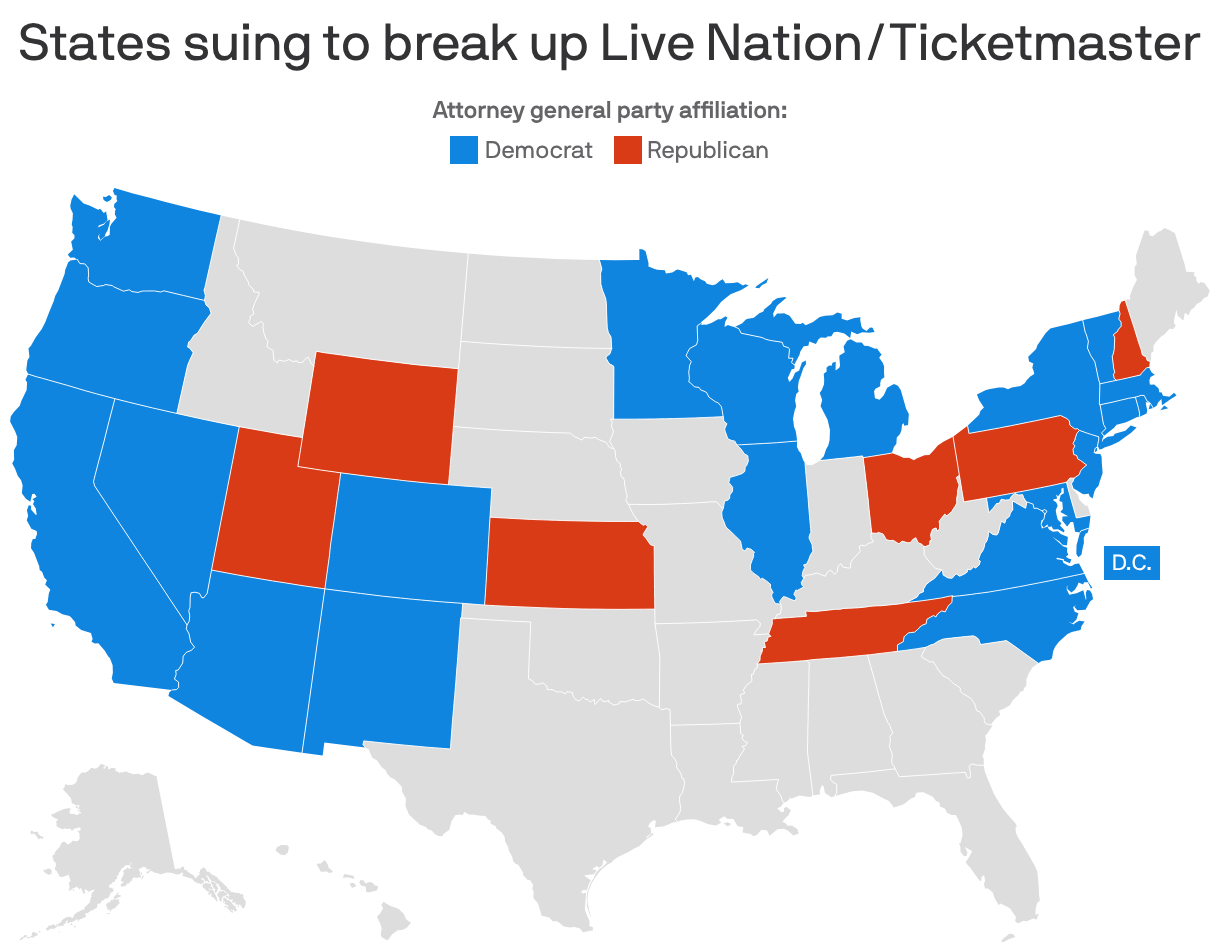
Driving the news: More than two dozen Republican and Democratic state attorneys general on Monday filed a motion for a mistrial in the federal antitrust lawsuit that sought to break up Live Nation/Ticketmaster.
- They are looking to continue their lawsuit after the Justice Department on Monday said it settled the case for $280 million.
- The settlement quickly drew outrage from consumer groups and activists, who argue the Trump administration let the firm off the hook.
Catch up quick: A group of 40 states formed a bipartisan coalition in 2024 to sue to break up the company alongside the Justice Department.
- Not all states initially involved in the DOJ's lawsuit filed a motion to continue to sue the company Monday, but most did.
- While the motion for a mistrial has mostly been signed by Democrats, it still has bipartisan support.
- 27 states and the District of Columbia are participating in the lawsuit.
State of play: States are playing a greater role in trying to block deals and break up companies amid what they perceive as a regulatory pullback from the Justice Department, Federal Trade Commission and Federal Communications Commission.
- Local news: A coalition of states including California, Colorado and New York is preparing to sue Nexstar and Tegna for antitrust should the FCC approve their $6 billion megamerger, per the Wall Street Journal.
- Hollywood: California's Attorney General Rob Bonta has already said that the state's Department of Justice has an opened investigation into the deal between Paramount and Warner Bros. Discovery.
Between the lines: While some state attorneys general may be politically motivated to sue to block a deal, they would need to present a compelling antitrust argument for a lawsuit to hold up in court.
- Each state has different antitrust laws that they can point to when determining whether a deal or company is anti-competitive.
- A company that receives federal approval for a deal but is blocked by a state lawsuit may need to abandon its deal altogether, or consider a settlement that includes divestitures or other remedies.
- For the Nexstar-Tegna deal, states that are home to overlapping broadcast stations would likely make the case that the merger would give one company too much power in certain markets.
- For the Paramount-WBD deal, the most viable state antitrust argument would likely be that the combination of two major studios would result in fewer bidders for services, which could impact production jobs and theatrical distribution.
Zoom out: State attorneys general have played critical roles over the past few years in joining federal regulators to sue to break up social media behemoths, like Google and Meta.
- States that teamed up with the Justice Department to sue Google for antitrust around its search and advertising businesses in 2020 and 2023, respectively, won both cases.
- But states that joined the FTC to sue Meta for antitrust in 2020 ultimately lost their case last year.
The bottom line: While individual states can sue to block deals or break up companies on their own, they are getting better at finding ways to combine enforcement resources to present legal challenges to corporate titans together.
