States test climate tools as Paris goal slips

Add Axios as your preferred source to
see more of our stories on Google.
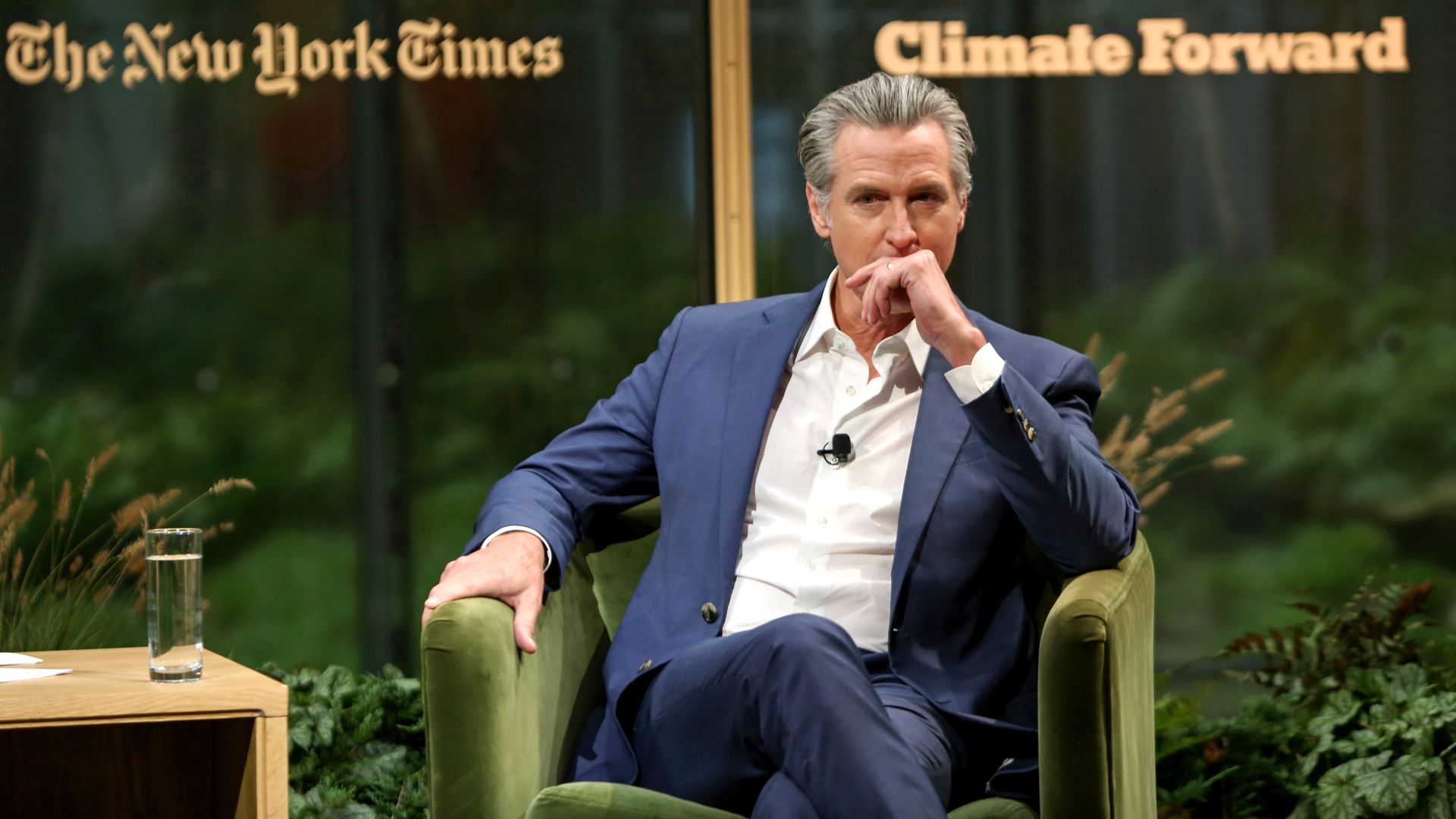
California Gov. Gavin Newsom in New York City in 2025. California co-founded the U.S. Climate Alliance of 24 governors in 2017. Photo: Yana Paskova/Getty Images for New York Times
States still have powerful energy and technology tools to cut emissions, but the path is getting harder as the Trump administration retreats from climate action and a key global warming threshold slips out of reach.
Why it matters: A UN report maps out what's needed now that a long-term breach of the Paris Agreement's 1.5°C goal is considered unavoidable — making rapid emissions cuts critical to limiting how high temperatures rise and for how long.
- While states can't replace the federal government, they retain control over consequential parts of America's energy system — and tools to cut emissions from them.
Zoom out: The United Nations Environment Program's most optimistic scenario has warming peaking around 1.8°C before declining. Limiting the size and duration of that overshoot requires immediate emissions cuts, including methane reductions, it says.
How it works: Karen Palmer, a senior fellow and director of Resources for the Future's Electric Power Program, pointed to broad clean-energy standards, streamlined siting and permitting, and utility rules that encourage more efficient use of the existing grid as powerful state levers.
- She pushed back on the idea that all the electricity sector's "low-hanging fruit" has been picked, noting that potentially economic clean-energy projects remain stuck behind siting, permitting and interconnection barriers.
Case in point: Danny Cullenward, an economist and lawyer and senior fellow at the University of Pennsylvania's Kleinman Center for Energy Policy, said California demonstrates both the potential and pitfalls of state action.
- He called its battery deployment an "extraordinary success," partly traceable to the state requiring deployment before grid-scale storage became mainstream. Batteries are now displacing some gas generation throughout the day and night, he said.
- California's battery fleet has grown from less than 700 MW in 2019 to more than 21,000 MW today. Clean energy supplied 100% of demand on the state's main grid for at least part of 279 days last year, the governor's office told Axios.
- However, Cullenward argued California's biofuel policies show the pitfalls, saying they've become captured by industry interests and waste scarce climate funding. The governor's office did not respond to a request for comment on that criticism.
Yes, but: The state climate landscape looks different than it did when Trump first withdrew from the Paris Agreement in 2017.
- Some states have scaled back or delayed earlier climate commitments as concerns about costs and rising electricity demand collide with emissions goals.
- Palmer pointed to RFF analysis finding Virginia could use carbon-market revenues to lower household electricity bills while preserving incentives for power plants to cut emissions.
Transportation remains a tougher challenge. Cullenward said federal rollbacks of EV incentives and legal challenges to California's authority to set vehicle standards mean many of the state's short-term tools "aren't really there right now."
- California is still using tools it controls: Gov. Gavin Newsom (D) recently signed six bills aimed at speeding EV charger deployment and expanding charging access, including by streamlining permitting and reducing barriers at apartments and mixed-use developments.
- Longer term, Cullenward pointed to transit-oriented housing and reducing car dependency as important state and local levers.
The big picture: The question isn't whether states can fill the federal climate policy void. They can't. It's how much progress they can make with the policies they still control.
- The U.S. Climate Alliance —formed by California, New York and Washington after Trump's first Paris withdrawal — now comprises 23 Democratic governors and one Republican representing 60% of the U.S. economy, all still pursuing Paris-aligned emissions reductions.
What's next: The gas utility system is the "next sort of frontier," Cullenward said.
- States regulate both electric and gas utilities, but as buildings and other services electrify, fewer customers could be left paying for the fixed infrastructure of the gas network.
- That risks leaving stranded infrastructure and spiraling costs for customers who remain on gas, he said.
Flashback: Trump signs order to pull U.S. out of Paris Agreement again
