Tim Cook's legacy hinges on Apple's AI bet

Add Axios as your preferred source to
see more of our stories on Google.
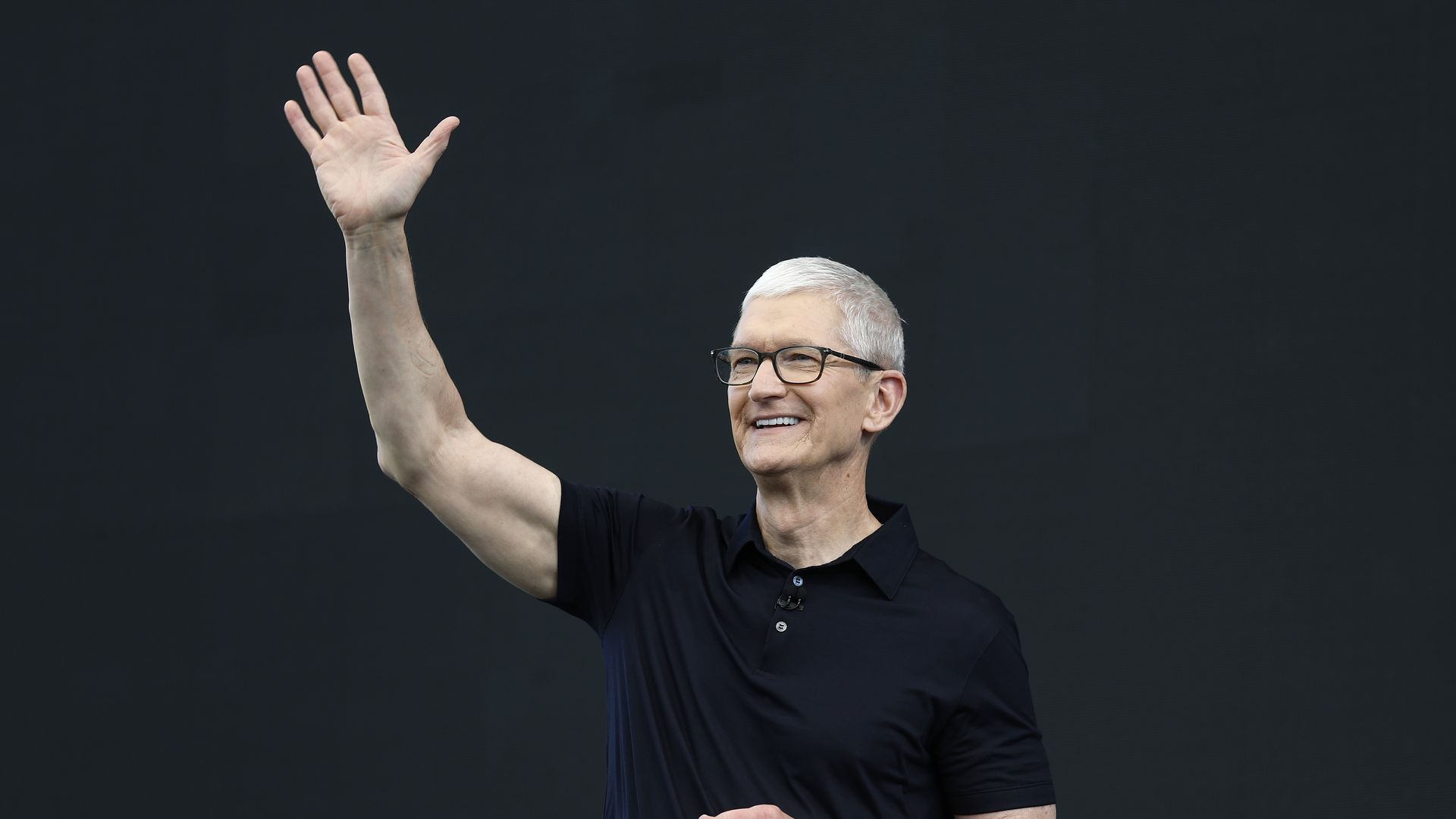
Tim Cook. Photo: Justin Sullivan via Getty Images
For better or worse, Tim Cook's legacy is likely to be determined by something we don't really know the answer to yet: Apple's bet to build its AI strategy partly around other companies' models.
Why it matters: In the short term, the move could save substantial sums compared with building and operating a frontier-model business of its own, but it's left Apple dependent on Google for some of its most important AI capabilities.
Driving the news: As John Ternus officially takes over Tuesday as Apple CEO, much of the analysis of Cook's tenure has focused on his record.
- On the positive side, he has more than quadrupled annual revenue and grown Apple's market capitalization by an even higher amount, to more than $4 trillion.
- And he built Apple into a services powerhouse, convincing hundreds of millions of iPhone and Mac owners to spend billions more on Apple TV+, Apple News, iCloud and other subscription products.
- Among the negatives, Apple's car project was narrowed and then killed on Cook's watch, and the Vision Pro has failed to find a mass market, surviving as a pricey toy for VR enthusiasts.
Between the lines: Looking back 10 years from now, Cook is likely to be judged not on any of those things, but on something just starting to play out: Apple's AI strategy.
Zoom in: The first part of that effort was clearly bumpy.
- The initial vision for Apple Intelligence — outlined at WWDC in June 2024 — was ambitious and privacy-focused.
- The company claimed that its AI could answer highly personalized questions with underlying personal data remaining on the device or in its privacy-protected cloud system.
- However, Apple encountered many delays, with the centerpiece of the strategy, a revamped Siri, just now arriving with iOS 27. And even to get that far, it was forced to rely on models from Google.
Zoom out: The future, though, is likely to gloss over those delays, with the outcome more likely hinging on where the value is in AI.
- If models wind up being a commodity, Cook could look like a genius for avoiding the kinds of sums that Google, Meta, Microsoft, OpenAI and Anthropic have invested in model development and infrastructure.
What we're watching: If OpenAI, Anthropic or another AI company parlays its work into a successful new hardware platform, Cook could be criticized for not using Apple's financial resources to secure a stronger position in the next era of computing.
