U.S. gives Iran Saturday deadline to publicly renounce Hormuz attacks

Add Axios as your preferred source to
see more of our stories on Google.
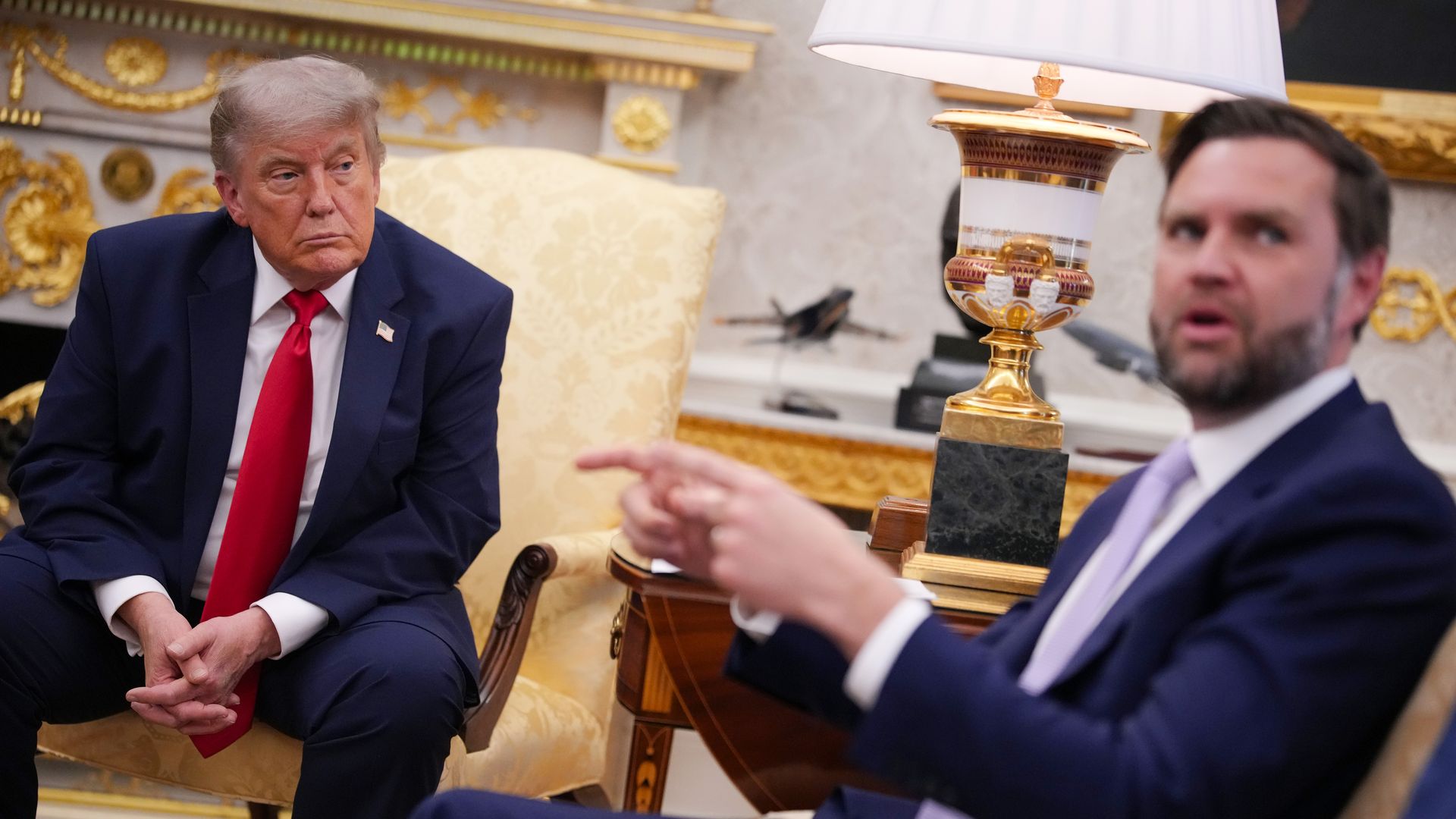
President Trump with Vice President JD Vance during a meeting with NATO Secretary-General Mark Rutte in the Oval Office on June 24. Photo: Andrew Harnik/Getty Images
The Trump administration is demanding that Iran publicly acknowledge that the Strait of Hormuz is open and pledge to stop firing on commercial ships.
- The message has been conveyed directly and through regional mediators, three U.S. officials said in a briefing with reporters Friday.
Why it matters: The administration says Iran violated the memorandum of understanding it signed with the U.S. three weeks ago by repeatedly firing on commercial vessels in and around the strait.
- The attacks triggered several exchanges of fire and pushed the fragile agreement closer to collapse, with President Trump declaring the ceasefire "over" this week.
- U.S. officials argue that Iran's failure to honor such a straightforward commitment raises serious doubts about its willingness and ability to implement a far more complex nuclear agreement.
Driving the news: Iranian Foreign Minister Abbas Araghchi and Omani Foreign Minister Sayyid Badr al-Busaidi are expected to meet Saturday in Muscat to discuss the Hormuz crisis.
- In recent weeks, even before the MOU was signed, Oman had aligned with the U.S. and its Gulf allies by opening a southern channel near its coast for ships to transit the strait.
- Iran was furious that the move weakened its negotiating position. U.S. officials claim Iranian negotiators told them that radical elements within the regime opened fire on ships in an effort to claw back leverage.
- Publicly, Iranian negotiators, Islamic Revolutionary Guard Corps commanders and other senior officials have been united in their demand that Tehran retain control over navigation through the strait.
The other side: Iran's Foreign Ministry spokesperson Esmail Baghaei said Friday that Araghchi's visit to Oman will focus on the Strait of Hormuz and maritime security.
- "Iran accepted a clear responsibility regarding the establishment of normal arrangements and maritime services related to ship traffic in the Strait of Hormuz, and we have been very determined and resolute in fulfilling that responsibility. Under the agreement, we were to consult and cooperate with Oman on this matter," he said.
Behind the scenes: A U.S. official said the Iranians reached out to the administration after two days of skirmishes earlier this week and sought further talks to resolve the dispute.
- "They told us, 'We screwed up. We made a mistake. Let's keep talking,'" the official claimed.
- Baghaei denied on Friday that Iran had requested negotiations with the U.S. and claimed Iran only agreed to a request by the Qatari mediators to discuss the matter.
- The U.S. official added that a power struggle is underway inside the Iranian regime over implementing the MOU and the next steps in negotiations with the Trump administration.
- "There are elements within their system that want to reach a deal, but we can't make decisions for them. They need to get things under control," one U.S. official said.
What they're saying: The U.S. officials said they expect Iran to issue a statement after Saturday's meeting in Oman.
- "We want them to publicly say that they will stop shooting at ships and explicitly, or at least implicitly, acknowledge that they screwed up. We are working on that now," one U.S. official said. "We expect the Iranians to say ... that every channel in the strait will be open and that it will be toll-free."
- A second U.S. official said there will be harsh consequences if Iran refuses. "If it is not their position [tomorrow], it is not gonna be a great day for them," the official said.
- The U.S. has already launched two rounds of strikes on Iran in retaliation for the Hormuz attacks. Thursday was a quieter day, as Trump signaled openness to returning to diplomacy.
What to watch: One U.S. official said the U.S. and Iran have made progress toward a nuclear deal during three weeks of direct and indirect negotiations.
- "We are talking to people with authority there who say they want a deal," one U.S. official said.
- But officials also said the Hormuz crisis has raised serious questions about whether Iran will ever agree to a nuclear deal — or whether it would stay committed.
- One official stressed that Trump has given U.S. negotiators space and time to pursue a nuclear deal with Iran, "but not a lot of space and time." The official added that plans are being drawn up for alternative options if no nuclear deal is reached.
