Buyer's remorse hits Trump's Latino voters

Add Axios as your preferred source to
see more of our stories on Google.
A new UnidosUS poll finds that 1 in 4 Hispanic Trump voters say they would not vote for him again if given the choice.
Why it matters: The erosion of Latino support for President Trump, combined with dissatisfaction with the economy, signals danger for competitive GOP-held seats in the 2026 midterm elections.
- Trump's gains with Latinos were one of the biggest political stories of 2024.
- Now, a new UnidosUS/BSP Research/Shaw & Co. poll suggests those voters remain highly movable — a problem for Republicans in Latino-heavy battleground districts where both parties are watching for signs of a post-2024 snapback.
By the numbers: Two-thirds of Latino voters disapprove of Trump's job performance, compared with 30% who approve. Disapproval is a majority in every region tested, including 51% in Florida.
- 25% of Latino Trump 2024 voters say they probably or certainly would not vote for him again. That compares with 5% of Harris 2024 voters who say they would not vote for her again.
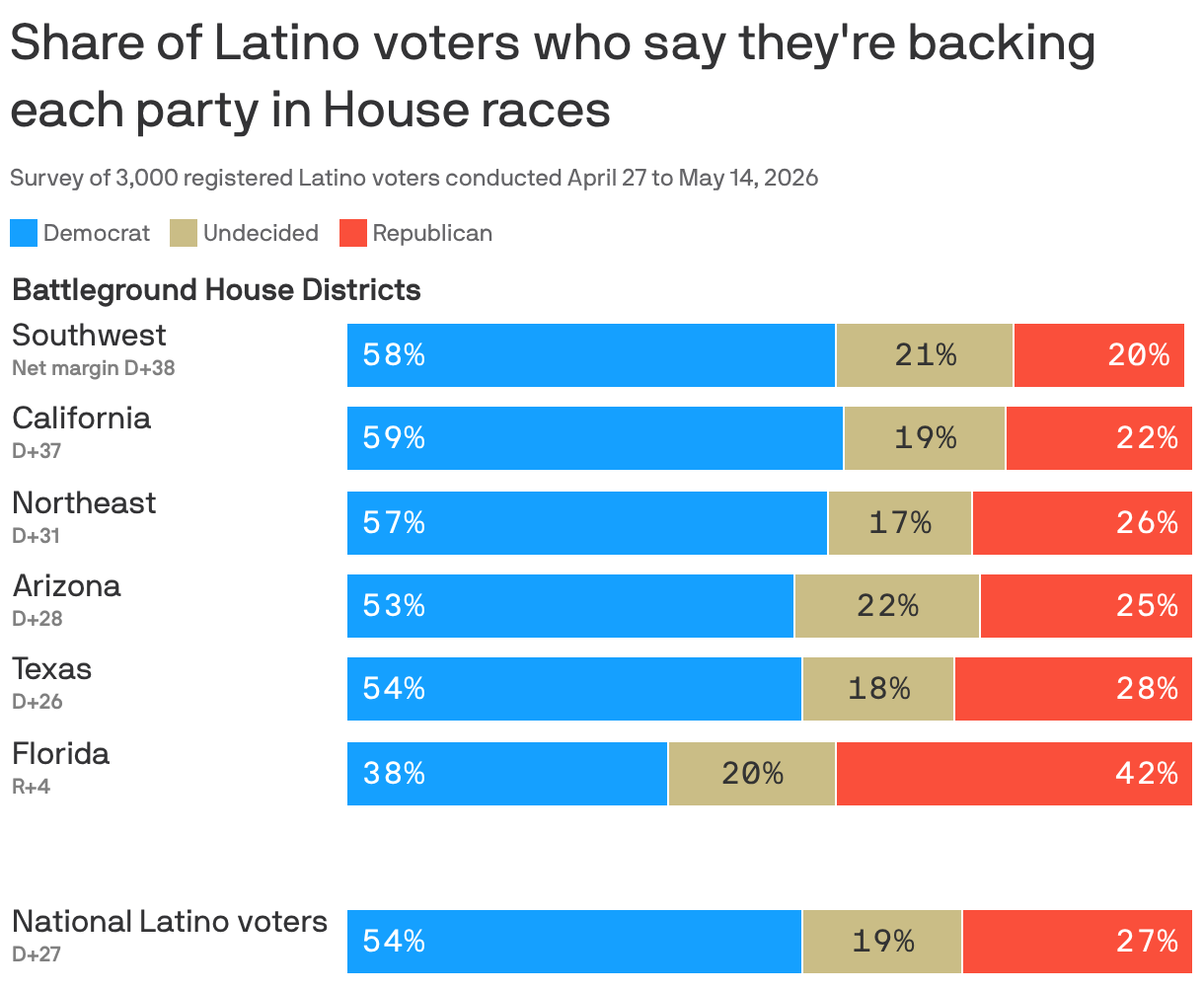
- On the 2026 House ballot, Latino voters back the Democratic candidate over the Republican candidate 54% to 27%, with 19% undecided.
State of play: Latino voters are emerging as "the swingiest of the swing voters" ahead of the midterms, with economic anxiety and immigration concerns making them highly fluid in competitive districts.
- The GOP had hoped Trump's 2024 Latino gains represented a lasting realignment.
- Democrats see inflation, tariffs and aggressive immigration enforcement reopening Latino-heavy seats they feared were lost.
Zoom in: The political damage to Republicans is highly apparent in critical battlefield states containing high-density Latino populations, the UnidosUS poll found.
- In Texas, where significant rightward shifts occurred in 2024, Trump's disapproval has skyrocketed to 67% among Latinos, and Democrats have opened a massive 54% to 28% generic House ballot lead.
- In California, Latino disapproval of Trump stands at 71%, paving the way for a 59% to 22% Democratic advantage on the generic congressional ballot.
- In Arizona, Trump faces a 67% disapproval rating, with Democrats leading the generic House ballot 53% to 25%.
Zoom out: Voter dissatisfaction extends into deep anxieties regarding governance, military stability and civil rights.
- 84% of Hispanic voters are deeply concerned that Congress is failing its constitutional duties by ceding too much authority to the executive branch and failing to act as a proper check and balance.
- 58% believe that their civil rights and civil liberties have become noticeably less secure under the Trump administration.
- 79% assert the president should be legally required to obtain congressional approval before executing military action.
- 64% explicitly oppose the war in Iran.
The intrigue: Latino voters say cost of living, not immigration, is the top issue shaping their views of Trump.
- Immigration enforcement ranks second, ahead of jobs and the economy, the Iran war, tariffs and cuts to Medicaid, ACA/Obamacare and food assistance programs.
The other side: Florida remains the glaring exception.
- Latino voters there back the Republican House candidate over the Democrat 42% to 38%, and Florida GOP candidates also lead in Senate and governor matchups tested in the poll.
The bottom line: Trump's Latino gains are no longer looking like a locked-in GOP advantage.
- The poll gives Democrats a clear opening in Latino-heavy battlegrounds — but not a guarantee.
Methodology: This UnidosUS Bipartisan Poll of Hispanic Voters: Road to the 2026 Midterms was conducted April 27–May 14 by BSP Research and Shaw & Company Research on behalf of UnidosUS. The poll is based on a sample of 3,000 Latino registered voters across the U.S.
- The margin of sampling error is ±1.8 percentage points for results based on the entire sample.
- The survey was offered in English or Spanish, based on respondent preference, and conducted via live telephone interviews, text message invitations and online panels. All participants were confirmed registered voters.
