It's Trump's trade world now

Add Axios as your preferred source to
see more of our stories on Google.
One year after "Liberation Day," the global economy is still reckoning with the fallout of a trade policy that has since been diluted.
Why it matters: President Trump's tariff wall has been torn down by the court, watered down by exemptions and scaled back under trade agreements.
- Even so, the past year of policy changes turned the global trading system upside down in ways that appear irreversible.
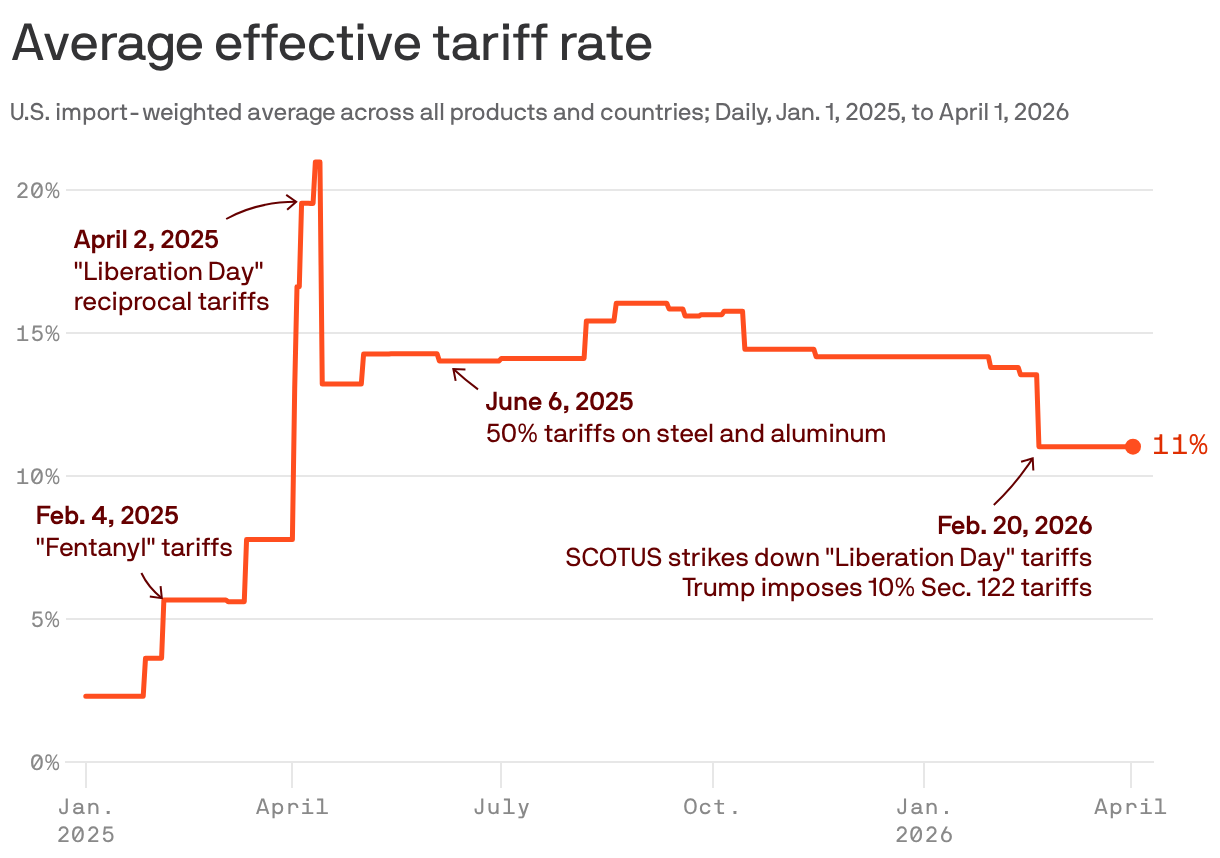
The intrigue: The Trump administration has enacted more than 50 different trade policy changes, a historic whipsaw illustrated by a new daily tariff tracker launched by the Budget Lab at Yale.
By the numbers: The effective tariff rate — a measure of how much the U.S. actually collects in duties as a share of total imports — started 2025 around 2%, a level that had been roughly stable for years.
- Tariffs spiked to the highest in a century after Trump took office, ultimately peaking at 21% in the days following "Liberation Day."
Zoom in: The rate now sits at 11%.
- Expect further changes in the months ahead: Trump vowed to raise the 10% blanket tariff rate he imposed in the aftermath of the Supreme Court decision that unraveled the bulk of tariffs imposed over the past year.
- Trump's trade officials promise to recreate those tariffs with a patchwork of other authorities before the current import taxes expire in July.
- Trump may also shift the structure of its steel and aluminum tariffs, the Wall Street Journal reported, which could result in higher costs for imports.
The big picture: The fallout is visible in three critical ways:
- New trade alliances. Countries are forging new trade pacts, while trying to adhere to U.S. trade agreements and investment pledges promised under a framework the Supreme Court says is illegal.
- U.S. manufacturing. Manufacturers have been saddled with higher input prices, a portion of which are being passed along to American consumers.
- Manufacturing employment has decreased in all but one of the 10 months of employment data since Liberation Day in April, losing a net 89,000 jobs over that period.
- White House officials are encouraged by indicators like the closely watched industry survey by the Institute for Supply Management, which shows manufacturing activity expanded for the third straight month in March after years of contraction. Still, its prices index is the highest since 2022.
- More Chinese goods. Despite Trump's claims that countries would bend to have access to the world's largest market, China has found new buyers to re-route its exports. China ended 2025 with a record $1.2 trillion trade surplus.
What they're saying: "Liberation Day was on its way to being a great success until the Supreme Court," Wilbur Ross, former Commerce secretary during Trump's first term, tells Axios.
- The ruling now "limits his ability to make tariffs fluctuate," Ross says, though he adds it's not necessarily a bad thing. "Businesses can adjust to bad news. It's hard for businesses to adjust to uncertainty."
What to watch: The tariffs sparked an economic rewiring that CEOs are treating as permanent.
"Trade barriers mean our model no longer works as intended and a structural reset is required," Volkswagen CEO Oliver Blume told investors last month. "This will take time. There are unfortunately no quick fixes."
- Blume later added that investment activity depends on tariff refunds: "We can't both pay, on the one hand side, a high amount of tariffs, and on the other side heavily invest" in the U.S.
For the record: White House spokesperson Kush Desai said in a statement that Trump has "powerfully used tariffs to lower our goods trade deficit, renegotiate trade deals, secure trillions in manufacturing investments and lower drug prices."
