U.S. reaches trade agreement with Europe with 15% tariff

Add Axios as your preferred source to
see more of our stories on Google.
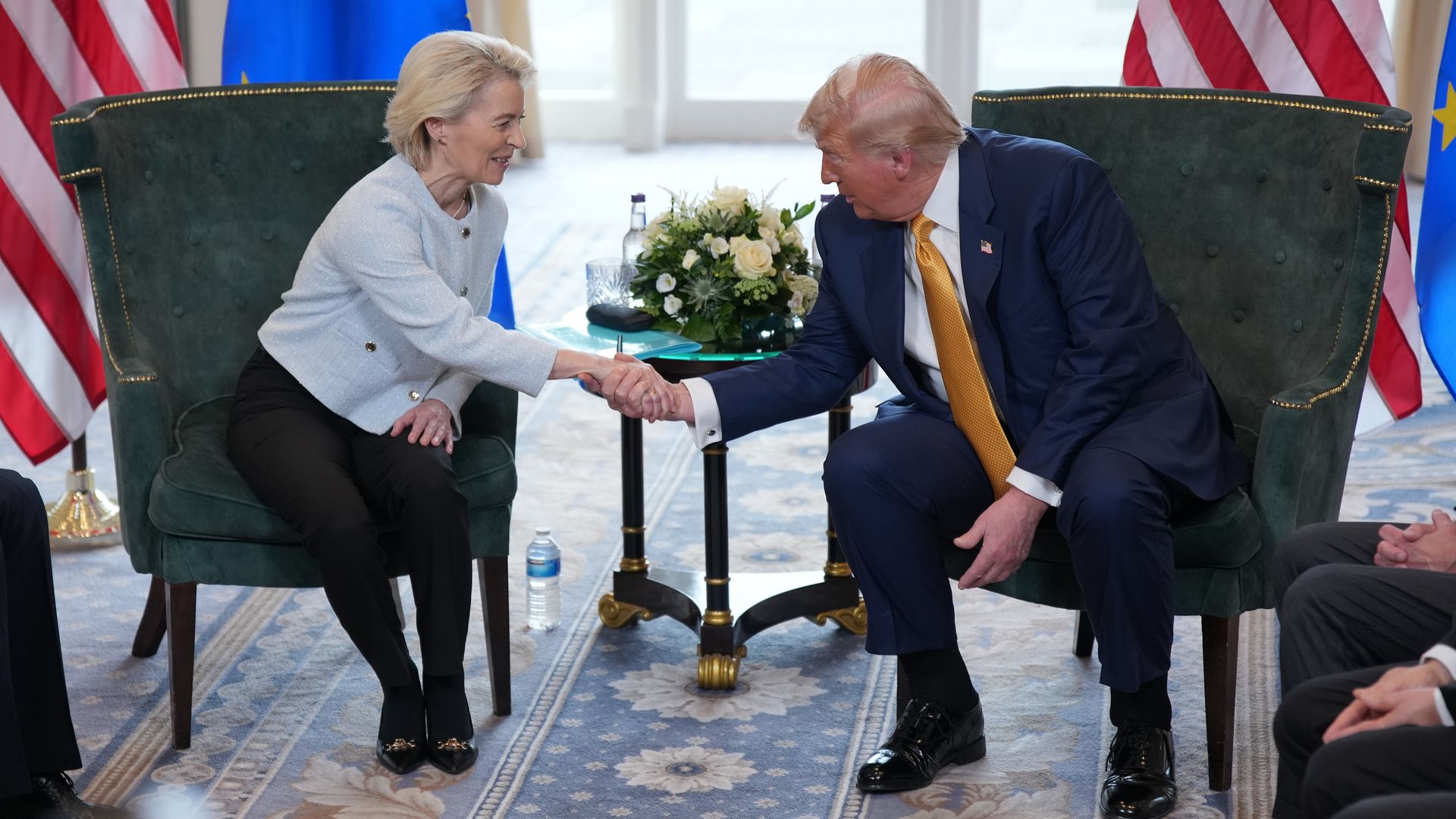
European Commission President Ursula von der Leyen and President Trump during a meeting in Turnberry, Scotland, on Sunday. Photo: Andrew Harnik/Getty Images
President Trump said on Sunday that the U.S. reached a trade agreement with the European Union that would impose a 15% tariff rate on its goods.
Why it matters: Europe is the latest major partner to accept significantly higher tariffs to stave off worsening trade fights with Trump.
Details: Trump announced the deal alongside European Commission President Ursula von der Leyen during a trip to Scotland.
- Trump said the EU agreed to buy more than $750 billion worth of U.S. energy, as well as invest $600 billion on top of the bloc's existing commitments in America.
- Trump said that the EU would also purchase military equipment as well as open its markets for U.S. manufacturers.
What they're saying: "I think it's the biggest deal ever made," Trump said on Sunday.
- Von der Leyen echoed those comments in a post to X that noted the U.S. and EU "are a market of 800 million people," representing nearly 44% of global GDP.
- "It will bring stability, it will bring predictability," von der Leyen said at a briefing on the deal.
Catch up quick: The EU pact comes after one struck with Japan earlier this week.
- That deal imposed 15% tariffs on U.S.-bound imports, but also included a massive investment mechanism that has come under scrutiny.
The big picture: Europe's economy was reeling before Trump took office. Still, White House trade policy has targeted its most dominant sectors, including auto manufacturing.
- German carmakers — Mercedes, BMW and Audi — have been subject to a 25% tariff rate since April, while other goods faced a blanket 10% tariff.
Zoom out: German Chancellor Friedrich Merz said on X the deal meant "a trade conflict has been averted that would have severely impacted the export-oriented German economy."
- Italian Prime Minister Giorgia Meloni in a media statement called the agreement "sustainable" and later told reporters: "I consider it positive that there is an agreement, but if I don't see the details I am not able to judge it in the best way."
- Ireland's Taoiseach Micheál Martin said in a statement posted to his social media accounts that he welcomed the agreement for bringing "clarity and predictability" to the EU-U.S. trading relationship.
- However, he added: "It does mean that there will now be higher tariffs than there have been and this will have an impact on trade between the EU and US, making it more expensive and more challenging."
By the numbers: As a bloc, the EU is America's top trading partner, with more than $600 billion worth of goods imported from European nations last year.
- The U.S. exported slightly more than half of that sum, with $370 billion worth of goods sent to Europe in 2024.
- That trade deficit has been one source of Trump's frustration with Europe since taking office.
The bottom line: Some of the world's largest economies will adjust to far higher tariff rates than initially thought, with huge implications for global economic growth and inflation.
More from Axios:
- Trump's tariffs start August 1, no extensions, Lutnick says
- EU trade deal with Trump helps Europe ditch Russian fuels
- Photos: Protesters rally with bagpipes, pointed signs as Trump visits Scotland
Editor's note: This story has been updated with additional details from the agreement and comment from German Chancellor Friedrich Merz, Italian Prime Minister Giorgia Meloni, Irish Taoiseach Micheál Martin, and further comment from EC President Ursula von der Leyen.
