4 Iran pressure points to watch this week

Add Axios as your preferred source to
see more of our stories on Google.
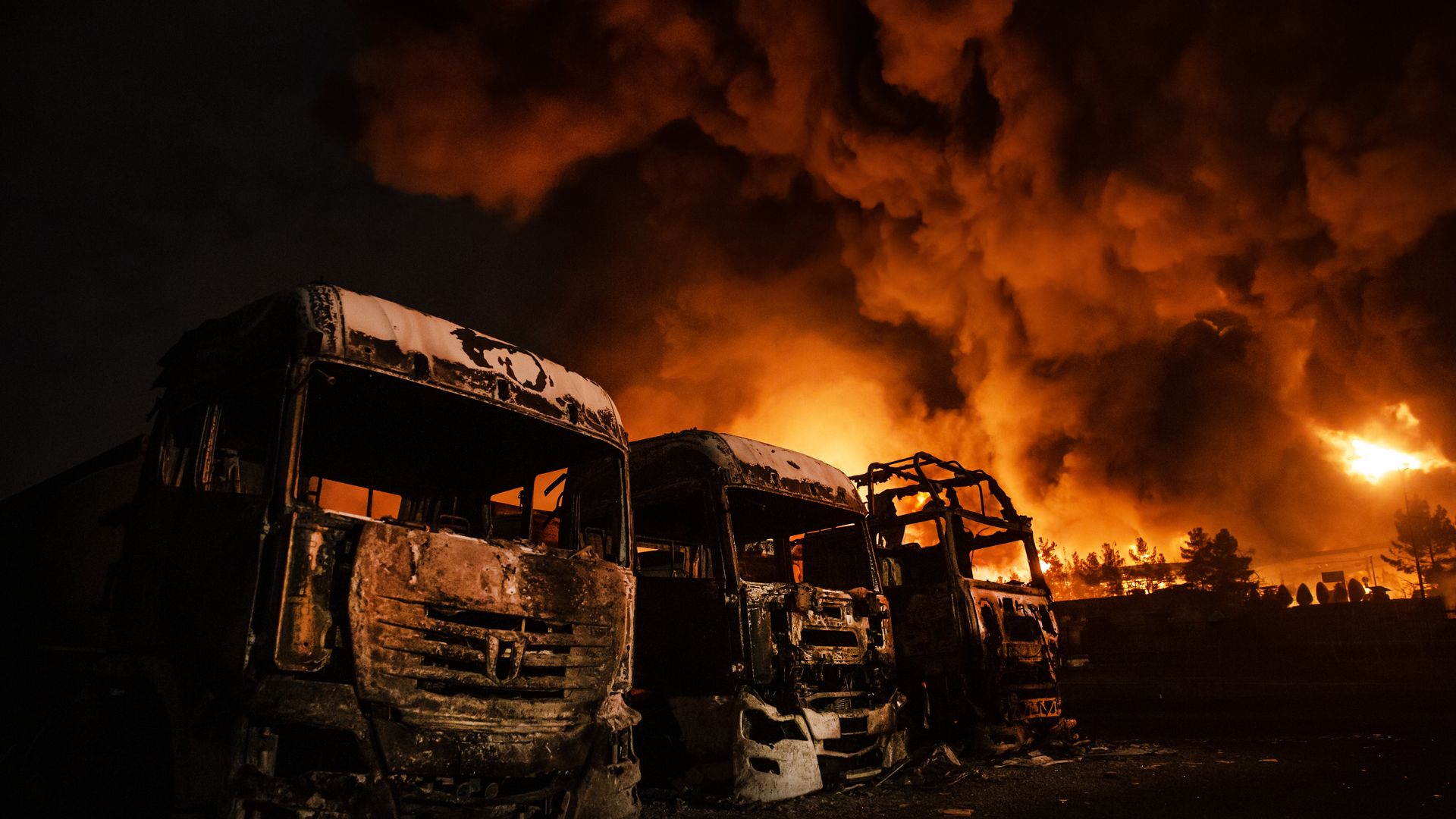
Fire burns at Tehran's Shahran oil depot after reported U.S. and Israeli attacks on March 8. Photo: Hassan Ghaedi/Anadolu via Getty Images
The Iran war has entered its third week with ballooning costs and a deepening humanitarian crisis — and no diplomatic off-ramp in sight.
The big picture: Trump and his aides have mentioned varying timelines for ending the war. But with a heavily damaged but defiant Iran stymieing trade, the U.S. remains dug in.
The latest: The U.S. has unleashed days of "overwhelming firepower" deep in Iran, U.S. Central Command Adm. Brad Cooper said Monday.
- Trump told NBC News on Saturday that Iran wants to make a deal, but he wouldn't "because the terms aren't good enough yet."
- Iran's foreign minister told CBS News' "Face the Nation" Sunday that Tehran had not asked for negotiation.
Between the lines: The U.S. can point to air supremacy and a decimated Iranian navy, but Iran doesn't need to win militarily to still inflict pain.
- Iran's strangling of the Strait of Hormuz is compounding economic pain that risks an "escalation trap," as Axios' Jim VandeHei and Mike Allen write.
Here are four storylines to watch this week:
Humanitarian fallout
Thirteen U.S. service members have died and some 140 have been injured, the Pentagon confirmed last week.
- "We expect casualties," Trump told NBC News after the first deaths, "but in the end, it's going to be a great deal for the world."
Iran's UN ambassador said earlier this month that more than 1,300 had died in Iran with thousands more injured.
- Lebanon's Health Ministry says 850 have been killed since the latest strikes began, while the UN's International Organization for Migration estimates nearly 1 million have been forced to flee their homes.
- Israel and several Gulf states have also recorded fatalities.
The Hormuz hurdle
Trump is trying to build a coalition of countries to reopen the Strait of Hormuz, with a goal of announcing it later this week, Axios' Marc Caputo and Barak Ravid learned.
- Trump claimed Saturday the U.S. and other countries would send warships to reopen commercial shipping, calling on China, France, Japan, South Korea and the U.K. to help.
- He later told reporters aboard Air Force One he "demands" that NATO countries and other oil-importing nations — including China — contribute.
Zoom in: Germany, Spain, Italy and Greece have all declined committing warships, Reuters reported. Australia also declined, per the Wall Street Journal,. Other leaders signaled they don't have immediate plans to send ships.
- U.K. Prime Minister Keir Starmer stressed Monday that while his nation and others were working on a plan, it would not be a NATO mission.
- "What does ... Donald Trump expect a handful or two handfuls of European frigates to do in the Strait of Hormuz that the powerful U.S. Navy cannot do?" German Defense Minister Boris Pistorius said Monday, per a Reuters translation. "This is not our war, we have not started it."
A Lebanon offensive
Israel announced what it called "limited and targeted" ground operations in southern Lebanon Monday.
- The Lebanese government is deeply alarmed the renewed war — triggered by Hezbollah launching rockets at Israel — will devastate the country, Ravid reports.
- UN experts warned the strikes are exacerbating a displacement crisis in Lebanon.
Between the lines: Axios previously reported that Israel is aiming to seize the entire area south of Lebanon's Litani River and dismantle Hezbollah's military infrastructure.
The costs
The war exceeded $11.3 billion in the first six days, Pentagon officials told lawmakers, per multiple reports — a number likely to rise as the conflict stretches on.
Meanwhile, U.S. gasoline, diesel and home fuel oil prices continue to rise.
- The global benchmark Brent crude remains above $100 per barrel Monday morning, while the U.S. benchmark eased to the mid-$90s after breaching $100 earlier.
Go deeper: The Iran war is a new test of America's economic superpower
