5 scenarios for how the Iran war could end

Add Axios as your preferred source to
see more of our stories on Google.
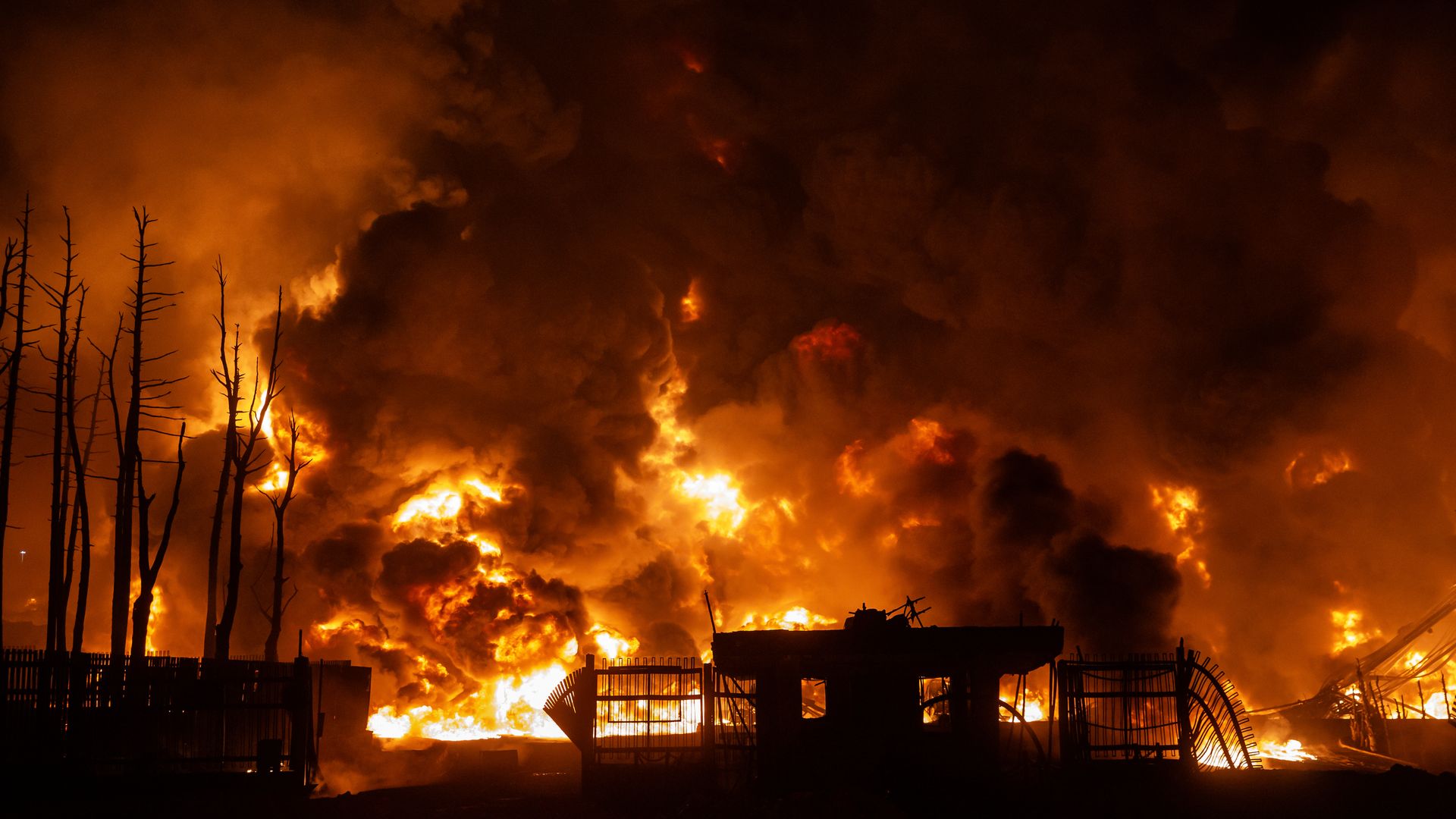
Flames and smoke rise at the Shahran oil depot in Tehran on March 8. Photo: Hassan Ghaedi/Anadolu via Getty Images.
Mixed signals from President Trump and his own Pentagon are leaving allies, markets and lawmakers guessing how — or when — the Iran war ends.
Why it matters: Every week without a resolution deepens economic pain at home and instability abroad — raising the political stakes for Trump ahead of the midterms.
State of play: Trump told Republicans at an annual retreat on Monday that the U.S. has already won the war, "but we haven't won enough." That came hours after he told CBS News that the war is "very complete, pretty much."
- Defense Secretary Pete Hegseth, meanwhile, said that Tuesday "will be our most intense day of strikes" yet.
Here are five scenarios for how the Iran war ends.
1. Negotiated ceasefire and nuclear deal
Ending Iran's nuclear weapons program has been one of Trump's key stated objectives since Operation Epic Fury began.
- Iran and the U.S. held three rounds of indirect nuclear talks in Geneva just days before the war started, but Trump's envoys ultimately determined Tehran was not serious about a deal.
- Trump told Fox News Monday that renewed talks are "possible," but that he's disappointed by the selection of hardliner Mojtaba Khamenei to succeed his late father as supreme leader.
The intrigue: The day before the strikes began, Oman's mediators said Iran had agreed to never stockpile enriched uranium and called peace "within reach." It's unclear how the war would affect future negotiations.
2. The Venezuela model
Trump has pointed to Venezuela — where the U.S. captured President Nicolás Maduro in January and established a working relationship with his successor, Vice President Delcy Rodríguez — as a template for Iran.
- Trump said Monday he thinks Iran "made a big mistake" with Mojtaba Khamenei's appointment, and suggested the new supreme leader may not last.
Reality check: Beyond just geography, the Iran-Venezuela comparison has significant limits. Experts say treating them as equivalent misunderstands the Islamic Republic's power structure.
- The regime has survived 47 years of sanctions, wars and internal uprisings — entrenching itself with military, religious and political institutions designed to outlast any single leader.
- For the Iranian protesters who have risked their lives demanding regime change, a U.S.-backed leader from within the system could be seen as a betrayal rather than liberation.
3. Popular uprising and regime collapse
The potential for collapse is real. Ayatollah Khamenei is dead, the economy has cratered, and Iran saw its largest protests since the 1979 revolution just weeks before the war began.
- Israeli Prime Minister Benjamin Netanyahu has framed the strikes as creating "conditions for the brave Iranian people to take their destiny into their own hands."
Yes, but: The Iranian opposition has no unified leader and no organized force on the ground.
- Exiled Crown Prince Reza Pahlavi is among the most popular opposition figures, but Trump has downplayed his credibility — in part because Pahlavi hasn't lived in Iran for nearly 50 years.
- Kurdish forces backed by Israel could provide some ground support, but the risks are substantial — including the possibility that Iran devolves into the kind of civil war that consumed Syria for a decade.
4. Special forces raid on nuclear stockpile
The U.S. and Israel have discussed sending special forces into Iran to physically secure or destroy its stockpile of highly enriched uranium, Axios' Barak Ravid and Marc Caputo report.
- This scenario ends the war not with a political settlement, but with the physical elimination of the nuclear threat.
Yes, but: The mission would require boots on the ground in a country that is still actively firing ballistic missiles.
5. Trump declares victory and withdraws
In this scenario, Trump decides Iran's missile and drone capabilities have been degraded enough, declares a historic win and withdraws — whether or not the underlying political situation in Tehran is resolved.
- Markets have been betting on a quick exit, especially as economic pain at home threatens to become a serious political problem for the president.
Yes, but: Trump himself warned that allowing the wrong leader to take over would force the U.S. back to war "in five years."
- Ending the operation may also require buy-in from Israel — which has shown it is willing to act unilaterally and has vowed to permanently eliminate the Iranian nuclear threat with or without Washington.
The bottom line: The war in Iran started without much warning. That may be true for the ending too.
Go deeper: A world at war: Iran conflict goes global
