Trump to Axios: "Unconditional surrender" is when Iran "can't fight any longer"

Add Axios as your preferred source to
see more of our stories on Google.
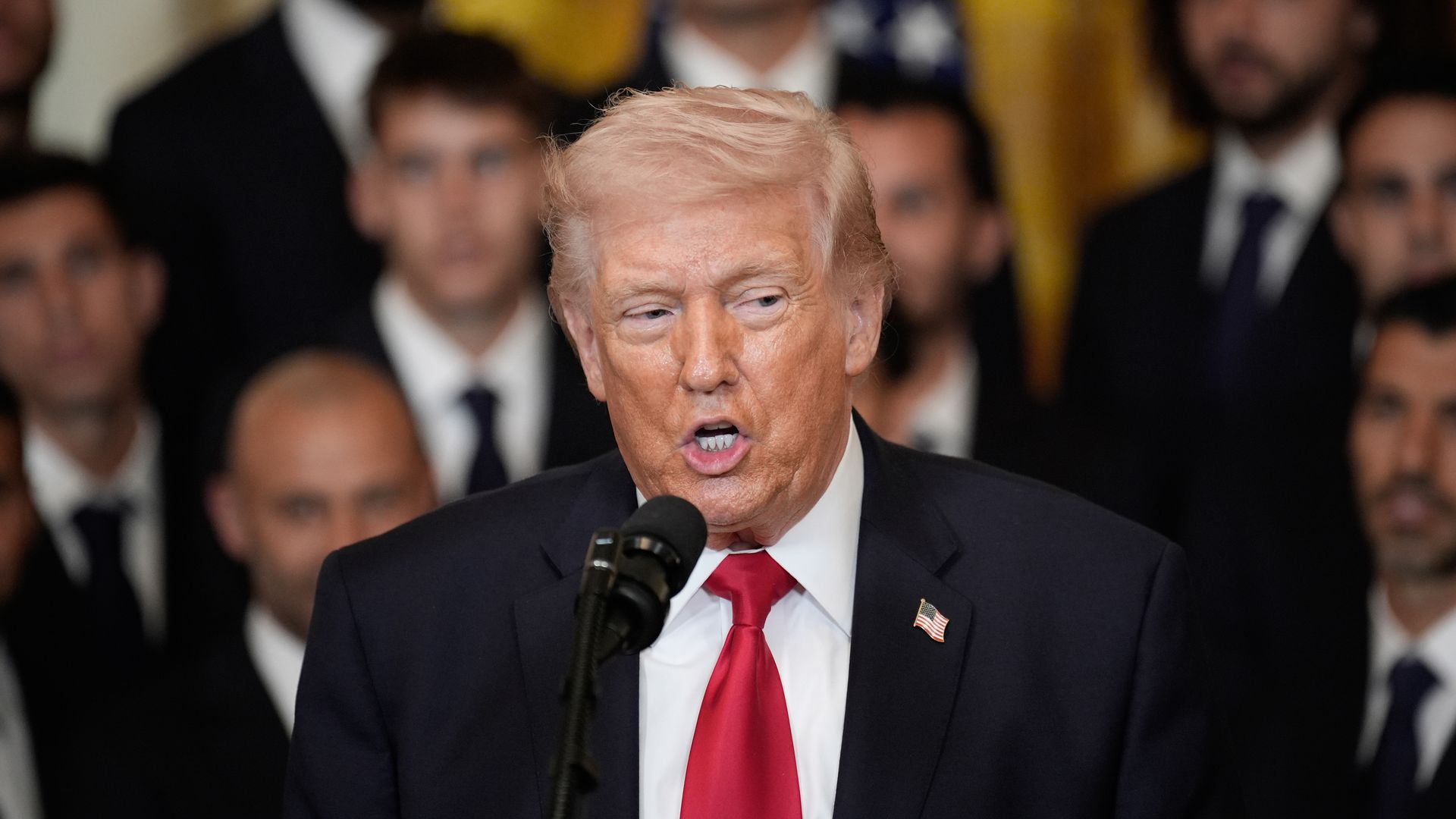
Photo: Yuri Gripas/Abaca/Bloomberg via Getty Images
President Trump told Axios Friday that his demand for Iran's "unconditional surrender" could mean the complete destruction of the regime's military capabilities — not necessarily a formal surrender.
- "Unconditional surrender could be that [the Iranians] announce it. But it could also be when they can't fight any longer because they don't have anyone or anything to fight with," he said in a phone interview.
Why it matters: Trump's explanation came hours after he appeared to leave no visible off-ramp for Iran, ruling out any kind of "deal" as he demanded "UNCONDITIONAL SURRENDER" in a post on Truth Social.
- White House press secretary Karoline Leavitt later said on Fox News that "unconditional surrender" means Trump determining "that Iran can no longer pose a threat to the U.S. and our troops in the Middle East."
- Leavitt listed U.S. objectives as destroying Iran's navy, eliminating its ballistic missile threat, ensuring it cannot obtain a nuclear weapon and weakening its regional proxies.
Driving the news: Several hours before Trump's statement, Iranian President Masoud Pezeshkian wrote on X that "some countries have begun mediation efforts" to stop the war.
- "Let's be clear: we are committed to lasting peace in the region yet we have no hesitation in defending our nation's dignity & sovereignty. Mediation should address those who underestimated the Iranian people and ignited this conflict," he wrote.
What they're saying: "There will be no deal with Iran except UNCONDITIONAL SURRENDER!" Trump wrote on Truth Social Friday morning.
- He added that after the current regime surrenders, "GREAT & ACCEPTABLE Leader(s)" must be selected.
- Trump pledged that the U.S. and its allies would help rebuild the country and make it prosperous after the war: "IRAN WILL HAVE A GREAT FUTURE. MAKE IRAN GREAT AGAIN (MIGA!)" he wrote.
Zoom out: On Thursday, Trump told Axios he wants to be personally involved in selecting Iran's next supreme leader to ensure the successor doesn't pursue policies that lead to another war.
The other side: The speaker of the Iranian Parliament Mohammad Bagher Ghalibaf wrote on X that Iran will not allow Trump to "dictate terms to a nation."
- "Trump still doesn't realize what calamity he has brought upon himself and the American soldiers by martyring our Imam," he said, adding that Iran's fate "will be determined solely by the proud Iranian nation, not by Epstein's gang."
Between the lines: "If this is the official position of the U.S. administration, and given the fact that the current regime in Iran will not surrender, then the campaign will have to continue until the collapse of the current regime," said Danny Citrinowicz, an Iran expert at Israel's Institute for National Security Studies and the Atlantic Council.
- "Anything short of that would effectively be considered a failure, despite all the operational successes of the campaign," he added.
Behind the scenes: Secretary of State Marco Rubio told Arab foreign ministers in a series of phone calls Thursday that the war is expected to last several more weeks, according to sources with direct knowledge of the conversations.
- Rubio said the current military focus is on Iran's missile launchers, stockpiles and factories.
- He told the ministers the U.S. goal is not regime change — while simultaneously making clear Washington wants different people running the country, the sources said.
Rubio added that there is currently no U.S. dialogue with the Iranian regime, and that any talks now would undermine ongoing military objectives.
- Trump said Thursday that Iran wants to negotiate but that he told them they are "too late."
- The State Department didn't immediately respond to a request for comment.
State of play: U.S. and Israeli strikes entered their seventh day Friday with growing intensity. Iran and its proxies — Hezbollah in Lebanon and Shia militias in Iraq — continue launching missiles and drones at U.S. bases, Israel and Gulf states.
- But the pace and scope of Iranian attacks has significantly decreased: CENTCOM commander Adm. Brad Cooper said Iranian missile attacks have fallen 90% since the war's first day.
- U.S. and Israeli officials claimed Thursday that 60% of Iran's missile launchers and stockpiles have been destroyed.
On Friday, Israeli fighter jets struck a heavily fortified bunker beneath the late Supreme Leader Ali Khamenei's compound — his emergency command center.
- IDF spokesman Brig. Gen. Efi Defrin said Israel believes senior Iranian officials had been using the bunker in recent days and is still assessing whether anyone was inside at the time of the strike.
Editor's note: This story has been updated with responses from Iranian officials.
