Inside Democrats' long game on Iran


Add Axios as your preferred source to
see more of our stories on Google.
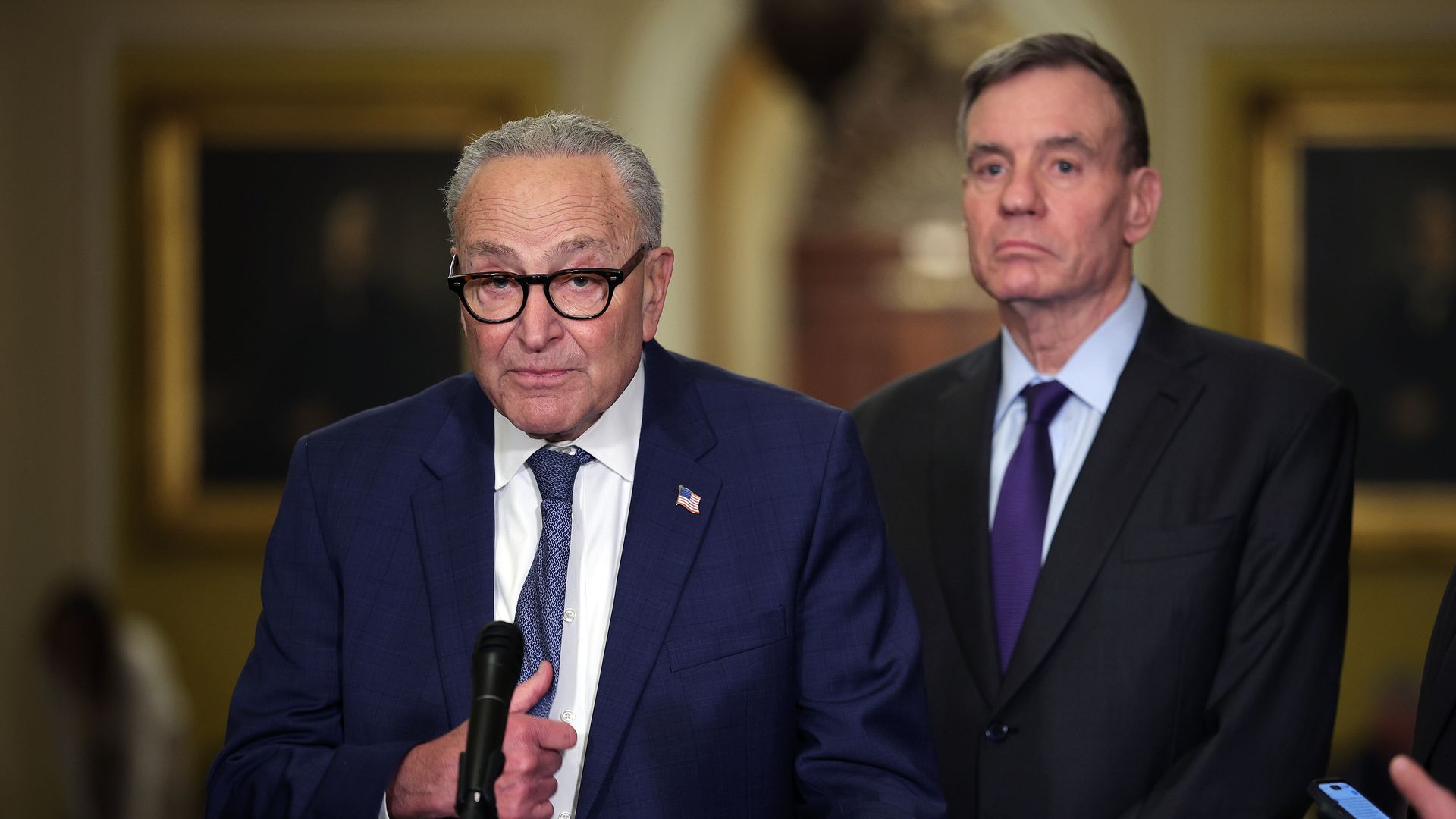
Senate Minority Leader Chuck Schumer, joined by Intelligence Committee Chair Mark Warner, speaks during a news conference at the U.S. Capitol in January. Photo: Kevin Dietsch/Getty Images
Senate Democrats expect to lose a symbolic vote this week to check President Trump's authority to strike Iran. They're preparing for a bigger fight over the war's funding.
Why it matters: The War Powers Resolution vote, which could come as soon as Tuesday, will unite the Democratic Party on process. But a potential funding debate could expose deeper foreign policy disagreements in the party.
- Sen. Bernie Sanders (I-Vt.), a leading progressive critic of Trump's foreign policy, told Axios on Monday that Democrats need to focus on "the purse strings" in trying to push back against the war in Iran.
- Sen. Ruben Gallego (D-Ariz.) said on X on Sunday that "when the bill comes" for Trump's military action, "the middle eastern countries that we have been protecting need to pay for it."
Driving the news: After being briefed by administration officials Monday afternoon, House Speaker Mike Johnson (R-La.) said Congress may need to consider a supplemental appropriations package down the line.
- "There are more details to be determined on how long the operation goes and what the need is," Johnson told reporters.
- Sen. Jeanne Shaheen (D-N.H.), the top Democrat on the Senate Foreign Relations Committee, told Axios that while she hasn't heard whether a supplemental will be needed, the U.S. is "spending a lot of money in the Middle East."
- "Let's wait. Let's play one step at a time," said Sen. Gary Peters (D-Mich.). "Let's deal with the War Powers first."
State of play: Secretary of State Marco Rubio and CIA Director John Ratcliffe briefed senior lawmakers from both parties ahead of separate briefings for the full House and Senate on Tuesday.
- Lawmakers left the briefings with starkly different views, with Senate Minority Leader Chuck Schumer (D-N.Y.) calling the Trump administration's justification for the use of force inadequate.
- "I found the answers completely and totally insufficient," Schumer said. "In fact, at least to me, that briefing raised many more questions than it answered."
Zoom out: Just as Democrats — with the exception of Sen. John Fetterman (D-Pa.) — are expected to support the War Powers Resolution, Republicans look to be united on opposing it — with the exception of Sen. Rand Paul (R-Ky.).
- "What this administration has done is consistent with what previous administrations have done, and in prior conflicts," Senate Majority Leader John Thune (R-S.D.) told reporters.
- It was addressing a "national security issue that needed to be addressed," Thune said.
Zoom in: Sen. Josh Hawley (R-Mo.), who initially supported a War Powers Resolution on Venezuela, announced he would oppose one on Iran.
- Sen. Thom Tillis (R-N.C.) and Lisa Murkowski (R-Alaska) told reporters they were still undecided.
- Centrist Democrats also said they would support the resolution. That includes the likes of Sen. Chris Coons (D-Del.) and Jacky Rosen (D-Nev.).
The bottom line: The War Powers Resolution is expected to fall along party lines in the Senate.
- A funding fight will be less predictable but more consequential.
