Senate Dems united on Iran procedure but not policy


Add Axios as your preferred source to
see more of our stories on Google.
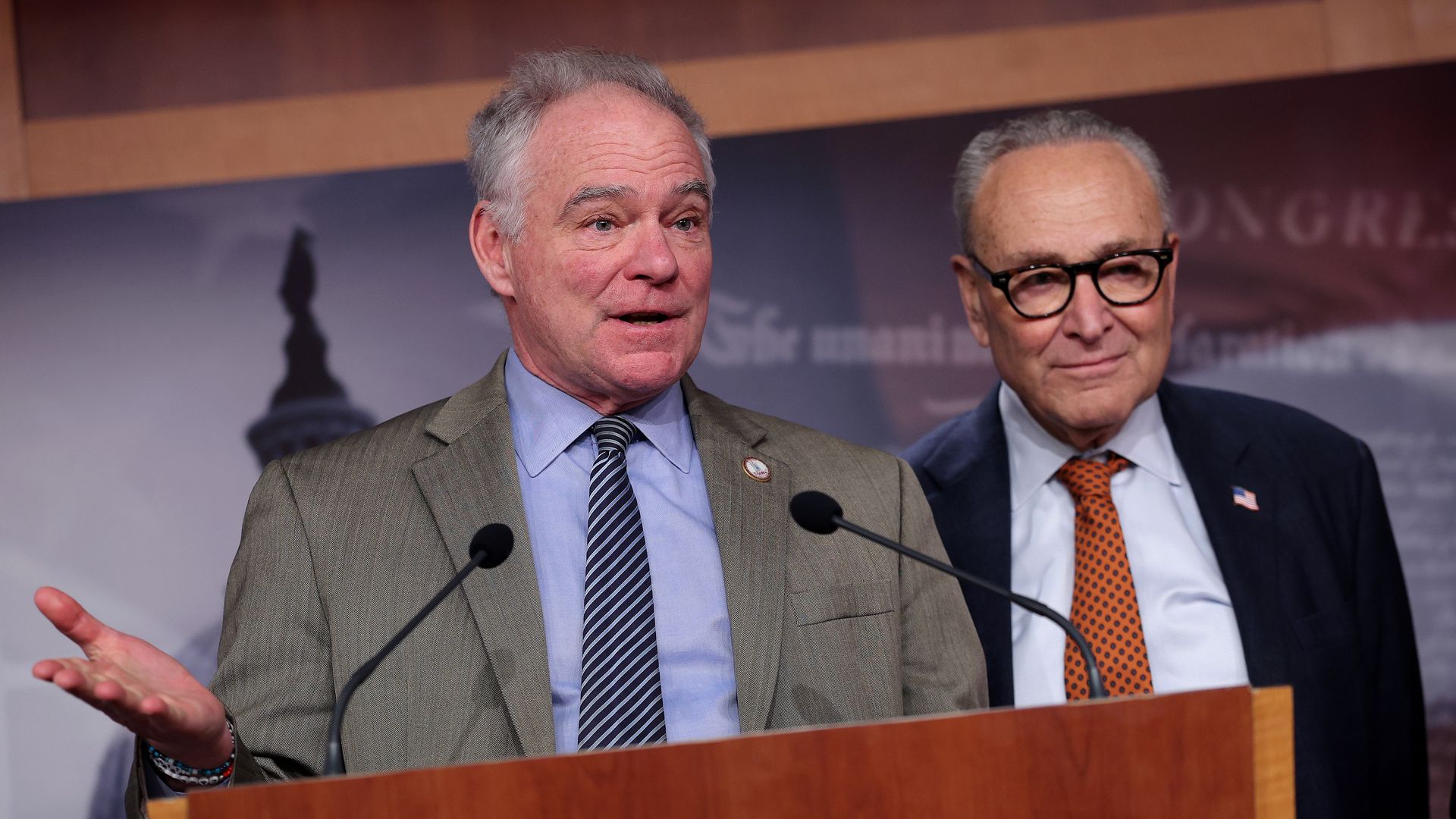
Sen. Tim Kaine (left) and Senate Minority Leader Chuck Schumer at a U.S. Capitol news conference on Jan. 8. Photo: Kevin Dietsch/Getty Images
A potential U.S. strike on Iran is exposing a quiet but consequential split inside the Senate Democratic caucus.
Why it matters: The Democratic base strongly opposes war with Iran, but some of Senate Minority Leader Chuck Schumer's (D-N.Y.) colleagues are more open to military action — provided Congress has a say.
- Nearly all Democrats are insistent that Congress needs to be consulted, but they are less clear on whether the U.S. should strike Iran to thwart its nuclear ambitions.
- Schumer, like many of his colleagues, is avoiding complicated policy questions by emphasizing Democratic unity on procedural matters.
- Asked by Axios whether he personally supports a strike on Iran, Schumer said: "The administration should come clean and tell the American people their goals." It's a line — and essentially a policy dodge — he's repeated all week.
Driving the news: Sen. Tim Kaine (D-Va.) plans to put senators on the record next week with a war powers resolution vote, which Schumer is cosponsoring, that would curtail President Trump's authority to strike Iran without congressional approval.
- Senate Republicans killed a similar Democratic effort in January to curb Trump's power to strike Venezuela, with Vice President Vance casting the tie-breaking vote.
Flashback: In 2002, Schumer voted to authorize the use of military force in Iraq, along with 29 of his Democratic colleagues. Only one other of the 29, Sen. Maria Cantwell (D-Wash.), is still in the Senate.
- Four of the 23 total "no" votes in 2002 are currently in the Senate: Sens. Dick Durbin (D-Ill.), Patty Murray (D-Wash.), Jack Reed (D-R.I.) and Ron Wyden (D-Ore.).
Zoom in: Moderate Democrats are more willing to leave the door open to military action, with an important caveat: Congress must be consulted.
- Sen. Jacky Rosen (D-Nev.) told Axios this week that Iran "should never have a nuclear weapon" but appealed to the Trump administration to "exercise every bit of diplomacy that we can first."
- Sen. Elissa Slotkin (D-Mich.), a member of the Senate Armed Services Committee and former CIA analyst, told Axios she's "ready to get the brief" and the president must "be really clear" about his goals.
But the party's left flank is loudly lining up against military action in Iran.
- "Donald Trump clearly did not learn the lessons about what happened in Iraq," Sen. Chris Van Hollen (D-Md.) told Axios this week. "He has never put forward a rationale for why America should go to war against Iran, because he doesn't have one."
- "Donald Trump does not have the authority, and he does not have the backing of the American people, to initiate a war with Iran," Sen. Elizabeth Warren (D-Mass.) told Axios.
- "You can't take out Iran's nuclear program without a ground invasion," Sen. Chris Murphy (D-Conn.) told Axios. "Nobody in this country supports a ground invasion."
The bottom line: The wars in Iraq and Afghanistan have turned both parties increasingly skeptical of military action in the Middle East.
- Trump rode some of those concerns to the White House, but he authorized strikes against Iran in June. In his first term, Trump also ordered the killing of Iranian General Qasem Soleimani.
- But with potential strikes in Iran in the coming days and a war powers vote next week, senators in both parties will be forced to go on the record on Iran.
