How Trump's Iran gamble breaks from past regime overthrows

Add Axios as your preferred source to
see more of our stories on Google.
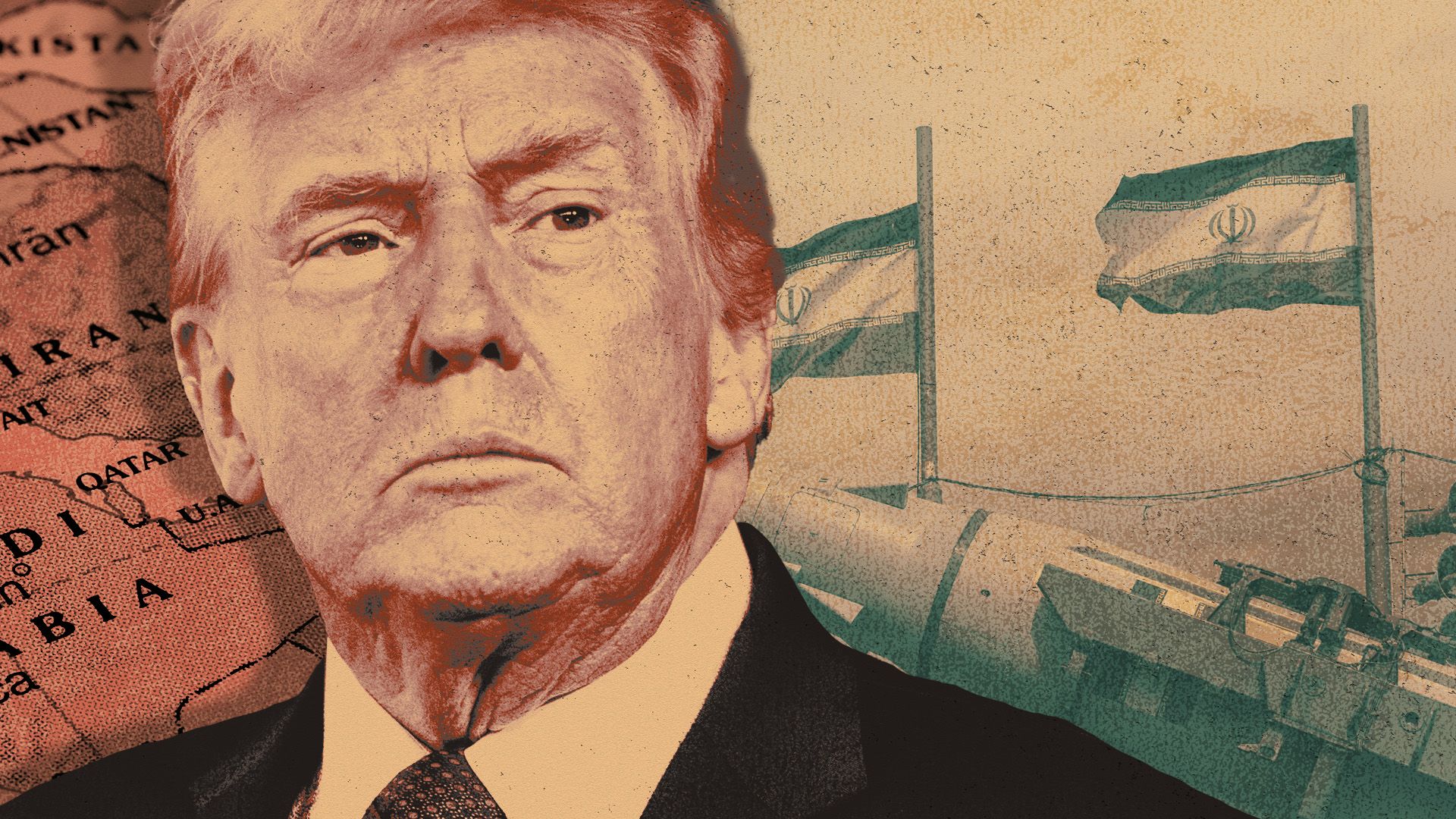
Photo illustration: Sarah Grillo/Axios. Photos: Majid Saeedi and Stefani Reynolds/Bloomberg via Getty Images
President Trump's bid to topple Iran's regime marks a sharp break from two decades of U.S. intervention playbooks across multiple presidencies.
The big picture: Trump's weekend strikes on Iran — and his explicit call for an uprising — diverge from how the U.S. approached regime pressure in Iraq and Venezuela, historians tell Axios. The gamble signals a more unpredictable stretch of his foreign policy ahead as he openly threatens force elsewhere.
- The U.S. and Israel announced Saturday that Ayatollah Ali Khamenei, the Supreme Leader of the Islamic Republic, was killed in an Israeli strike — throwing the future of the country's government into immediate uncertainty.
State of play: Trump announced military strikes against Iran on Saturday and vaguely called for Iranian people to overtake their government following months of their demanding a regime change amid worsening economic conditions.
- The attacks were a result of failed diplomacy over Iran's nuclear weapon supply as tensions mounted between the countries through Trump's second term.
After announcing the operation Saturday, Trump addressed Iranians in a video: "When we are finished, take over your government. It will be yours to take. This will be probably your only chance for generations."
- Trump exclusively told Axios the "off ramps" he envisions: "I can go long and take over the whole thing, or end it in two or three days and tell the Iranians: 'See you again in a few years if you start rebuilding [your nuclear and missile programs]."
Reality check: Trump's Iran play is different than the U.S. invasion of Iraq in 2003 under former President George W. Bush and the seizure of Venezuela's leader Nicolás Maduro in January — two instances where the U.S. took a more direct hand in dismantling a government's power structure.
- "Iran is different from both of those conflicts," retired U.S. Army Colonel Peter Mansoor, professor of military history at The Ohio State University, tells Axios.
Both regime overthrows, the historians said, were done with future government infrastructure in mind — which is less clear in the Iran crisis so far.
- "As General David Petraeus remarked at the beginning of the Iraq War in 2003, 'Tell me how this ends,'" Mansoor said.
Read more below.
Differences with Iraq War
When former President Bush sought to overthrow Saddam Hussein's regime in Iraq, he started with a full-scale invasion that included deploying 200,000 American ground troops in March 2003.
- Baghdad fell within weeks, and Hussein was captured just under nine months later in December 2003.
The U.S. coalition against Iraq had specific objectives: removing Hussein from power and eliminating alleged weapons of mass destruction.
- The U.S. led an interim government before power was eventually transferred — though this came after many years of war. Full Iraq sovereignty began after the U.S. withdrew forces in 2011.
The Iraq War is "an example of some of the faulty assumptions that go into the idea that replacing the political leadership of another country can happen quickly and easily," David Kieran, a military history professor at Columbus State University, tells Axios.
The other side: With Iran, Trump isn't suggesting the U.S. controls the government or puts boots on the ground. So far, his suggestions tease Iranians taking back control on their own.
Differences with Venezuela
Trump's decision to topple Venezuela's regime in January included some boots on the ground, too.
- The U.S. framed the capture as a law enforcement operation based on U.S. indictments of Maduro, as well as his illegitimacy as Venezuelan leader stemming from the country's sham 2018 election.
- Privately, White House officials viewed the removal of Maduro as a key aim, Axios' Marc Caputo reported.
The U.S. had an endgame in mind, says Kieran.
- "They removed Maduro through a special forces raid, but largely left the Venezuelan government intact," says Kieran.
With Venezuela, Trump said the U.S. will have oversight over the transition of power and its future elections — something that could last for months.
- The U.S. also snatched de facto control of oil production in Venezuela, which has the largest crude reserves in the world.
- This is a break from how the Trump admin is handling Iran so far. Trump hasn't suggested taking control of the Iranian government, nor indicated any invasions as was the case with Venezuela.
What we're watching: Cuba
Trump has teased action against Cuba on multiple occasions since the Venezuela raid, making it clear he wants the Cuban regime gone.
- But Trump said that the U.S. might hold off from any action because he believes the country might fall by its own doing.
"Cuba looks like it's ready to fall," he said, adding: "I don't think we need any action. It looks like it's going down."
The future of Iran
A succession plan remains unclear for Iran following the supreme leader's death.
- Under Iran's constitution, a council of clerics must select a new supreme leader. However, the typical chain of command involving senior Islamic Revolutionary Guard Corps (IRGC) commanders remains in disarray amid the chaos.
- Iranian ally China is "highly concerned" over the strikes, according to reports, and Russia's Foreign Ministry called the attack "a preplanned and unprovoked act of armed aggression against a sovereign and independent U.N. member state."
Protesters in Iran have shown few signs of mounting an offensive against the government yet, says Suzanne Maloney, a senior fellow at the Brookings Institution who studied Iran for 30 years.
- "I'd be surprised if we see significant defections or other conditions that would permit an uprising to succeed today," Maloney tells Axios.
At least 200 people have been killed and more than 700 injured from the strikes as of Saturday afternoon, the AP reports.
- Iranian foreign minister Seyed Abbas Araghchi said Israeli strikes hit a girls' school, leading to 53 students killed and 63 wounded.
- Iran has retaliated against U.S. bases, with Araghchi saying that "Iran will punish those who kill our children."
- "We do not understand the reasons for the U.S. attack on Iran. Perhaps the U.S. administration was dragged into it," he wrote on X.
What to watch: "It's not clear whether this regime will fall, or whether this regime would depart, would step down, because of these bombings," says Kieran. "And the real question also is, what it would replace it?"
Go deeper: 6 ways Trump escalated military force in his second term
