Which states paid the most of Trump's overturned tariffs

Add Axios as your preferred source to
see more of our stories on Google.
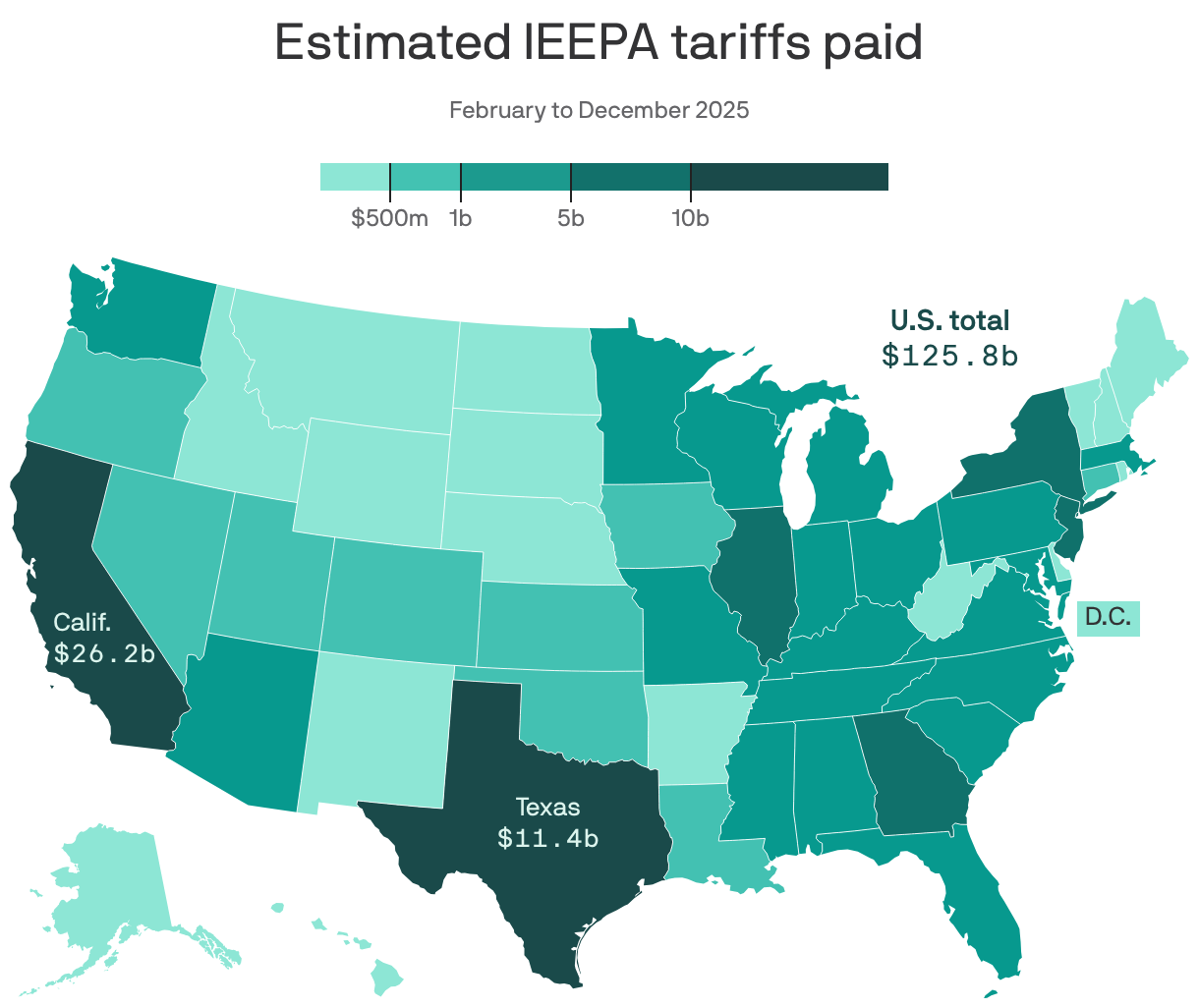
Roughly $126 billion is now potentially up for grabs after the Supreme Court struck down a swath of President Trump's tariffs on Friday, according to the Trade Partnership Worldwide.
Why it matters: Those tariffs likely made all kinds of stuff more expensive as businesses passed higher costs onto everyday Americans, but the ruling now could lead to a chaotic refund process — and it's unclear who gets to pocket that cash.
- The Supreme Court ultimately left that question to the Trump administration in its ruling. "The Court says nothing today about whether, and if so how, the government should go about returning the billions of dollars that it has collected from importers," Justice Brett Kavanaugh wrote in his dissent.
- Economists at TD Securities view the refund process as "highly unclear" and estimate that it could take up to 18 months as cases make their way through the federal court system.
The big picture: Uncertainty still abounds. The sweeping global tariffs overturned by the Supreme Court were instituted under a previously untested law, the International Emergency Economic Powers Act (IEEPA) — but they don't make up the entirety of Trump's tariff agenda.
- The administration has also adopted tariffs under more tried-and-true portions of the Trade Act of 1974, like section 232 (focused on specific products, like steel and aluminum) and section 301 (focused on specific countries).
- Trump responded to the ruling by saying he would sign an executive order to impose a blanket 10% tariff on all nations under section 122, which allows him to impose tariffs of up to 15% for 150 days to address trade deficits or a dollar crisis.
State of play: The overturned IEEPA tariffs mean that billions of dollars are now in limbo across America, according to economic research firm Trade Partnership Worldwide, based on trade from February to December 2025.
- That impact was largest for some of the biggest states, with California leading the way with $26 billion paid in IEEPA tariffs. It was followed by Texas ($11.4 billion), Georgia ($7.1 billion), Illinois ($6.7 billion) and New York ($6.7 billion).
How it works: The group uses data from the Census Bureau and the U.S. International Trade Commission to determine the tariffs that should be paid and then estimates excess tariff payments by using state-level census import data to assign them by product, country and month paid.
- It says their estimated totals are likely conservative because it assumed any product subject to both IEEPA and another tariff authority, like section 202, fell under the latter. It also doesn't account for any IEEPA tariffs paid so far in 2026.
The bottom line: A lot of people around the country are due some amount of cash back, but no one has any idea just yet who will get that money or when they might see it.
Editor's note: This story and map have been corrected to show that the paid national estimated IEEPA tariffs were roughly $126 billion (not $136 billion).
The specific figures for California, Texas, Georgia, Illinois and New York have also been corrected.
