SCOTUS may erode a key Voting Rights Act tenet. What to know about the law

Add Axios as your preferred source to
see more of our stories on Google.
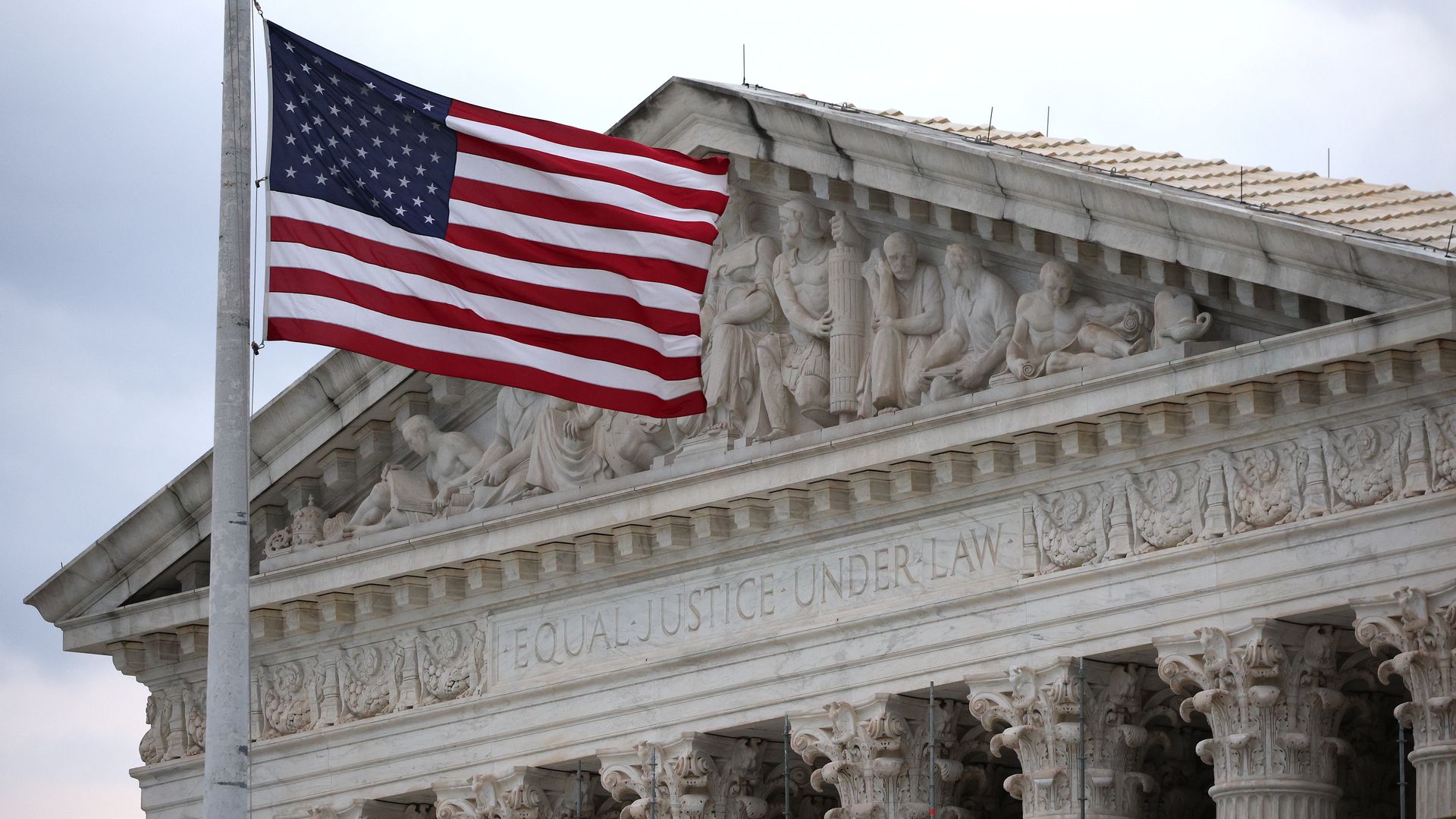
The Supreme Court's conservative majority on Wednesday appeared receptive to the Trump administration's arguments in the Louisiana v. Callais case. Photo by Win McNamee/Getty Images
The Supreme Court on Wednesday seemed open to weakening, or even killing, a key part of the Voting Rights Act.
Why it matters: The high court could limit Section 2 of the landmark 1965 law, which has historically preserved and expanded the political power of Black Americans.
- If it guts one of the last federal protections for Black political power, it would undo decades of hard-won gains born out of the violence of Jim Crow, per Axios' Delano Massey.
- Limiting or eliminating Section 2 would open the door to gerrymandering in red states, potentially eliminating many House seats currently held by Democrats.
Driving the news: The court's conservative majority appeared receptive to the Trump administration's arguments in the Louisiana v. Callais case.
- The Trump administration and Louisiana attorneys argued that race played an outsized role in the decision to designate a second majority-Black congressional district in the state, saying that its creation violated the Constitution's provision that all people must be treated equally.
Between the lines: The Trump administration is invoking the 14th Amendment's "equal protection" clause in a way that flips its intent — using it to argue against race-conscious remedies meant to ensure equality.
What we're watching: An official ruling is expected next summer.
Here's what to know:
The Voting Rights Act of 1965
In 1965, President Lyndon B. Johnson signed the VRA into law with bipartisan support, one of the key moves that ended the Jim Crow era.
- Johnson signed the law after the attack on unarmed peaceful demonstrators in Selma, Alabama.
Context: The VRA was born out of the Civil Rights Movement to enforce the 14th Amendment's promise of equal protection after centuries of legalized discrimination.
- At the time, the law served as a powerful force to address barriers to Black voters, who faced state-sanctioned barriers via policies like poll taxes and complicated literacy tests.
- Those tests were disproportionately administered to Black voters by white clerks, who could fail them arbitrarily.
- Black voters also faced white supremacist violence from groups like the Ku Klux Klan, who terrorized them leading up to elections.
The VRA's passage had a significant, immediate impact, on Southern states in particular.
- Black voter registration rates in Mississippi increased from 6.7% in 1965 to 59.8% in 1967, per the US Commission for Civil Rights.
State of play: A backlash to the 2020 racial reckoning has made it almost impossible for any bipartisan effort to renew the VRA.
- Since taking office, President Trump has attempted to reverse many of the gains made during the Civil Rights Movement and unravel Johnson's civil rights legacy.
Meanwhile, Republican-leaning states have passed bills in recent years that impose de facto restrictions on voters of color.
Section 2
Section 2 prohibits voting practices or procedures that discriminate on the basis of race, color, or membership in minority groups outlined in the law.
- It has historically opened the door for people to bring voting discrimination claims to federal courts.
Flashback: In 1982, Congress said a plaintiff could prove a violation of Section 2 through evidence that a certain standard, practice, or procedure denied a qualifying minority "an equal opportunity to participate in the political process," per the Justice Department.
By the numbers: Since 1982, 466 Section 2 cases have resulted in published decisions or opinions available on major legal databases, the University of Michigan Law School's Voting Rights Initiative found in 2023.
- More cases addressed vote "dilution" (e.g. districting plans) than "non-dilution" (e.g. challenges to election procedures like voter ID and early voting).
- It's been harder for plaintiffs to succeed in recent years, per the University of Michigan.
What they're saying: Section 2 is "critical to ensuring an equal voice and an equal vote for all Americans throughout the country, no matter their race or neighborhood or beliefs," Alan Jenkins, a professor and constitutional law expert at Harvard University, told Axios.
- "The U.S. Supreme Court should recognize both the history and the current necessity of a strong voting rights act, and continue to uphold its full promise."
Why Section 2 is on the chopping block
Zoom out: Louisiana started off as a narrow challenge to one congressional district, but it has grown to encompass the Trump administration's broader attacks on civil rights protections.
- Trump has pushed baseless claims about voter fraud and signed an executive order to tighten voting restrictions in March.
- He has pressured states like Texas to redraw congressional district boundaries to favor Republicans, which has led to a redistricting cold war between blue and red states.
Context: Louisiana's legislature drew a map after the 2020 Census that only included one majority-Black district. Black voters sued, challenging the map under the VRA.
- Courts agreed that the map likely violated the Act. So Louisiana drew a new one, adding a second district of primarily Black voters.
- Then a group of self-described "non-African American" voters sued, claiming that adding the second district had watered down their voting rights, and these seem likely to win.
Of note: Some conservative justices argue the relevant part of the Act is unconstitutional because it allows for the use of race in policy decisions.
- "This Court's cases, in a variety of contexts, have said that race-based remedies are permissible for a period of time — sometimes for a long period of time, decades in some cases — but that they should not be indefinite and should have a end point," Justice Brett Kavanaugh said during oral arguments.
Go deeper: Voting Rights Act's 60th anniversary comes amid uncertainty
Editor's note: This article has been updated with more context.
