How Texas redistricting could prove risky for Republicans


Add Axios as your preferred source to
see more of our stories on Google.
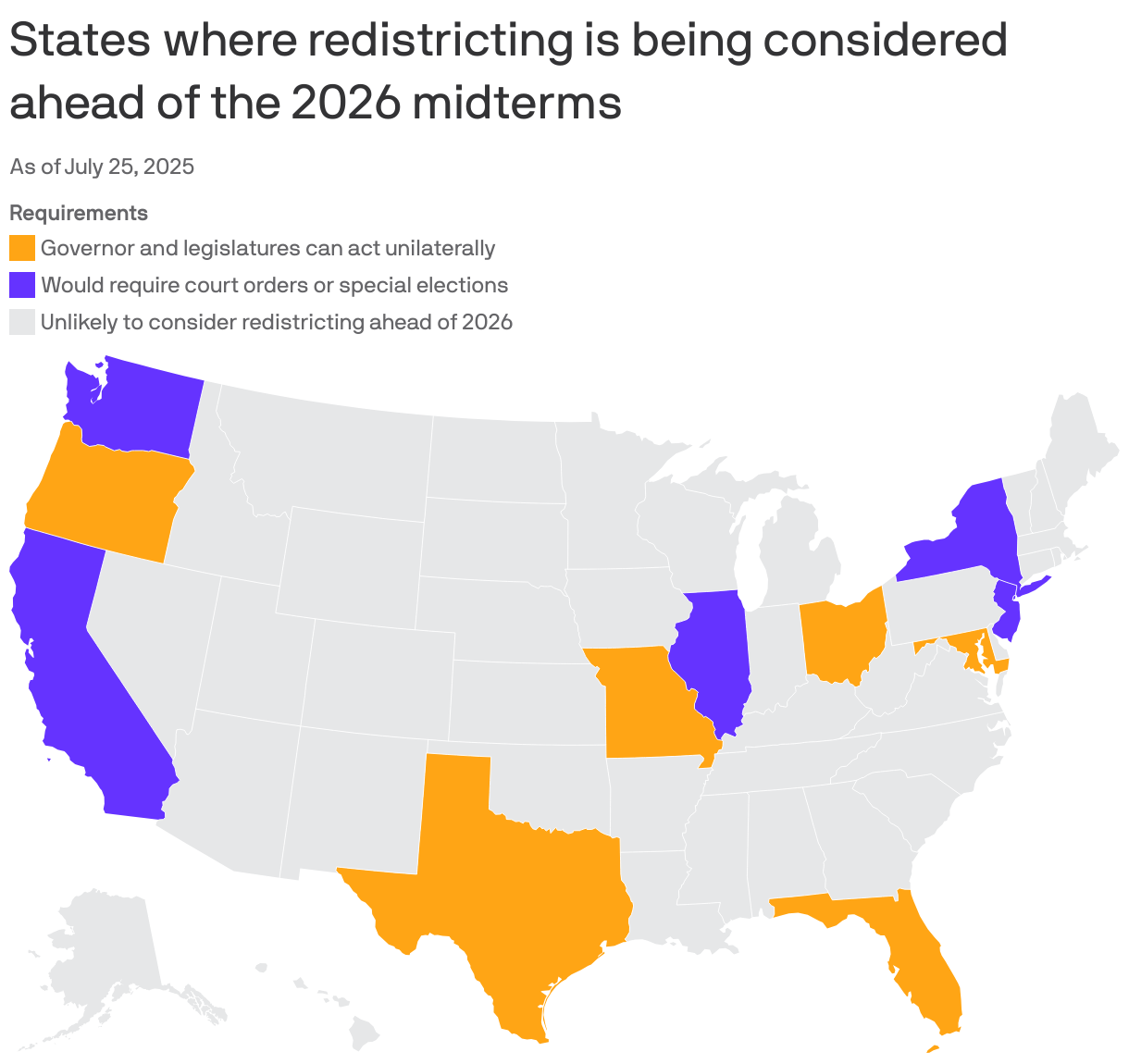
Texas Republicans' move to redraw congressional district boundaries in the middle of the decade could backfire on them.
Why it matters: Everything starts with Texas. The push to add up to five GOP House seats here is sparking a chain reaction as the parties fight tooth-and-nail over the majority.
- Redistricting is usually done after the census, next scheduled for 2030.
State of play: Midterm elections are typically a tougher playing field for the party in power. Democrats are eyeing taking back the House in 2026.
- If safe Republican districts in Texas are diluted with Democratic voters to build Republican districts elsewhere, then reliable seats could turn competitive for Republicans, Jon Taylor, department chair and political science professor at the University of Texas at San Antonio, tells Axios.
Between the lines: Gov. Greg Abbott and other state Republicans were at first hesitant to take up the issue, the Texas Tribune reported. After President Trump called Abbott, it appeared on the agenda of the special session that started a week ago.
What they're saying: "Given the kind of election that's taking place, given the issues that may be in play, they may be in for an unpleasant surprise," Taylor says of the Republican Party.
- "They are putting everything at risk in this special session by putting this on the agenda."
Zoom in: The Cook Political Report says the most obvious targets are the 28th and 34th congressional districts in South Texas, represented by Democratic U.S. Reps. Henry Cuellar and Vicente Gonzalez, respectively.
- Taylor also thinks Republicans could "radically" redraw the 35th Congressional District, represented by Democratic U.S. Rep. Greg Casar, which runs from East Austin to San Antonio along Interstate 35.
- Other potential targets: the 32nd and 37th districts, represented by Democratic U.S. Reps. Julie Johnson of the Dallas area and Lloyd Doggett of Austin.
- Republicans who could gain Democratic voters include U.S. Reps. Tony Gonzales, whose sprawling district extends from San Antonio to El Paso, and Chip Roy, whose district encompasses much of the conservative Hill Country but includes portions of Austin and San Antonio.
What we're watching: Republicans are looking to South Texas after Trump performed well with Latino voters there.
- But Taylor says it isn't a given that they will continue to prefer Republicans.
- Hispanic adults give Trump's handling of immigration a lower approval rating (21%) than the national rating (35%), per a Gallup poll conducted in June.
Zoom out: Republicans in other states, including Ohio and Missouri, are now looking to redraw their maps to gain an advantage.
- Democrats, led by California Gov. Gavin Newsom, have vowed to punch back by drawing roughly as many new Democratic seats.
The bottom line: There's already a warning sign for Republicans as they weigh redistricting.
- The top concern among Texas voters is no longer immigration or border security — for years, winning issues for the GOP — according to the Texas Politics Project Poll in June.
- It's now "political corruption/leadership."