States expand fertility coverage for cancer survivors

Add Axios as your preferred source to
see more of our stories on Google.
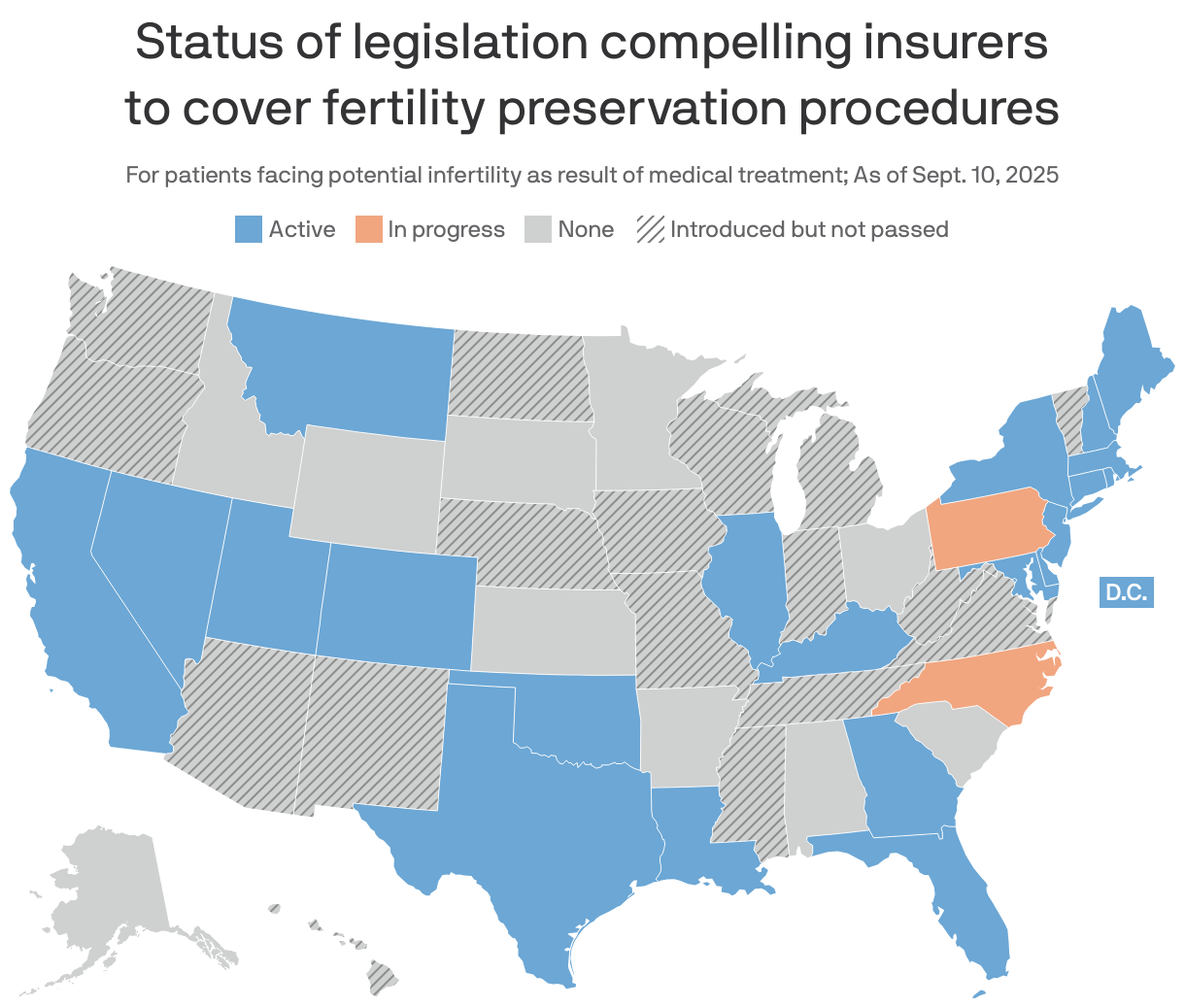
A wave of new state laws is making fertility preservation procedures — from egg freezing to the emerging ovarian tissue freezing technology — a covered benefit for cancer patients.
Why it matters: Chemotherapy and radiation can cause reproductive problems, but fertility preservation procedures are costly and can be left out of cancer treatment conversations.
State of play: As more Americans survive cancer at younger ages and delay parenthood, demand for oncofertility care — a field bridging oncology and reproductive medicine — is rising.
By the numbers: 21 states and Washington, D.C., now require insurers to cover fertility preservation for medical reasons, per the Alliance for Fertility Preservation.
- There was legislative action this year in Georgia, Virginia and New York, and executive director Joyce Reinecke tells Axios she's "hopeful" that laws are passed in Hawaii and Washington next.
Between the lines: Coverage rules vary by state, including which insurers must comply, which procedures are included, and which diagnoses qualify patients for coverage.
- "Experimental" procedures are rarely covered by insurance.
Established fertility preservation options include freezing eggs or embryos, the most common approach for women; and freezing sperm, standard for men.
Emerging technology includes:
- Freezing ovarian tissue: Includes ovarian removal before cancer treatment and reimplantation after treatment. (A few hundred babies have been born around the world from this technology, which was considered experimental until 2019.)
- In vitro maturation: Immature eggs are collected and grown to later be merged with sperm and become embryos. (It's no longer "experimental" as of 2021.)
- Uterine displacement: Removing the uterus from the field of radiation, and then putting it back in. (This is still an "investigational" procedure, says H. Irene Su, a professor of obstetrics, gynecology and reproductive sciences at UC San Diego School of Medicine.)
- Creating good egg and sperm cells out of other cells, like skin cells. ("That's a ways away," Su tells Axios.)
What we're watching: The American Society of Clinical Oncology (ASCO) has expanded its fertility preservation guidelines, and the American Society for Reproductive Medicine (ASRM) is expected to update its guidelines soon, which could push more insurers to cover these services.
