Modi vows to "deepen partnership" with Putin after Trump's tariffs


Add Axios as your preferred source to
see more of our stories on Google.
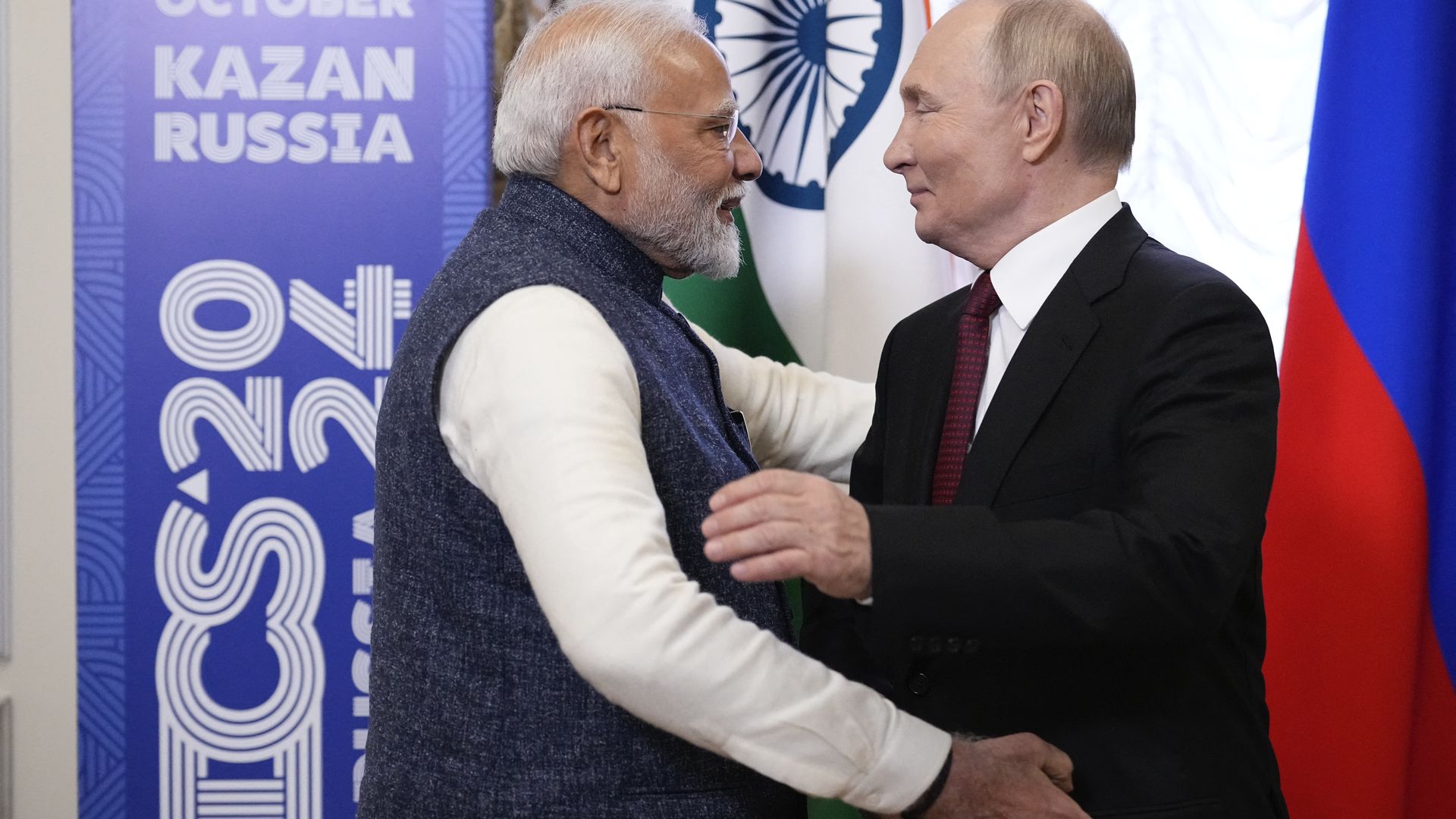
Modi and Putin at the 2024 BRICS summit. Photo: Alexander Zemlianichenko/Pool via Getty
The 50% tariffs President Trump announced this week were officially designed to drive a wedge between India and Russia, but so far the only rupture they've caused is with the United States.
Why it matters: The steep levies over India's purchases of Russian oil are threatening to unravel years of calculated U.S. efforts to position New Delhi as a bulwark against China.
- New Delhi has signaled it won't stop buying Russian oil any time soon — but it has frozen plans to purchase arms from the U.S. and canceled a high-level defense visit to Washington, per Reuters.
- The sudden split is particularly jarring considering leaders from both parties — including Trump himself — spent more than a decade building up U.S.-India ties as a linchpin of their strategies to compete with China.
Driving the news: On Friday, Prime Minister Narendra Modi vowed to "further deepen" ties with Moscow following a "very good" call with his "friend" Vladimir Putin.
- A day earlier, Modi spoke with President Luiz Inácio Lula da Silva of Brazil, a fellow member of the BRICS and another of Trump's biggest tariff targets.
- Modi plans to visit China later this month for the first time in seven years, Beijing announced Friday, with Chinese state media citing a "warming" of ties. He'll also host Putin later this year.
Friction point: While Trump 1.0 was marked by mutual courtship between the two strongmen, Indian nationalists reacted with outrage after Trump started threatening tariffs and declared India's economy "dead."
- The Russia tariffs are all muddled together with trade talks, with Trump accusing India of unfair market practices in agriculture and Modi declaring India will "never compromise on the wellbeing of its farmers."
- The kindling was already dry after Trump's repeated claims that he brokered a ceasefire between India and Pakistan — a highly sensitive issue for India's nationalist government.
The intrigue: The India tariffs were supposed to be part of a larger sanctions package to impose costs on Russia.
- But within minutes of announcing them, Trump received an invitation to meet Putin and pivoted to engagement.
- Thus, Trump's long-promised package of penalties may not affect any other buyer of Russian oil, or even Russia itself. So far, only India gets hurt.
Particularly galling for New Delhi — there's another big customer for Russian oil whom Trump has not targeted: China.
- Treasury Secretary Scott Bessent noted this week that China already faces high tariffs and has negotiated a 90-day truce with the U.S., though he didn't rule out additional tariffs.
Breaking it down: Russia is India's primary supplier of oil, accounting for around 35% of imports, which India buys at a discount.
- Replacing those barrels would be difficult and expensive.
- Plus, Modi clearly has no desire to disrupt India's long-standing strategic relationship with Russia.
The bottom line: Common cause on China brought the U.S. and India together over the past decade. Differences on Russia and over Trump's tactics are pulling them apart much more quickly.
