U.S.-India ties grow as Delhi and Beijing remain icy

Add Axios as your preferred source to
see more of our stories on Google.
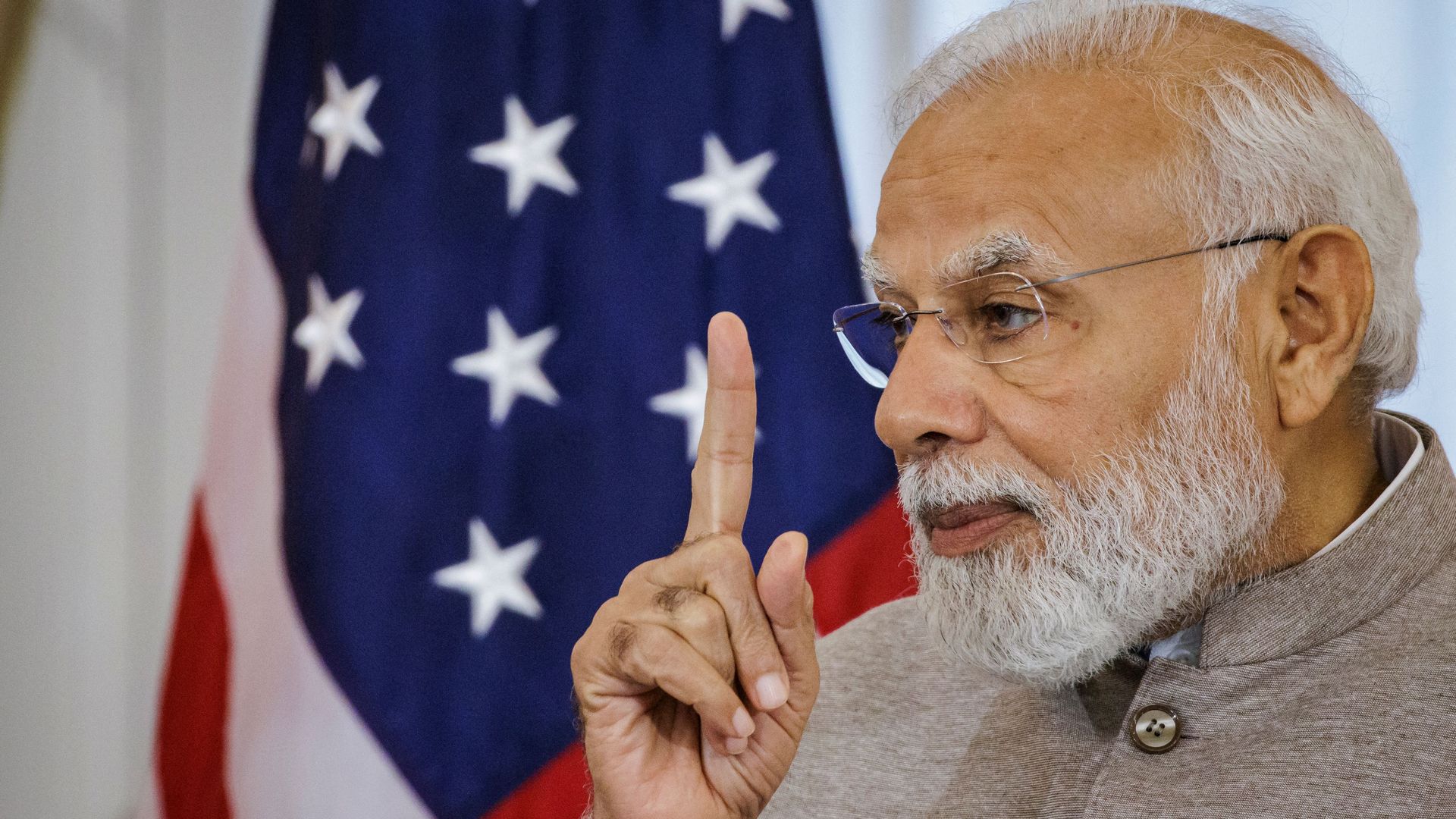
Indian Prime Minister Narendra Modi speaks during a luncheon at the U.S. Department of State in Washington, D.C., on June 23. Photo: Samuel Corum/AFP via Getty Images
Tensions between China and India have brought Delhi closer to Washington, with India joining democracies, including the U.S., Japan and Australia, to strengthen security and technology cooperation in the Indo-Pacific.
The big picture: The relationship between China and India has never been cozy, but over the past three years, ties have hit a new low amid border clashes, fears of regional influence and growing great power rivalry.
Driving the news: In the past two weeks, China and India both expelled the last remaining journalists hailing from the other's country, leaving no Chinese journalists in India. Chinese authorities are forcing the last Indian journalist in China to leave by the end of June.
What's happening: President Biden welcomed Indian Prime Minister Narendra Modi for a state visit last week.
- In a joint statement, the two leaders said the two countries are "among the closest partners in the world."
- Several major new commitments were announced, including a deal to build GE F-414 fighter jet engines in India for India’s next-generation indigenous fighter aircraft. India also signed the Artemis Accords, which promote international cooperation in space.
Background: The ongoing border dispute in the Himalayan region is the single most important factor in the deterioration of China-India ties. The two countries fought a brief war over disputed regions in 1962 and, though ties subsequently stabilized, have remained suspicious of each other ever since.
- But tensions escalated dramatically in 2020, when border clashes in the Galwan Valley resulted in the deaths of 20 Indian soldiers and at least four Chinese soldiers, the worst conflict there in decades.
- "The killing of those soldiers overnight shifted [Indian] government opinion and the calculus of what the government was willing to do," said Vikram Singh, senior adviser to the Asia Program at the United States Institute of Peace.
- Both sides began a military buildup at the border, and India also responded by banning dozens of Chinese apps, including TikTok, and introducing security screening for incoming Chinese investments.
- India believes that China is refusing to work toward a resolution or even acknowledge that the border dispute is a serious issue.
Pakistan's close ties to China are another serious thorn in Delhi's side. India sees Pakistan as its top threat. China helped Pakistan develop nuclear weapons several decades ago.
- India is also concerned about the China-Pakistan Economic Corridor, part of China's Belt and Road Initiative, which includes the construction of a deep-water port that gives China access to the Indian Ocean.
- "India feels surrounded on all fronts," said Sana Hashmi, a postdoctoral fellow at the Taiwan-Asia Exchange Foundation. "China has been trying to expand its economic and military footprint in India’s neighborhood, and that’s one of the most volatile regions in the world."
The other side: The Chinese government says the border region is stable and that India and China have maintained "smooth and constructive communication" on border issues.
- Liu Zongyi, a researcher at the Shanghai Institute of International Studies who specializes in India, says Hindu nationalism and the U.S. desire to pull India into an anti-China coalition are the primary causes of friction between India and China.
- An editorial in the Chinese state-backed media outlet Global Times criticized Modi's state visit, stating "becoming a pawn in US' containment of China does not align with India's interests and principles, nor does it preserve its dignity as a major power."
