Tsunami waves lash Hawai'i, U.S. West Coast, Japan, Russia after 8.8M quake

Add Axios as your preferred source to
see more of our stories on Google.
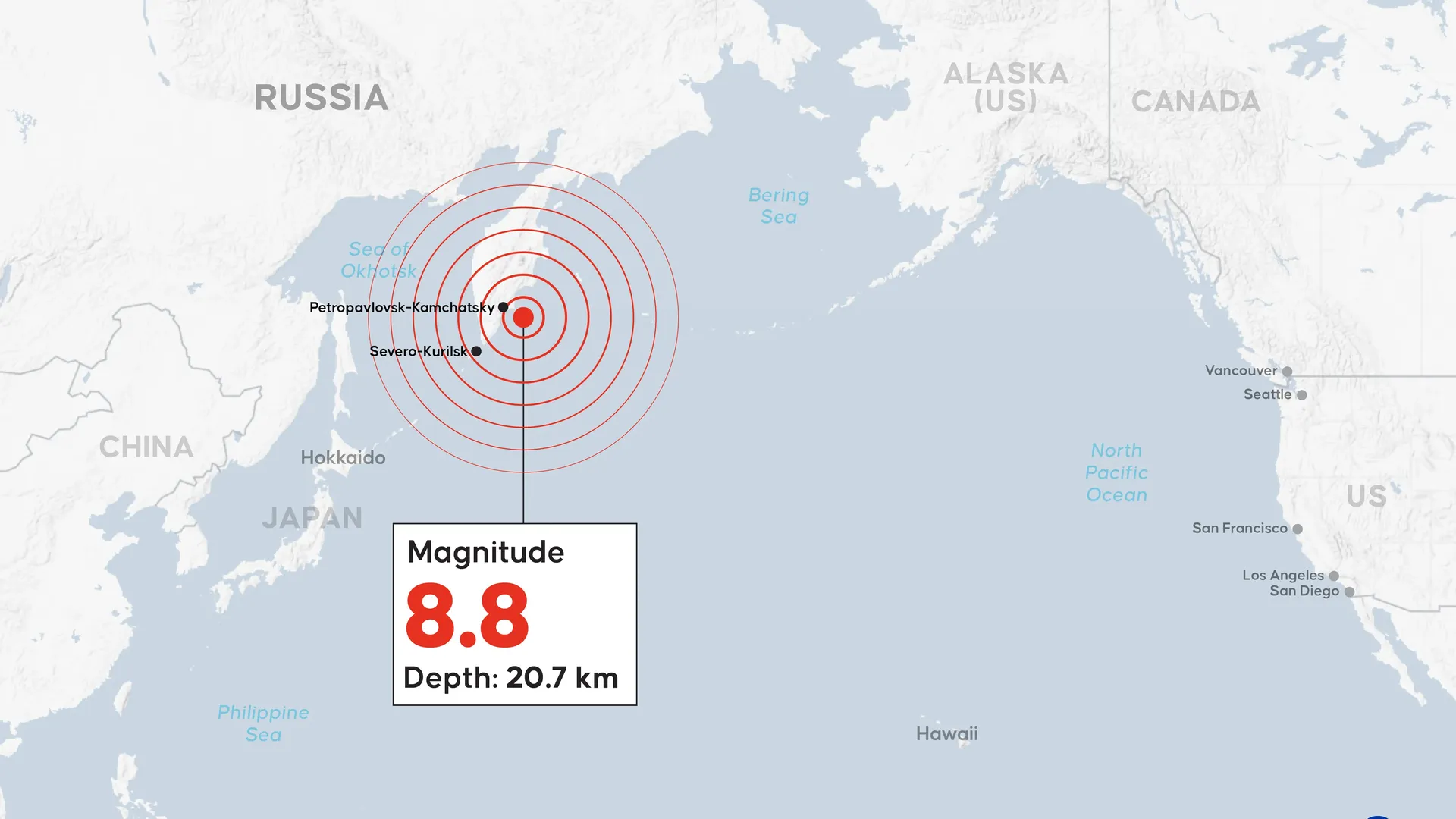
An infographic showing where the earthquake struck. Photo: Mehmet Yaren Bozgun/Anadolu via Getty Images
An estimated 8.8-magnitude earthquake struck off Russia's far eastern Kamchatka Peninsula Wednesday, triggering widespread tsunami warnings and evacuation orders along coastal areas in Japan and Hawai'i.
The big picture: Following one of the biggest quakes ever recorded, tsunami waves topping 5 feet were detected at Kaua'i Island, Hawai'i, and waves exceeding well over a foot were reported in several parts of California, where a tsunami warning remained in effect for the northern coast on Wednesday morning.
- Tsunami advisories were in effect for the San Francisco Bay Area and the most of California coast, along with the coasts of Oregon and Washington coast.
- A tsumani warning remained in place for Humboldt County and Del Norte County, California in the northwest corner of the state.
- The National Weather Service in Los Angeles warned that waves could return in Port San Luis throughout the next 24 hours. "The first wave may not be the largest," the NWS posted on X.
- In Hawai'i, the tsunami warning was downgraded to an advisory on Wednesday at about 5am ET.
Outside the U.S., officials in Russia, reported waves of more than 10 feet and said a tsunami had "flooded" parts of a port city following the quake that struck the sparsely populated region on Wednesday morning local time.
- Japan's meteorological agency reported waves of up to 2 feet along its Pacific coast, from Hokkaido to Tokyo Bay, and tsunami advisories were issued as far away as New Zealand.
- "Tsunami alerts were issued around the Pacific Basin," noted the U.S. Geological Survey on its social media accounts.
Zoom in: There were no immediate reports of casualties in Russia, but Sakhalin government said on Telegram "a state of emergency was declared in the Severo-Kurilsky District, where an earthquake and tsunami occurred today."
- Russia's Ministry of Emergency Situations said on Telegram that a tsunami had flooded parts of the port city of Severo-Kurilsk and that residents had been evacuated.
- Kamchatka Gov. Vladimir Solodov wrote on Telegram that structures damaged included a local kindergarten and noted that it was the strongest quake in the region since 1952, when a 9.0-magnitude earthquake struck.
In the U.S., Hawai'i Gov. Josh Green said in an online video update that a 6-foot wave passed through the Midway Atoll island in the North Pacific Ocean between Japan and the state.
- The Hawai'i Department of Transportation said on X that some 200 passengers were sheltering in the terminal of Kahului Airport on the island of Maui and that all flights to and from the airport had been canceled.
- Some flights at Hawai'i's international airport in Honolulu were canceled or diverted and multiple roads were closed in the capital, but the airport has since reopened and flights are set to resume.
In Alaska, waves of up to a foot were detected on Atka Island and waves of 1.1 ft on islands in the north of Japan, according to the National Weather Service Anchorage.
- Tsunami advisories were in effect as of Wednesday morning.
Multiple West Coast beaches were closed and residents were urged to stay away from the coast.
What they're saying: President Trump noted on Truth Social that a tsunami warning was in effect for Hawai'i and a tsunami watch for Alaska and the Pacific Coast. "STAY STRONG AND STAY SAFE!" he said, asking followers to visit tsunami.gov for the latest information.
Driving the news: Wednesday quake followed a magnitude-7.4 "foreshock" on July 20 that occurred just southeast of the epicenter of the 1952 earthquake, according to the USGS.
- This earthquake's epicenter was 40 miles from the Kamchatka Peninsula's coast at a depth of about 11 miles.
State of play: It's the "largest earthquake to have occurred worldwide" since Japan's magnitude-9.1 Tohoku earthquake in 2011, per John Townend, an earthquake scientist and geophysics professor at New Zealand's Victoria University of Wellington.
- "Today's earthquake released approximately 30x more energy than the 2016 magnitude 7.8 Kaikōura earthquake [in New Zealand] and approximately 3x less energy than the magnitude 9.1 Tohoku earthquake," Townend added in the emailed statement.
Between the lines: Jennifer Eccles, a senior lecturer at the University of Auckland's School of Environment in New Zealand, noted that the quake struck in a region that's part of the "Pacific Ring of Fire," a 25,000-miles-long tectonic belt known for frequent earthquakes and active volcanoes, that encircles most of the Pacific Ocean.
- That's why the Pacific Tsunami Warning Center issued potential threat warnings to eastern Russia, Western North America and Japan, with nearby coastlines likely to feel any impact first.
- "Tsunami waves travel at speeds comparable to commercial aircraft," Eccles noted in an emailed statement.
Go deeper: Mount Rainier earthquakes set new record
Editor's note: This article has been updated with new details throughout. Axios' April Rubin contributed reporting.
