Microsoft's need for AI speed

Add Axios as your preferred source to
see more of our stories on Google.
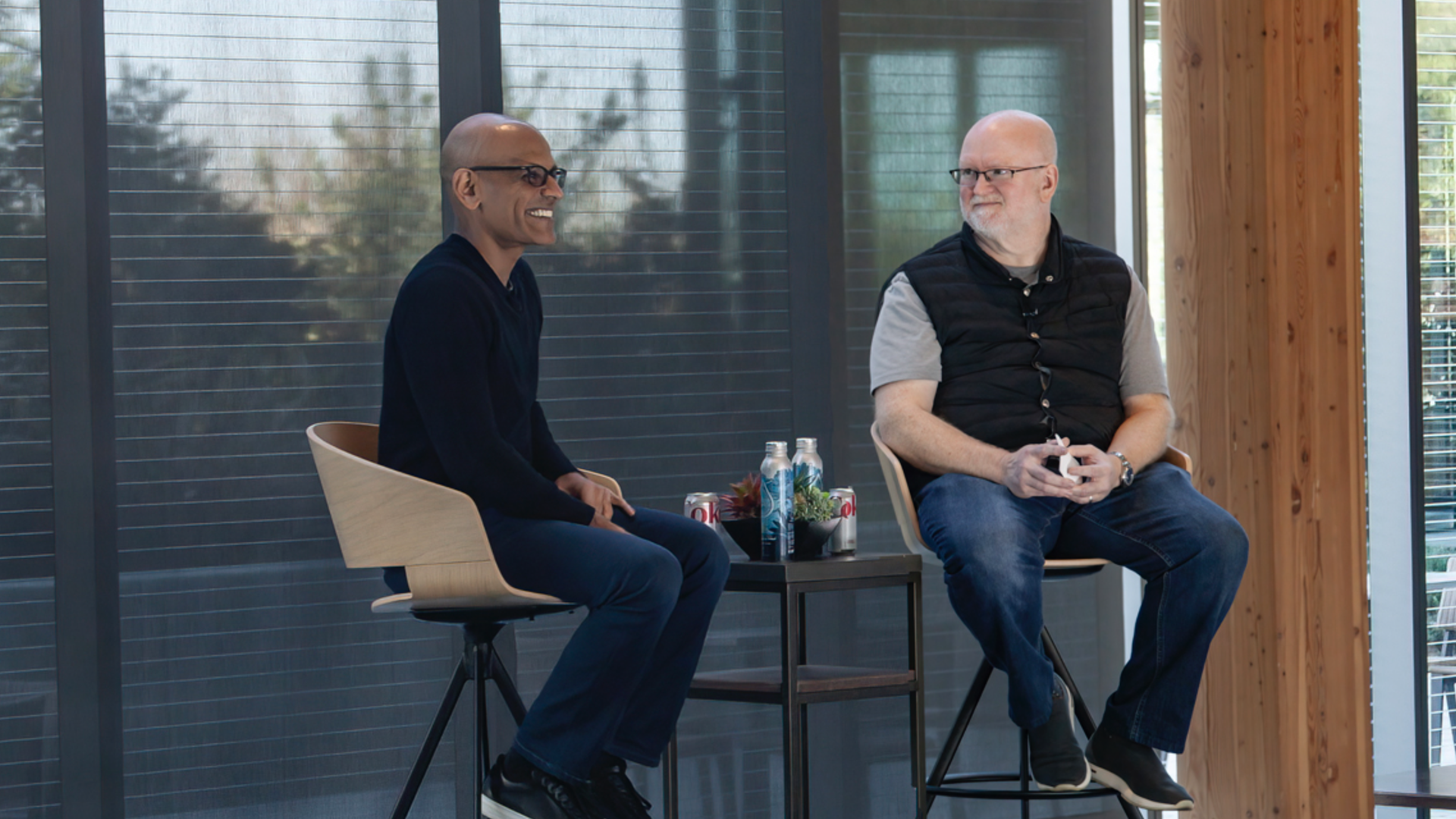
Microsoft executive VP Jay Parikh (left) with CTO Kevin Scott. Photo: Microsoft
In leading Microsoft's core AI work, Jay Parikh says he has a clear mission: To make sure the company develops, ships and improves products faster than Google and other rivals.
Why it matters: Despite its early partnership with OpenAI, critics say Microsoft hasn't fully seized the AI moment.
"It's all about speed," Parikh told Axios. "The thing for us is just, 'How do we learn faster than any of the other folks out there?'"
- Parikh, a former top engineering executive at Meta, was hired by Satya Nadella last year. But it wasn't until January that Microsoft announced his role, leading a new engineering team responsible for AI work across the company.
- That includes the technology that goes into Microsoft's own consumer and business products as well as the capabilities that get built into Windows and Azure for other software developers to use.
The big picture: The pace of Microsoft's progress versus the competition will be on full display this week.
- The company will be showing its latest AI efforts at its Build developer conference on Monday and Tuesday in Seattle.
- Meanwhile Google, is expected to show new AI models and tools at its I/O developer conference Tuesday and Wednesday in Mountain View.
- In addition, SAP is holding its Sapphire conference in Orlando this week, and Anthropic holds its first-ever developer conference in San Francisco on Thursday.
AI will be the focus of all of these events, with much of the talk this year shifting to how businesses can let AI work as an autonomous colleague rather than always needing supervision by a human.
- In coding, for example, Parikh said the approach is shifting from having the AI just help complete the code that a human programmer is writing to having the AI take on programming tasks on its own.
- "You'll see demos of this as we get into Build, but I can assign it an entire issue or a task and it can just go off and build stuff, fix stuff, secure stuff, triage stuff, coordinate with other agents if it needs to," Parikh said.
- That's a broader shift happening across the industry. Late last week, OpenAI introduced Codex, its own take on a coding agent that can work asynchronously on programming tasks.
Between the lines: Outsiders often struggle when joining Microsoft to figure out how to do what they want in an organization as vast and siloed as Microsoft is.
- With AI being such a focus for Microsoft, Parikh is unlikely to lack for resources.
- But the company has a lot of teams — including all of its various product teams, each of which has its own AI agenda, as well as a consumer AI effort being led by Mustafa Suleyman.
Parikh said he has spent most of his time since joining Microsoft talking to people to learn the company's ways.
- "When you get here and like, working with the Microsoft research team, the other tech teams, etc., it's pretty awesome," Parikh told Axios. "It's confusing, but it's awesome."
- "There's a lot of acronyms, a lot of different technologies, but it is actually amazing how much cool stuff is here, and how many smart people are here," he added.
What's next: Speaking to reporters on Sunday, Parikh said that getting the necessary speed requires changes to both processes and culture at Microsoft.
- "Maybe 25% or 33% is cultural," he said. "The rest is, 'How do you build the tools, the infrastructure that allow your product makers to go fast.' "
- But Parikh said he is encouraged by the progress so far. "We're picking up the pace in lots of places in the company," he said.
