Israeli Cabinet approves resuming immediate humanitarian aid to Gaza

Add Axios as your preferred source to
see more of our stories on Google.
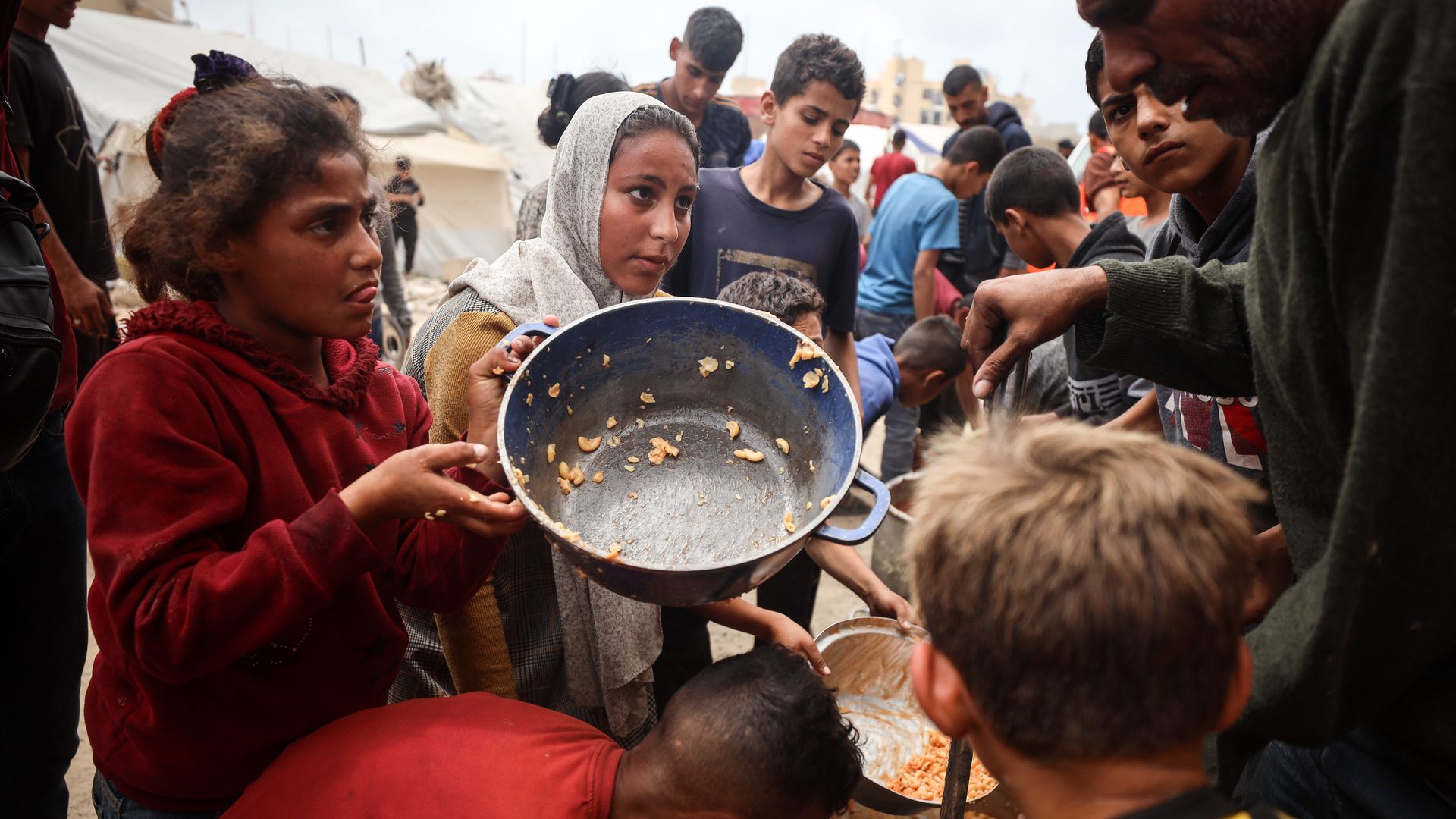
Palestinians jostle for position to get a hot meal in front of a distribution point in Gaza City. Photo: Majdi Fathi/NurPhoto via Getty Images
The Israeli Security Cabinet decided on Sunday to immediately resume the transfer of humanitarian aid to Gaza through existing channels until a new humanitarian aid mechanism starts working, according to two senior Israeli officials.
Why it matters: After the Gaza ceasefire's collapse in early March, Israel halted humanitarian aid into Gaza, resulting in a significant deterioration of the humanitarian crisis in the Gaza Strip.
- President Trump said several times over the past week that Palestinian civilians in Gaza are starving.
Driving the news: The Gaza Humanitarian Foundation (GHF), which developed the new aid mechanism, announced a few days ago that Israel had agreed to renew the transfer of humanitarian aid to Gaza using the existing mechanisms until the new arrangements are in place.
- Resuming aid delivery was the key condition of the GHF — established with backing from the U.S. and Israel — for the launch of a new aid delivery mechanism in Gaza, which Israel says will allow aid to be delivered without being controlled by Hamas.
- Senior Israeli officials denied last week that there is a plan to resume aid, asserting that aid would not be allowed into Gaza via the existing mechanisms, but only through the new mechanism.
- However, in recent days, international pressure increased, particularly from the Trump administration and many European countries, demanding that Israel immediately resume humanitarian aid to Gaza.
What they're saying: GHF executive director Jake Wood in a statement thanked the Trump administration for its support as he welcomed the Israeli Security Cabinet approving the resumption of humanitarian aid to Gaza "consistent with the commitment made to us to serve as a bridging mechanism until" the foundation is fully operational.
- "Today's announcement marks an important interim step. We expect GHF's new aid mechanism — including the establishment of four initial Secure Distribution Sites — to be up and running before the end of the month," Wood said.
- He said the GHF had secured, and will continue to mobilize, funding from the international community to support its operations and was coordinating with international partners and humanitarian organizations.
- "Now is the time for all participants in the aid community to step forward and collaborate on this effort," Wood said. "We cannot allow fragmentation or hesitation to delay life-saving assistance.
- "Through the GHF, we are building a secure, transparent system to deliver aid directly and effectively — without diversion or delay and in strict adherence to the humanitarian principles of humanity, neutrality, impartiality, and independence. ... The people of Gaza are counting on us, and we must not let them down."
Behind the scenes: During the Cabinet meeting, representatives from the Coordinator of Government Activities in the Territories (COGAT) and the IDF said that the food supplies from the United Nations and other aid organizations had been depleted, and therefore there was an urgent need to immediately bring in humanitarian aid, according to an Israeli official.
- The IDF and COGAT's recommendation contradicted statements made just the day before by Defense Minister Israel Katz, who claimed there was no immediate need to allow humanitarian aid into Gaza.
- A senior Israeli official said that Cabinet ministers were informed that the new aid mechanism for Gaza — operated through GHF and American private contractors — would begin functioning at the earliest on May 24, and therefore, a bridging period was necessary.
- The official added that the Cabinet decided the aid to be transferred would include food, such as flour for bakeries operated by international organizations or by the UAE, as well as medicine for hospitals in the enclave.
The aid will be delivered via the UN World Food Programme, World Central Kitchen, and other aid organizations. The senior official emphasized that the aid will be monitored by the international organizations.
- Although the Cabinet did not hold a vote on the decision, it was effectively approved. Far-right Ministers Itamar Ben Gvir and Bezalel Smotrich voiced opposition to the renewal of humanitarian aid during the meeting.
What they are saying: The Israeli Prime Minister's office said in a statement that the decision was based on the IDF's recommendation, "and due to the operational need to enable the expansion of the high-intensity fighting to defeat Hamas."
- "Israel will allow the entry of a basic amount of food for the population in order to prevent the development of a famine crisis in the Gaza Strip," the statement said.
- The statement added that a humanitarian crisis would endanger Israel's 'Gideon's Chariots' operation and prevent them from defeating Hamas.
- "Israel will act to deny Hamas the ability to take control of the distribution of humanitarian aid, in order to ensure that the aid does not reach Hamas terrorists," the Prime Minister's office said.
Editor's note: This story has been updated with comment from GHF executive director Jake Wood and additional information throughout.
