Scoop: Former UN food program director in talks to lead new Gaza aid foundation

Add Axios as your preferred source to
see more of our stories on Google.
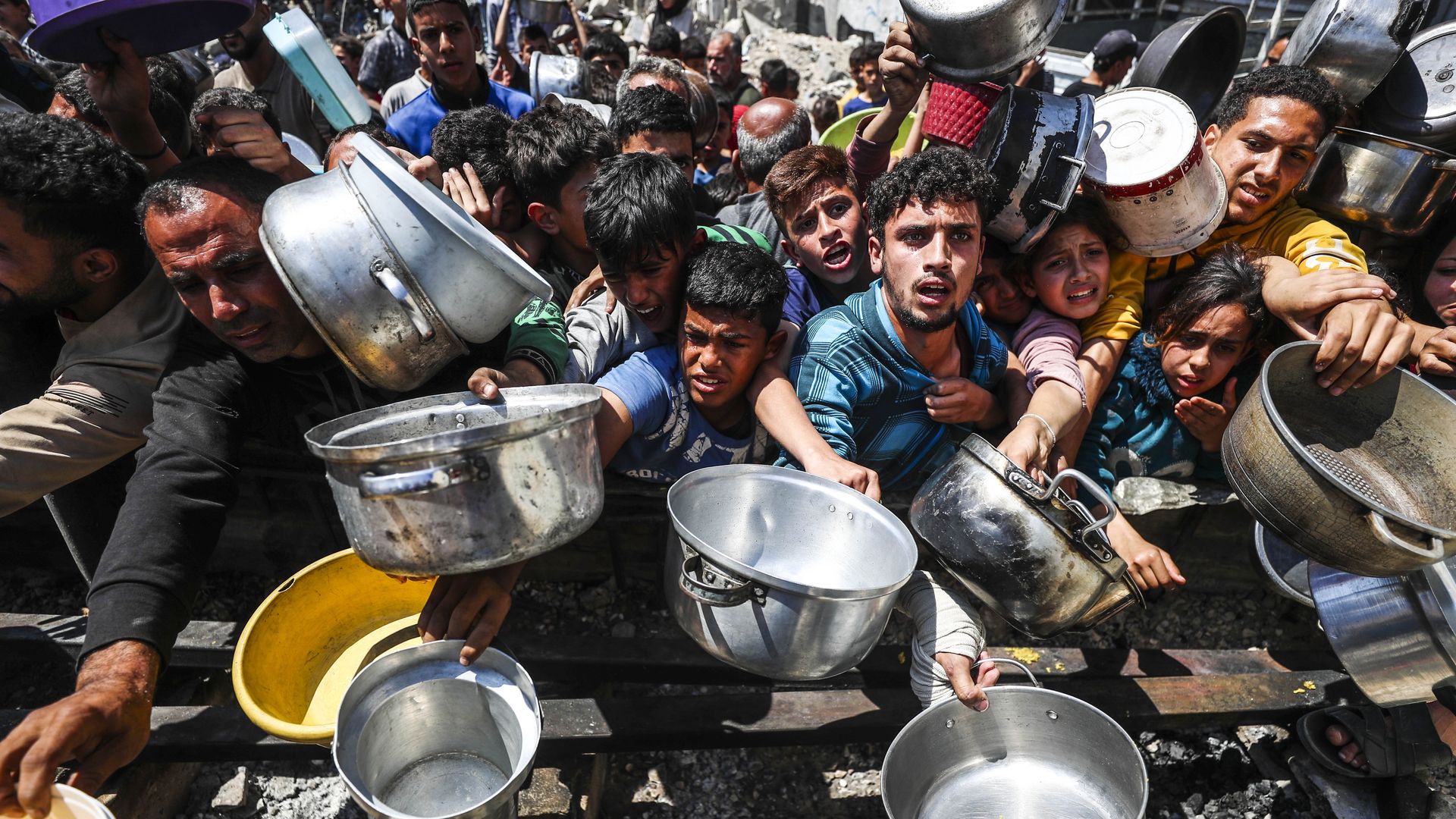
Displaced Palestinians receive hot meals distributed by aid organizations in Jabalia refugee camp in Gaza on May 05, 2025. Photo: Mahmoud Issa/Anadolu via Getty Images
The former executive director of the World Food Programme and Nobel Peace Prize laureate David Beasley is in talks with the Trump administration, the Israeli government and other key players to head the new Gaza Humanitarian Foundation, two sources with knowledge of the issue said.
Why it matters: Israel and the U.S. are trying to get international donors and the UN on board with the new humanitarian mechanism, which they argue will allow aid to enter Gaza without being controlled by Hamas. Israel has blocked food, water and medicine from entering the enclave for two months, but is in a standoff with aid groups on the terms under which it can resume.
The big picture: Beasley, a former governor of South Carolina, was appointed as the WFP chief during President Trump's first term in office. He served in the job until December 2023, and is highly respected in the humanitarian community and within the UN system.
- In December 2020 he received the Nobel Peace prize on behalf of the UN agency he headed.
- Beasley's leadership of the new Gaza Humanitarian Foundation (GHF) would give it significant credibility and could convince the UN and other international aid organizations to work with the new foundation.
- A source close to Beasley said he's negotiating the urgent reintroduction of aid in Gaza as a condition of the GHF's operations and his leadership.
State of play: The U.S., Israel and representatives of the new international foundation are close to an agreement on how to resume the delivery of aid in Gaza.
- The establishment of the foundation is still in progress. The UN and other aid organizations who work in Gaza announced they will not cooperate with the new foundation's plan, arguing it "contravenes fundamental humanitarian principles."
- The rollout of the new foundation also comes as Israel is threatening to occupy and flatten nearly all of Gaza, and displace the population of 2 million to a "humanitarian area."
- The new aid plan would function whether or not Israel follows through on those threats, according to plans seen by Axios.
The Trump administration is lobbying countries to donate money to the mechanism and the UN to cooperate with it. White House envoy Steve Witkoff briefed the members of UN Security Council on Wednesday about the plan. U.S. diplomats briefed members of the UN agencies in Geneva about the plan on Thursday.
- A source involved in the planning of the GHF said the foundation is independent and civilian-led. It aims at complementing the work of the UN and traditional aid groups — not replacing them, they said.
- "Our goal is to help ensure that aid reaches those who need it, safely, effectively, and at scale," the source said.
Friction point: The source said a key sticking point is how to ensure aid entering Gaza won't be intercepted by Hamas and that aid will flow directly to civilians.
- "Nothing is final until everything is final. We're building a new model that is different by design and that's not a flaw, it's the point. That takes time and deep collaboration across many, many stakeholders," the source involved in the GHF work said.
- "But those stakeholders all have one thing in common: they're all willing to think outside the box and act with urgency because the situation on the ground demands it."
- One key question is how aid will flow in the time before the new mechanism takes shape. The UN has warned that food supplies in Gaza will run out within days.
Zoom in: According to memo sent to potential donors about the establishment of the GHF, the new aid mechanism will initially stand up four "Secure Distribution Sites," each built to continuously serve 300,000 people —1.2 million Palestinians in the initial phase, with capacity to expand past 2 million.
- The memo says "pre-packaged rations, hygiene kits, and medical supplies will move through tightly controlled corridors, monitored in real time to prevent diversion. "
- The memo says donor countries can fund meals, donate goods or partner with an existing NGO that routs its cargo through the GHF
Zoom in: The memo, seen by Axios and included below, says the GHF will work with logistics subcontractors who will use armored vehicles to transport supplies to and from the humanitarian hubs around Gaza.
- "On-site and perimeter security will be provided by experienced professionals, including personnel who previously secured the Netzarim Corridor during the recent ceasefire. Their mandate is to deter interference from criminal networks or other armed groups who have historically sought to control or redirect humanitarian aid," the memo says.
- According to the memo the IDF "will not be stationed at or near the locations of the humanitarian hubs in order to "maintain the neutral and civilian-facing nature of operations."
- "Aid will be distributed without regard to identity, origin, or affiliation. There will be no eligibility requirements — assistance will be delivered purely based on need," the memo says.
- The memo adds that the new foundation wants to partner with NGOs, UN agencies, and civil society organizations to facilitate the movement and distribution of their aid through the GHF's secure distribution infrastructure in order to ensure the aid reaches intended beneficiaries without diversion or delay.
According to the memo, the foundation's board will include Nate Mook the Former CEO of the World Central Kitchen aid organization.
- Other members of the board are Raisa Sheynberg, VP of government affairs at Mastercard and a former National Security Council staffer; Jonathan Foster, founder and Managing Director of Current Capital; and Loik Henderson, a lawyer specializing in business structuring and governance.
- The executive leadership of the GHF will include Jake Wood, who founded the U.S. humanitarian organization Team Rubicon; David Burke, an expert on humanitarian delivery; and John Acree, a former USAID official.
- Security experts Bill Miller, a former UN official who was in charge of security for UN humanitarian operations, and Gen. Mark Schwartz, who served as the U.S. Security Coordinator for Israel and the Palestinian Authority.
