Why the Trump administration wants to try immigration cases in Louisiana

Add Axios as your preferred source to
see more of our stories on Google.
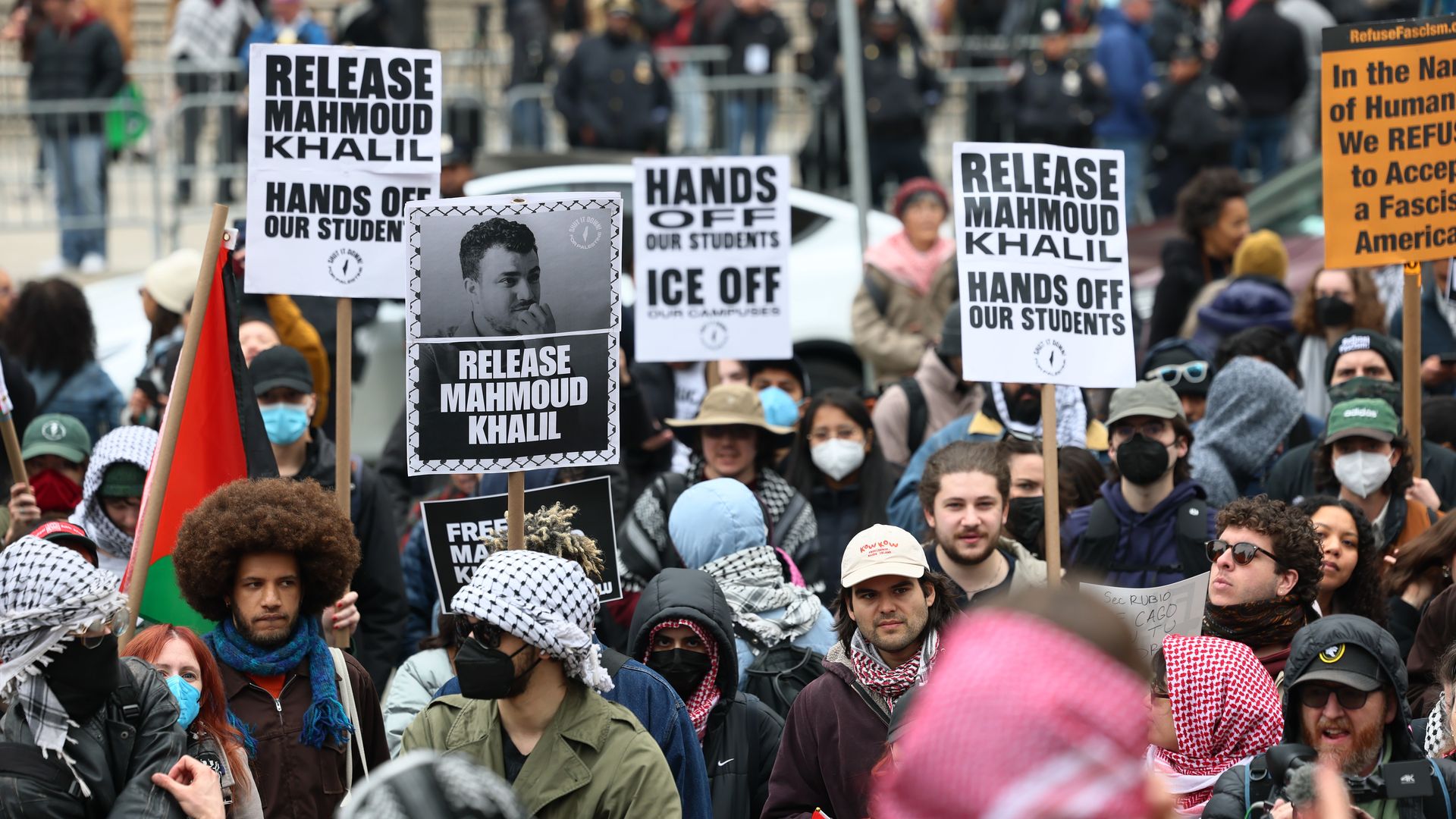
People gather outside of a New York court on March 12 to protest the arrest of Mahmoud Khalil. Photo: Michael M. Santiago/Getty Images
Louisiana has become ground zero for some of the Trump administration's most boundary-pushing immigration cases, including those of several international students and at least one U.S. green card holder.
Why it matters: The administration is pursuing high-profile cases against purportedly "pro-Hamas" activists legally in the U.S., which promise to define the limits of President Trump's deportation powers.
Driving the news: Tufts University doctoral student Rumeysa Ozturk, was detained by Immigration and Customs Enforcement (ICE) earlier this week and the latest of the administration's efforts to remove certain individuals from the country under several executive orders signed by the president.
- Ozturk, a Turkish national in the U.S. on a student visa, was sent to a detention facility in Louisiana within hours of her arrest according to ICE records obtained by the Boston Globe.
- Her detainment follows those of Columbia University alumnus Mahmoud Khalil, a permanent U.S. resident, and Georgetown University graduate student Badar Khan Suri. Both men were also quickly transferred by ICE to Louisiana facilities after their arrests.
- Khalil has challenged his arrest and a federal judge agreed this week that his case should be moved to New Jersey, rebuffing the government's bid to try his case in Louisiana's Western District.
Between the lines: The detainees were sent to Louisiana due to logistical and political calculation, Mary Yanik, a clinical associate professor of law at Tulane University, told Axios.
- During Trump's first term, criminal justice reform efforts in Louisiana reduced the state's prison population, and the space in jails was quickly filled by federal government contracts with ICE, she noted.
- As a result, "Louisiana has more detention beds for ICE than any other state save Texas," Yanik said.
- Once in ICE custody, "federal immigration officials believe they can transfer you at any time to any facility in the country ... often without notification of counsel," she added.
The big picture: Yet once in Louisiana's western district, detainees face a difficult legal environment.
- "If someone is appealing their immigration court case, those cases eventually can go to the federal appellate circuits," in this case the 5th U.S. Circuit Court of Appeals, based in New Orleans, Yanik said.
- "The 5th Circuit is arguably the most right-wing federal appellate court in the country," according to the Center for American Progress, a left-leaning think tank.
- In fact, the court is so conservative that it has had multiple rulings overturned by the conservative-leaning U.S. Supreme Court, per the Texas Tribune.
State of play: But another way immigration cases can wind up in federal courts is if detainees file a habeas corpus petition to challenge the legality of their detention, as Khalil did.
- These cases typically wind up in district court, and in Louisiana the majority of ICE detention centers are within the jurisdiction of the western district.
- The western district court is the "slowest moving" of the state's district courts and very conservative, in which formal court orders releasing detainees are "exceedingly rare," Yanik said.
The bottom line: The administration is "definitely choosing the immigration court" these cases are going in front of, "which can create an uphill battle for the immigrant's deportation case," Yanik said.
What to watch: Louisiana's role in the Trump administration's immigration cases is far from over. Trump promised this month that Khalil's arrest was the first of "many to come."
Go deeper: Trump promises more arrests after pro-Palestinian activist detained by ICE
