What to know about Germany's elections, as Europe adjusts to new Trump era

Add Axios as your preferred source to
see more of our stories on Google.
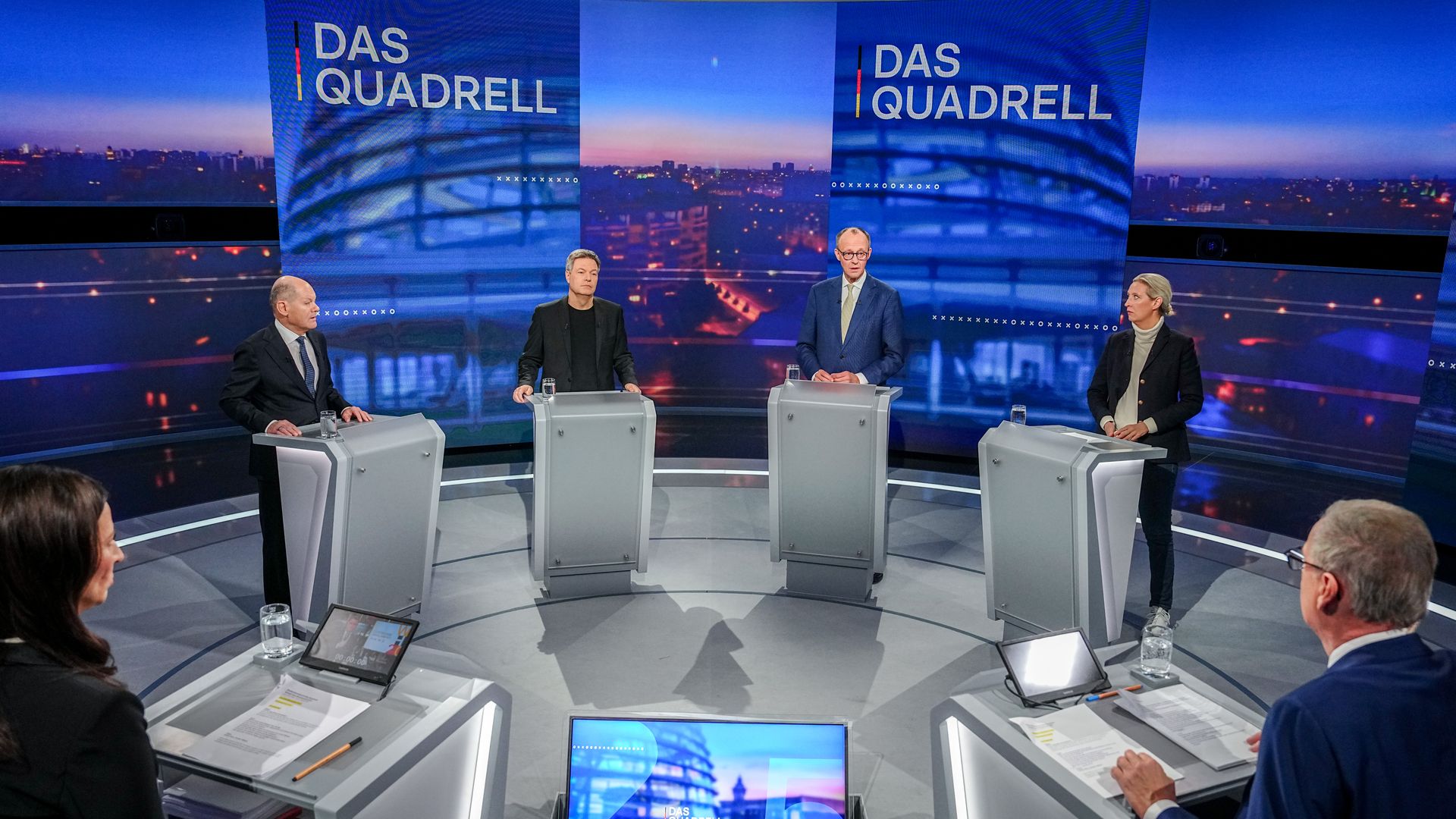
Olaf Scholz, Robert Habeck, Friedrich Merz and Alice Weidel take part in a televised debate on Feb. 16. Photo: Kay Nietfeld-Pool/Getty Images
German voters will head to the polls this weekend to elect new leadership, marking a decisive election that will help shape how Europe responds to the new Trump administration.
Why it matters: As Europe's biggest economy and the largest member of the European Union, Germany is one of the block's most influential states. The country is also the second-largest supplier of aid to Ukraine, behind the U.S.
- Germany's new leadership will be charged with shaping the country's response to the new Trump administration's foreign policy, especially as the U.S. seeks an end to the Russia-Ukraine war.
Who are the main contenders to be chancellor?
Four candidates are running to be Germany's next chancellor, including current German Chancellor Olaf Scholz, of the center-left Social Democratic Party.
- Friedrich Merz, of the center-right Christian Democratic Union, is currently in the lead to become the next chancellor, according to pre-election polls.
- Robert Habeck, of the Green party, is the current vice chancellor of Germany and the country's economy minister.
- Alice Weidel, one of the co-leaders of the far-right, anti-immigrant Alternative for Germany (AfD) party, would face difficulty forging a coalition even if victorious. Germany's major parties have refused to govern alongside the AfD.
What is the Trump administration's stake in the election?
Elon Musk, one of President Trump's most powerful backers, has made no secret of his support for the AfD.
- Musk endorsed the AfD in December, prompting the German government to rebuke him for attempting to influence the election.
- Even Vice President JD Vance's recent MAGA-coded speech at the Munich Security Conference — in which he decried the dangers of mass immigration — was also seen by some as a boon to the far-right, Axios' Barak Ravid reported.
Where does this leave Ukraine?
The results of this weekend's elections come at a consequential time, as the Trump administration has swiftly upended the U.S.' yearslong support for Ukraine.
- During his first month in office, Trump initiated peace talks with Russia without Kyiv's participation, escalated attacks on Ukrainian President Volodymyr Zelensky, and dashed Ukraine's bargaining chips in any potential negotiation.
- The results have sent Ukraine's European allies scrambling.
Zoom in: Germany has given 44 billion euros (nearly $46 billion) since the Feb. 2022 invasion, the German government said last month.
- Merz, who is favored to win the chancellorship, has slammed Trump's recent overtures to Russia. "We see in America a president who admires autocratic systems and rides roughshod over all kinds of norms," he said at an event Tuesday, the New York Times reported.
- Germany could prove to be a key counterweight to the U.S. and Merz outlined a vision of robust German support for Ukraine last week at the Munich Security Conference.
- Merz vowed to send more weapons to Ukraine and disagreed with the U.S.' assessment that NATO membership for Ukraine was unrealistic.
Go deeper: Trump's first month turns U.S. foreign policy upside down
