Trump's first month turns U.S. foreign policy upside down

Add Axios as your preferred source to
see more of our stories on Google.
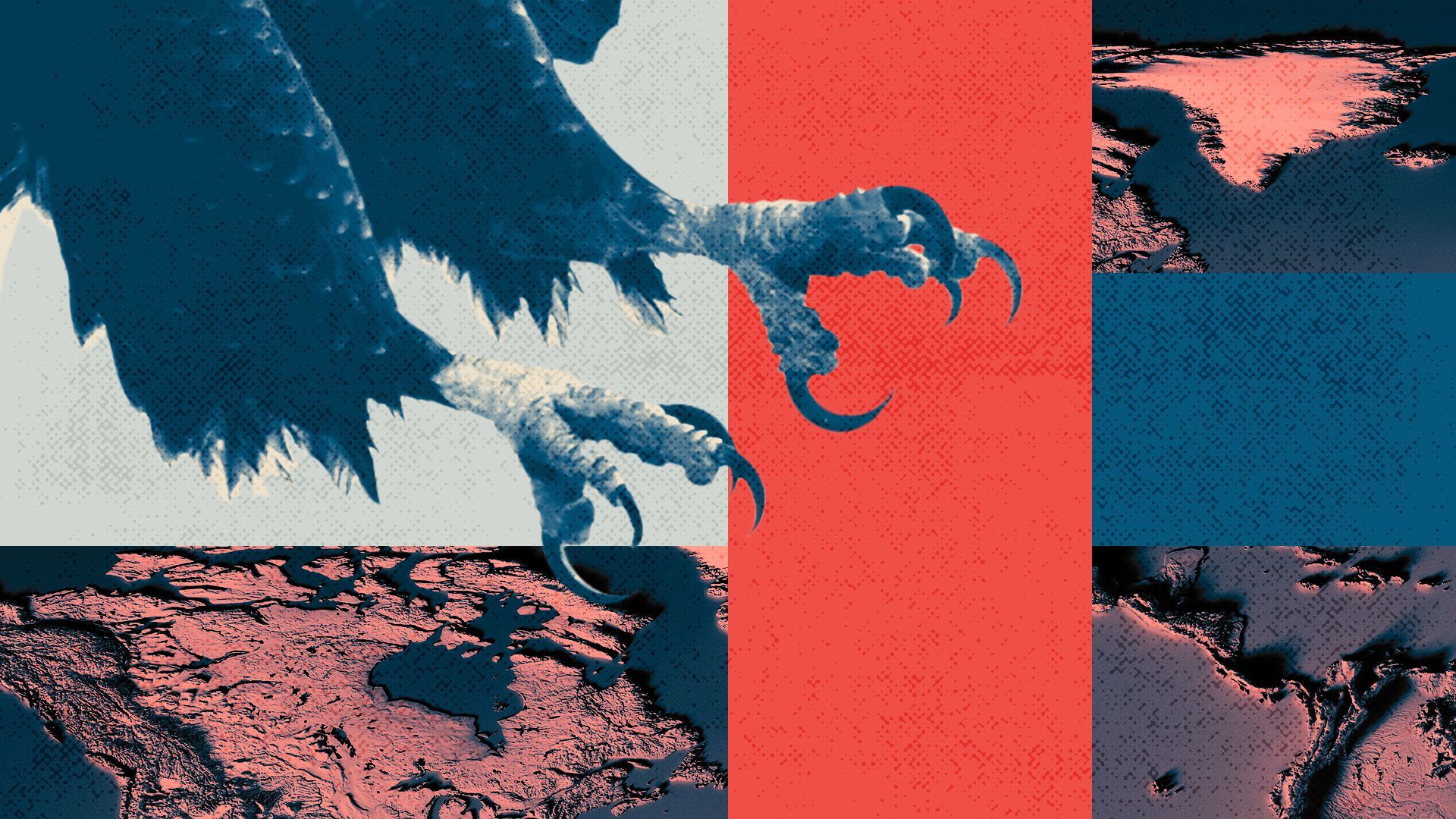
Illustration: Brendan Lynch/Axios
President Trump was not the first U.S. president or major Western leader to rail against a "dictator" for launching the war in Ukraine — but he was the first to mean Volodymyr Zelensky, not Vladimir Putin.
The big picture: It's hard to overstate how quickly and wildly Trump's foreign policy deviated from former President Biden's — and often from his own campaign pitch of America First restraint.
Before even taking office, Trump threatened to seize the Panama Canal and Greenland.
- He later stunned Middle Eastern leaders and his own advisers by laying claim to the Gaza Strip to construct a U.S.-owned Riviera.
- He's repeatedly insisted Canada become the 51st U.S. state — something that played as a joke at first, but which Prime Minister Justin Trudeau called a "real thing" in a hot mic moment.
Between the lines: Trump's expansionist urges, like his tariffs threats, have lent his first month the feel of raw but unfocused American power.
- His territorial demands may fade away, or narrow considerably (negotiating lower canal transit fees from Panama, say).
- But they're fueling a global sense that Trump's America is to be feared — including by allies.
Zoom in: Nothing has alarmed America's longtime European partners so much as his treatment of Zelensky, who was left out of this weeks U.S.-Russia talks then repeatedly bashed by the president.
- European allies are horrified by Trump's apparent abandonment of Ukraine, and openly lamenting that they can no longer rely on Washington.
- Trump's team, for its part, argues that Europe has coasted on American strength for far too long, and that NATO's previous approach to Ukraine only prolonged a terrible war.
- After eight decades, the Transatlantic marriage is undeniably on the rocks.
The bottom line: Trump may not change the map, but he is changing the world as we know it.
