The death of American soft power


Add Axios as your preferred source to
see more of our stories on Google.
Photo illustration: Lindsey Bailey/Axios. Photo: Fine Art/Getty Images
President Trump is taking a sledgehammer to a bedrock of U.S. foreign policy, ripping up decades of "soft power" in favor of a highly personalized, transactional, coercive style of dealmaking.
Why it matters: For Trump, results speak loudest. Less than three weeks into office, his administration already has struck deals of varying substance with Canada, Mexico, Colombia, Panama, El Salvador, Guatemala and even Venezuela.
- Most were secured through threats of tariffs and other leverage, with Trump's top diplomat, Secretary of State Marco Rubio, occasionally serving as the good cop.
- But the headlines obscure a longer-term risk: Trump is gutting key aspects of America's global influence and the workforce that promotes it — leaving a vacuum that U.S. adversaries are eager to fill.
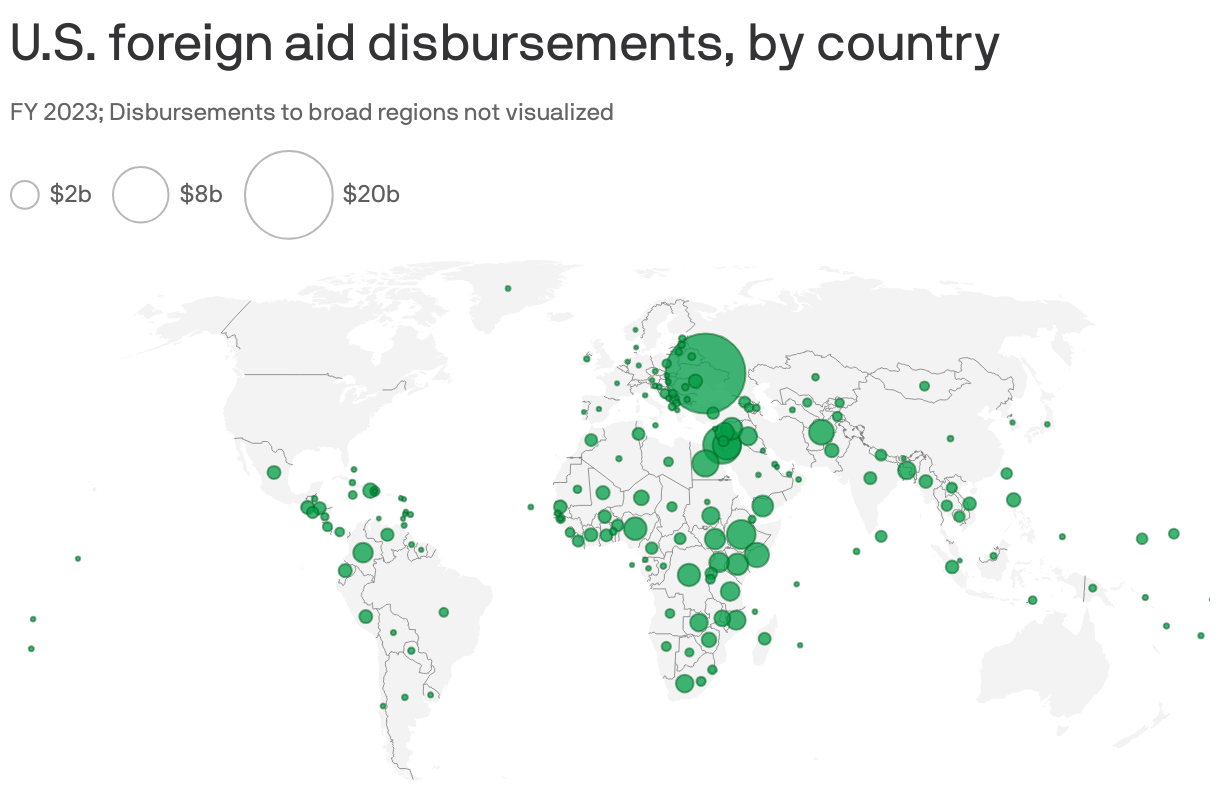
Zoom in: Trump and Elon Musk's rapid dismemberment of the U.S. Agency for International Development (USAID) — by far the world's largest provider of foreign aid — has stunned diplomats and NGOs around the globe.
- In an instant, the most impoverished and unstable regions of the world have seen funding dry up for basic food supplies, water, medicine, education, disaster relief — affecting the lives of millions of people.
- The New York Times reports that Trump is slashing the number of USAID jobs worldwide from over 10,000 to 290, while canceling about 800 grants and contracts.
- Trump and his "America First" allies argue the money should be spent at home, and that USAID is a Trojan horse for spreading destructive leftist ideologies. The governments of China, Russia and Iran seem to agree.
Between the lines: Republicans haven't always held such negative or conspiratorial views of foreign aid.
- "Our national interests are inextricably tied to the security and development of our friends and allies," said President Ronald Reagan, who made soft power central to U.S. foreign policy during the Cold War.
- As a senator, Rubio was a fierce defender of foreign aid — and even sent President Biden a letter in 2022 calling for more USAID funding to "counter the Chinese Communist Party's expanding global influence," according to CNN.
- "I promise you, it's going to be a lot harder to recruit someone to anti-Americanism, anti-American terrorism, if the United States of America was the reason why they're even alive today," Rubio said in 2017.
Zoom out: Meanwhile, Trump has made clear his disdain for America's network of alliances, which previous presidents have seen as a crucial competitive advantage over adversaries.
- Trump threatened Canada with 25% tariffs and has repeatedly suggested turning America's northern neighbor into the 51st state.
- He has said the European Union is "worse than China" when it comes to trade.
- He wouldn't rule out sending in troops if NATO ally Denmark doesn't hand over Greenland.
- And he threatened tariffs on Colombia, historically one of the closest U.S. partners in Latin America, for turning back a flight of deported migrants.
What they're saying: "There's really no better gift to Putin and Xi than for the world to see that the United States is a completely unreliable friend and partner," says Daniel Shapiro, a former U.S. ambassador to Israel who also held senior roles at the Pentagon and National Security Council.
- "People will obviously treat us as just one more transactional great power."
What to watch: Rubio announced Thursday that he would boycott a G20 gathering in South Africa after Trump and Elon Musk condemned a post-apartheid land reform law as "racist" toward white people.
- "South Africa is doing very bad things. Expropriating private property. Using G20 to promote 'solidarity, equality, & sustainability.' In other words: DEI and climate change," Rubio tweeted.
- It's very rare for any member of the club of global powers to skip such a gathering, let alone the U.S.
- China, which has invested heavily in soft power through its sprawling Belt and Road Initiative, pointedly expressed support for South Africa's G20 presidency after Rubio's snub.
The bottom line: Biden was fond of saying that what mattered was "not the example of our power, but the power of our example."
- Trump believes exactly the opposite.
