What is USAID, the federal agency the Trump admin is gutting


Add Axios as your preferred source to
see more of our stories on Google.
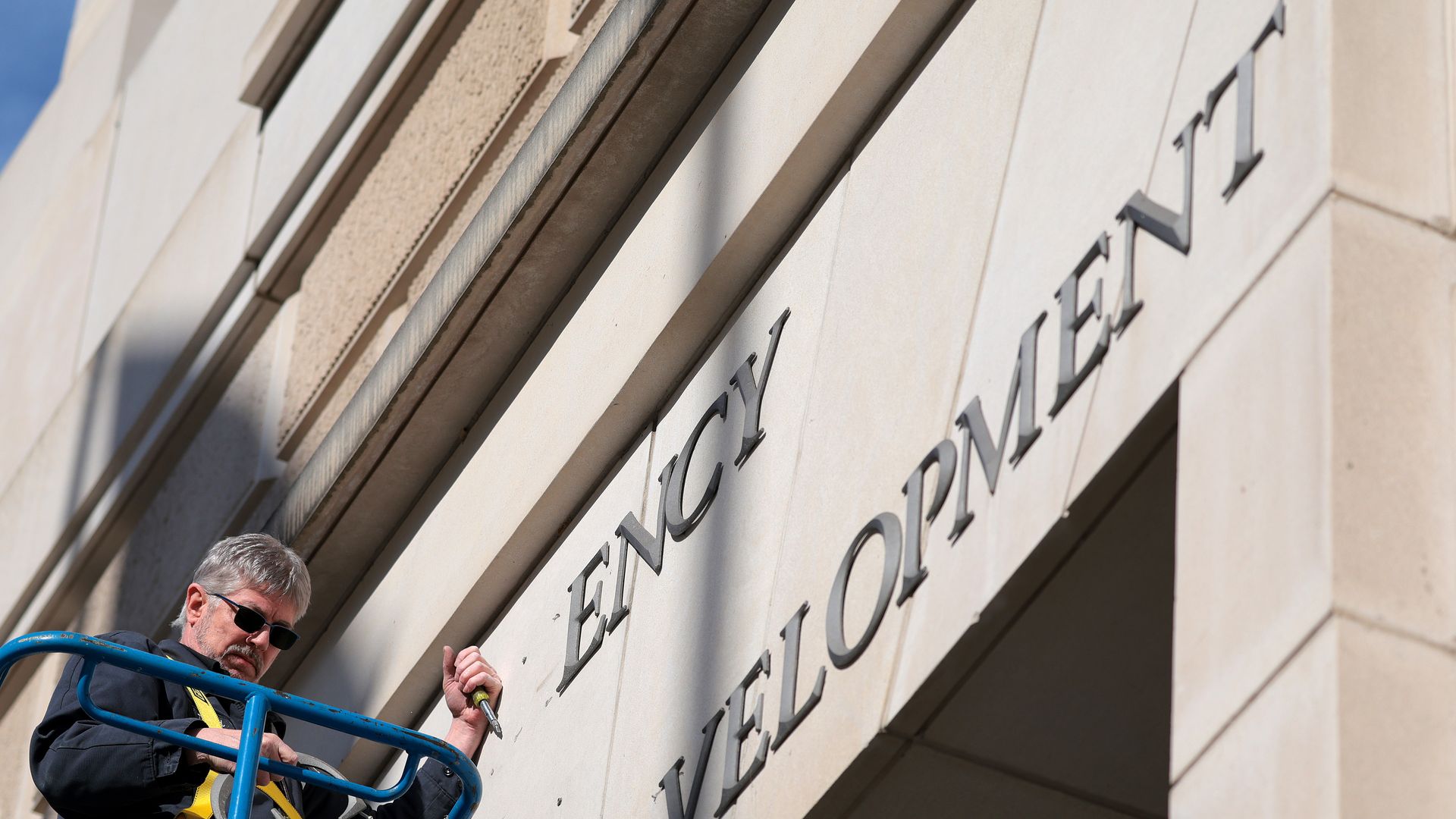
A worker removes the U.S. Agency for International Development sign on their headquarters on Feb. 7 in Washington, DC. Photo: Kayla Bartkowski/Getty Images
The Trump administration has upended the U.S. Agency for International Development (USAID) and moved to fire thousands of its staffers.
Why it matters: Elon Musk's Department of Government Efficiency (DOGE) has gutted the world's largest humanitarian aid organization over objections from Democrats and NGOs.
- Musk said earlier this month that Trump had "agreed" to "shut" USAID down. Musk has railed against the agency, labeling it as corrupt and wasteful.
- The teardown, coupled with the administration's attempted freeze on foreign aid, are already having devastating consequences on people around the world.
The latest: Trump moved Sunday to fire some 2,000 USAID workers and place most others on administrative leave after a federal judge permitted the administration to move forward with its purge.
- For overseas personnel, there will be a voluntary agency-funded return travel program, according to a statement posted to the now largely scrubbed website.
What has happened to USAID so far?
Employees of the agency were barred from entering its headquarters earlier this month, AP reported.
- A message posted to USAID's website stated that most of the agency's direct hires around the world would be placed on administrative leave by the end of Feb. 7.
- Unions representing the workers sued the administration.
- They were granted a temporary restraining order — but it was lifted weeks later.
Zoom in: Trump reportedly fired USAID's inspector general after the watchdog released a scathing report on the cost of Trump's foreign aid freeze.
- The Feb. 10 report stated that Trump's foreign aid freeze left $489 million of food assistance sitting at ports, in transit and in warehouses at risk of spoilage, unanticipated storage and diversion.
- USAID staff identified an additional 500,000-plus metric tons of food currently at sea or ready to be shipped. The food was sourced from American farmers, the report states.
- The report highlighted the risks of freezing some $8.2 billion in obligated humanitarian assistance, coupled with staff reductions and a lack of clarity, on the agency's distribution and oversight capabilities.
Catch up quick: The State Department announced Feb. 3 that Rubio had been appointed as USAID's new the acting administrator.
- In a letter to lawmakers from both parties, Rubio accused USAID of having "conflicting, overlapping, and duplicative" activities with the State Department, which result in "discord in foreign relations," Punchbowl News reported.
- Rubio said he had appointed Trump loyalist Peter Marocco to oversee a review of the agency and "potential reorganization," which he said could include eliminating or downsizing certain programs.
Here's what you need to know about the agency:
Why was USAID founded?
President John F. Kennedy founded USAID via executive order in 1961 to implement the Foreign Assistance Act of 1961, which CRS describes as the "cornerstone" of the country's foreign assistance programs.
- USAID brought together several existing foreign assistance programs under one umbrella, per an archived version of the USAID website.
- Building on the Marshall Plan, which assisted postwar Europe's recovery, USAID's early focus was on "technical and capital assistance programs," per its archived site.
- Through the decades, it expanded its scope to promote "human needs" — like nutrition and education — as well as democracy and free markets.
What does USAID do?
Its workforce of 10,000 managed some $43 billion in appropriations and assisted approximately 130 countries with disaster relief and economic development in fiscal year 2023.
- U.S. foreign assistance is a key pathway for achieving the country's foreign policy goals, according to the Congressional Research Service.
- The top funding recipients included Ukraine, Ethiopia, Jordan and the Democratic Republic of Congo.
Health programs were the largest USAID funding sector since the 1990s, according to CRS.
- USAID and its partners supported HIV and AIDs testing for more than 79.6 million people as part of the President's Emergency Plan for AIDS Relief (PEPFAR) in 2019.
- Health remained the top USAID sector until fiscal year 2022 due to the COVID-19 pandemic.
- Humanitarian assistance surpassed health for a time and was then passed by governance in FY 2023, a result of U.S. support for Ukraine.
By the numbers: The over $40 billion USAID managed in FY 2023 was still less than 1% of the federal budget.
Zoom in: It's not just other nations that benefit from USAID assistance.
- For example, the USAID Food for Peace Program, which provides emergency food assistance around the world, purchased 1.1 million metric tons of food from U.S. farmers and ranchers in fiscal year 2023.
What has Trump said about it?
Trump told reporters that USAID was run by "a bunch of radical lunatics, and we're getting them out."
- Responding to a report that two senior agency officials were put on leave after trying to stop DOGE reps from accessing restricted spaces, Musk wrote on X, "USAID is a criminal organization. Time for it to die."
Zoom out: The State Department ordered a freeze on all U.S. foreign assistance funded through the State Department and USAID last month to review whether programs are "efficient and consistent with U.S. foreign policy under the America First agenda" in accordance with an order from Trump.
- After widespread confusion, Secretary Marco Rubio signed a waiver allowing "existing life-saving humanitarian assistance programs" to continue work.
Yes, but: In the wake of the freeze, USAID partners and contractors were directed to halt work supplying critical drugs treating HIV, malaria and tuberculosis, Reuters reported.
- And in Pakistan, officials were ordered to cease working on several projects, including reconstructing police stations damaged by flooding, NPR reported.
Go deeper: Musk's wrecking ball pierces government's inner sanctum
Editor's note: This story was updated with additional developments.
