What to know about Trump's freeze on foreign aid

Add Axios as your preferred source to
see more of our stories on Google.
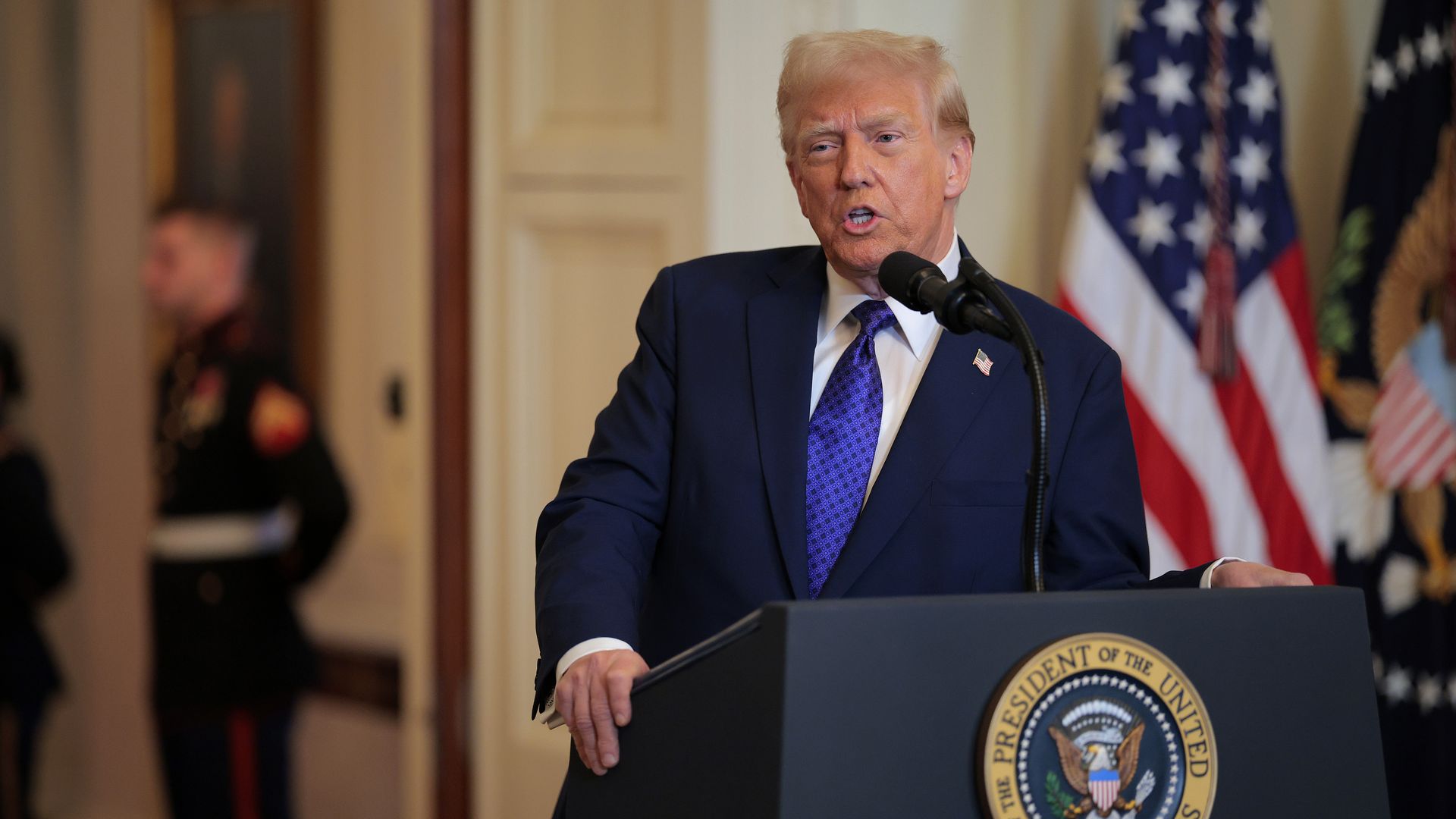
Donald Trump at the White House on Jan. 29. Photo: Chip Somodevilla/Getty Images
The Trump administration's freeze on foreign aid threatens to derail global efforts to fight disease outbreaks, counter terrorism, and provide humanitarian assistance to people affected by conflict.
Why it matters: President Trump's desire to shape an "America first" foreign policy — which was also a focus of his first term — could alter America's posture on the world stage and impact communities around the world.
- The U.S. government is the single largest humanitarian donor in the world, according to the United Nations.
- The foreign aid freeze undermines the U.S.' standing as a "reliable and credible partner" for its allies when they face crises, Michelle Strucke, director of the Humanitarian Agenda and Human Rights initiative at the Center for Strategic and International Studies (CSIS), told Axios.
Driving the news: The State Department issued the freeze on all foreign assistance for 90 days last week, effectively implementing an executive order signed by Trump on his first day in office.
- The freeze also includes a review of all federal assistance programs to ensure they align with Trump's foreign policy agenda.
- The only initial exemptions were for emergency food programs and military aid to Israel and Egypt were exempted from the freeze, per AP.
Zoom in: Amid widespread confusion and upheaval across the humanitarian sector, Secretary of State Marco Rubio announced that he had signed an additional waiver for "life-saving humanitarian assistance."
- The waiver signed Tuesday claimed that the exemptions would apply to "core life-saving medicine, medical services, food, shelter, and subsistence assistance."
- It specified that it would not include areas targeted by the Trump administration, such as "activities that involve abortions, family planning conferences … gender or DEI ideology programs, transgender surgeries, or other non-life saving assistance."
Between the lines: Despite the State Department's efforts to clarify the terms of the freeze, confusion persists among international aid workers.
- Many humanitarian organizations are still seeking clarity on what qualifies as "life-saving" assistance, the Washington Post reported.
- Asia Russell, executive director of Health GAP, an advocacy organization focused on HIV treatment that collaborates with groups impacted by the freeze, told Axios the new waiver was "meaningless" and that "massive disruptions are still in effect and threatening literally millions of lives."
- "People are right to be confused, because there's only been a two paragraph communication," she said, denouncing the lack of guidance of how to implement the waiver in practice.
- Even once a guidance is issued, the chaos is likely to continue. "When you trigger massive ... programs to fire their staff, they can't start back up again overnight," Russell noted.
The State Department did not immediately respond to Axios' request for comment.
What is foreign assistance?
Foreign assistance is a conduit for helping the U.S. achieve its foreign policy goals.
- This foreign aid is often distributed by the government in the form of grants to support projects implemented by NGOs, businesses, foreign governments, or even U.S. government agencies, per a Nov. 2024 report from the Congressional Research Service.
- Foreign assistance can also come in the form of direct budget assistance — essentially, cash — to foreign governments and multilateral organizations, like the UN, per the report.
By the numbers: The U.S. spent roughly $70 billion in foreign assistance in the 2022 fiscal year, the latest year for which comprehensive data is available, the CRS report stated.
- This accounted for about 1% of the total federal budget.
What kinds of humanitarian aid is included?
U.S. foreign assistance is critical to sustaining a plethora of humanitarian and relief efforts around the world.
- In 2024, the U.S. provided more than 40% of the UN's humanitarian aid budget.
- Foreign assistance grants are also critical to sustaining the work done by public health organizations and demining organizations.
The big picture: In the wake of the freeze, public health partners and contractors that work with the United States Agency for International Development (USAID) were ordered to halt the supply of critical drugs for the treatment of HIV, malaria and tuberculosis as part of the freeze, Reuters reported.
- This includes programs like the President's Emergency Plan for AIDS Relief (PEPFAR), created by former President George W. Bush.
- The State Department's backpedaling with the issuance of a humanitarian aid waiver has still led to disruptions for PEPFAR, with many health clinics in southern Africa remaining closed amid the confusion, the New York Times reported.
- For some clinics, there has been "absolute chaos" around the dispensing of HIV-related medications and the processing of blood samples, Russell noted.
- Former USAID official Atul Gawande warned in an X post Saturday that the freeze would do "serious damage to the world and the U.S.," noting that the freeze would impact global efforts to fight Marburg virus, monitor bird flu outbreaks, and eradicate polio.
What else does foreign assistance cover?
Some U.S. foreign assistance falls outside of the scope of traditional humanitarianism.
- Charles Lister, director of the Middle East Institute's Syria and Countering Terrorism & Extremism programs, pointed out in an X post Monday that the freeze would also impact security at camps in northeast Syria where ISIS members and their families are held.
- In the wake of the aid freeze, some camp guards stopped showing up for work. The State Department quickly worked to push through an exemption and resume funding Tuesday, Lister posted on X.
- "We narrowly escaped disaster and it just shows this team has no idea what they're doing," an unnamed U.S. official told Politico.
State of play: Counterterrorism is an "objective of a significant amount of U.S. foreign assistance," Strucke told Axios.
- Foreign assistance can also include funding for counternarcotics operations in places like Colombia, an initiative that the first Trump administration prioritized, she added.
- Cutting off funding for such operations could lead to increased drug trafficking, including into the U.S., she noted.
- For Ukraine, while the freeze doesn't impact U.S. military aid, it could hit funding for humanitarian assistance, such as for programs that promote accountability for Russian war crimes, Strucke noted.
