Oath Keepers with commuted sentences can visit D.C. after judge relents

Add Axios as your preferred source to
see more of our stories on Google.
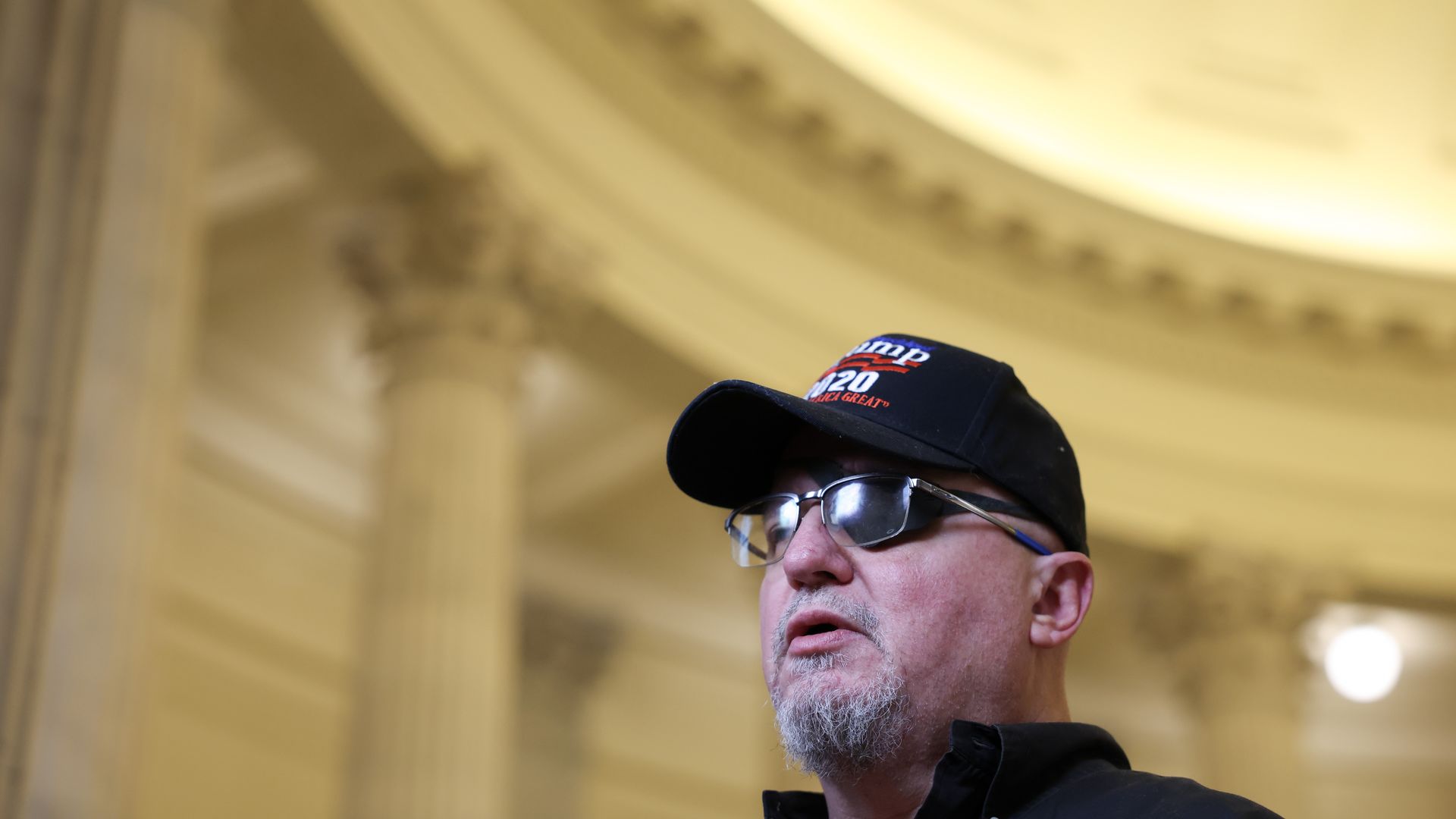
Oath Keepers founder Stewart Rhodes speaks to the press in the Cannon Rotunda on Jan. 22 in Washington, DC. Photo: Kayla Bartkowski/Getty Images)
The travel restrictions placed on eight Jan. 6 defendants whose sentences were commuted by President Trump will not be enforced, a federal judge ordered Monday.
The big picture: The group contains some of the most notorious names charged in the attack, including Stewart Rhodes, the founder of the far-right militia group the Oath Keepers.
- Rhodes, who was found guilty of seditious conspiracy and sentenced to 18 years in prison for his role in the deadly riot, visited the Capitol complex on Wednesday to meet with GOP lawmakers, according to multiple reports.
Catch up quick: U.S. District Judge Amit Mehta ordered Friday that Rhodes and seven of his co-defendants must get court permission to travel to Washington, D.C., or enter the U.S. Capitol.
- But Edward R. Martin, the interim U.S. Attorney for D.C., argued in a court filing that Mehta couldn't modify the terms of the defendants' release because their sentences had been commuted.
Driving the news: Mehta, an Obama-appointed judge, wrote in his Monday filing that the defendants "are no longer bound by the judicially imposed conditions of supervised release."
- He walked back his Friday order, saying it would be "improper" to modify the original sentences "post-commutation," but declined to dismiss the release terms altogether.
- Instead, Mehta ordered the terms not be enforced, writing that "the unconditional quality" of Trump's proclamation "can reasonably be read to extinguish enforcement" of the supervised release terms.
- "It is not for this court to divine why President Trump commuted Defendants' sentences, or to assess whether it was sensible to do so," he wrote, adding, "The court's sole task is to determine the act's effect."
Zoom in: The seven other defendants affected by the ruling were Kelly Meggs, Kenneth Harrelson, Jessica Watkins, Roberto Minuta, Edward Vallejo, David Moerschel and Joseph Hackett.
The big picture: Trump's day-one order issued "full, complete and unconditional pardon" to the vast majority of Jan. 6 defendants and commuted the sentences of 14 others, including the leaders of far-right extremist groups.
- Some lawmakers, experts and officers present for the Capitol riot have expressed concern that Trump's broad clemency for rioters could embolden further violence or political extremism.
Go deeper: "F--k it: Release 'em all": Why Trump embraced broad Jan. 6 pardons
