Where the minimum wage will rise in 2025

Add Axios as your preferred source to
see more of our stories on Google.
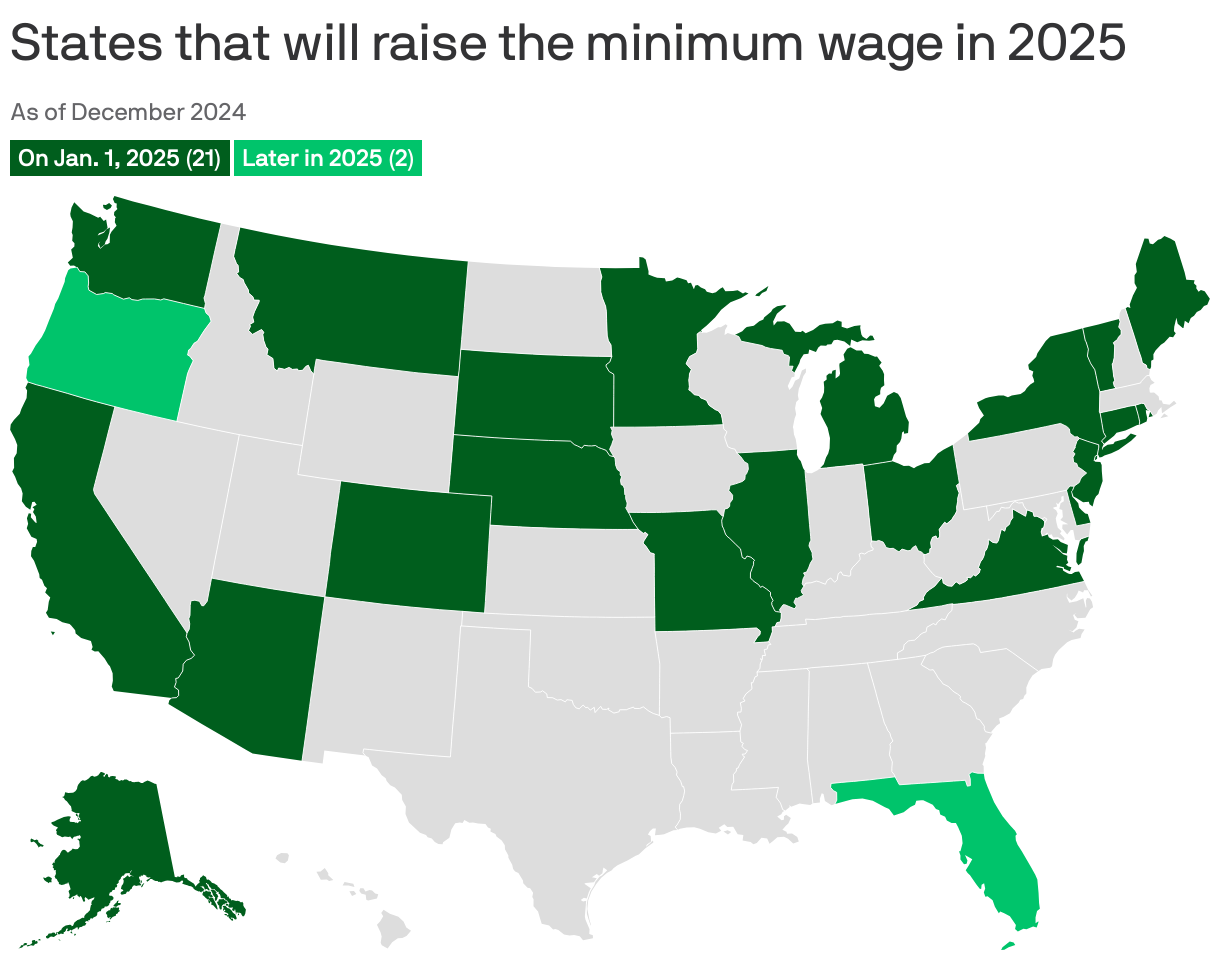
Millions of workers are getting a raise on Jan. 1, when the minimum wage is set to rise across 21 states, and 48 cities and counties.
Why it matters: The increases lift the pay of more than 9.2 million people, per the Economic Policy Institute's tally.
- Millions more will benefit. When the wage floor rises, that means pay goes up for other workers at the bottom of the income ladder, too.
The big picture: Congress last raised the federal minimum wage in 2009 to its current $7.25 an hour.
- Since then, many states and localities took matters into their own hands. Now only 20 states adhere to the federal minimum wage.
Between the lines: 19 of those states voted for President-elect Trump, as NBC's Kristen Welker recently pointed out.
- Trump said that although $7.25 an hour was "a very low number," he didn't know what the appropriate minimum wage would be because the cost of living varies so much by region.
- That's how the issue has effectively sorted itself out in the U.S. The areas with a higher cost of living now do have higher minimum wages.
Where it stands: California's minimum wage is rising to $16.50, with several cities going higher, including in pricey Silicon Valley spots like Mountain View ($19.20) and Cupertino ($18.20).
- In New York, the wage floor is rising to $16.50 in NYC and Long Island, and $15.50 upstate.
- Washington State rises to $16.66, but large employers in Seattle's King County pay at least $20.29.
- In some places, the minimum wage is linked to inflation, which is why the wage isn't a nice round number.
Higher wages aren't just a blue state phenomenon. Pay is rising to $14.70 in Arizona, $10.55 in Montana, $13.50 in Nebraska and $10.70 in Ohio.
- A few states are raising pay later in the year. Florida's minimum wage will go up to $14 an hour on September 30.
What to watch: By 2027, nearly half of U.S. workers will live in states with at least a $15 minimum wage, left-leaning EPI recently reported.
- That number was once considered impossibly high, but now thanks to a mix of intense worker activism (remember Fight for $15?) and sky high inflation it doesn't seem so wild.
Go deeper: The National Employment Law Project has a list of all the changes.
