How 15 years of stagnant federal minimum wage affects hourly workers

Add Axios as your preferred source to
see more of our stories on Google.
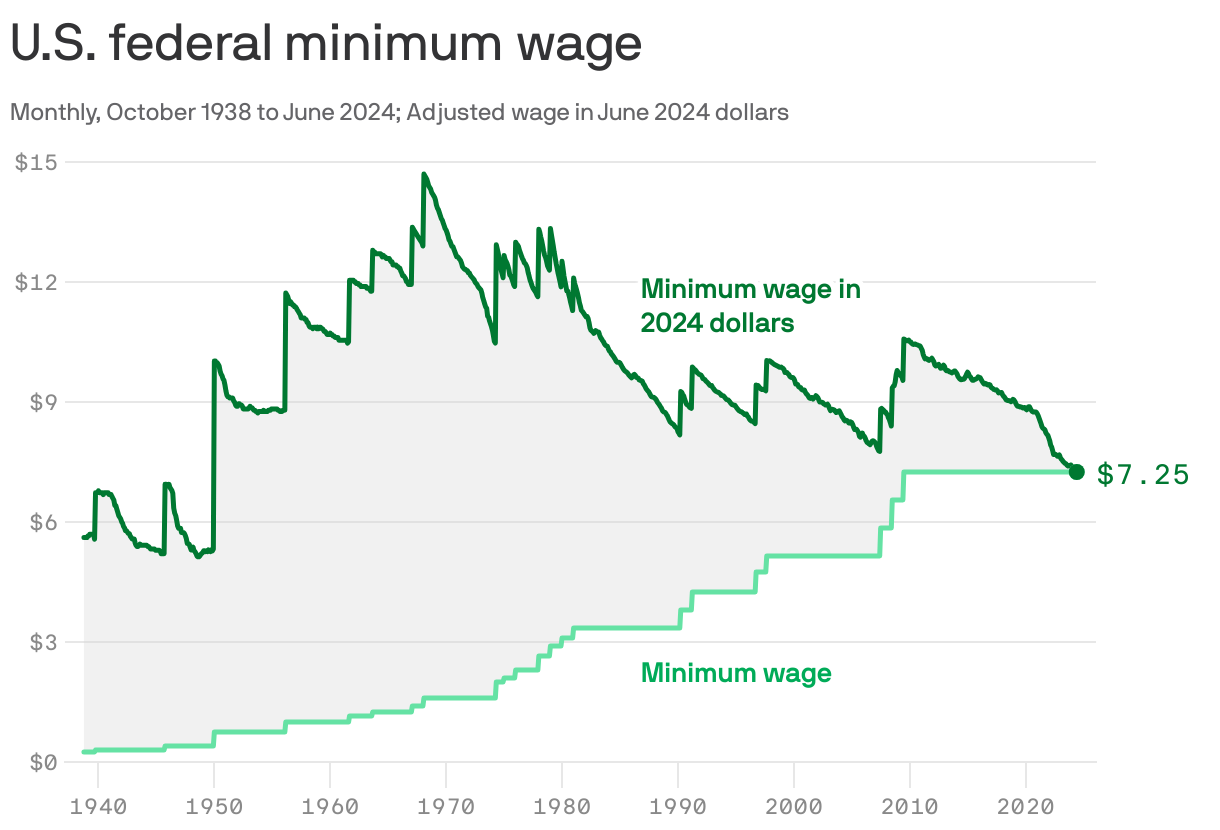
The federal minimum wage has basically become an outdated relic: It last went up to $7.25 on July 24, 2009 — 15 years ago.
Why it matters: Though very few people actually earn $7.25 an hour or less, the federal standard has ripple effects for all hourly workers — helping to keep pay low for millions.
The big picture: Look at the chart. In inflation-adjusted terms, the federal minimum wage is worth less now than at any time since 1949.
- Still, workers have managed to get raises without the federal standard moving. In recent years as the labor market has been tight, employers have been forced to pay more for hourly workers and an increasing number of states have set higher wage floors.
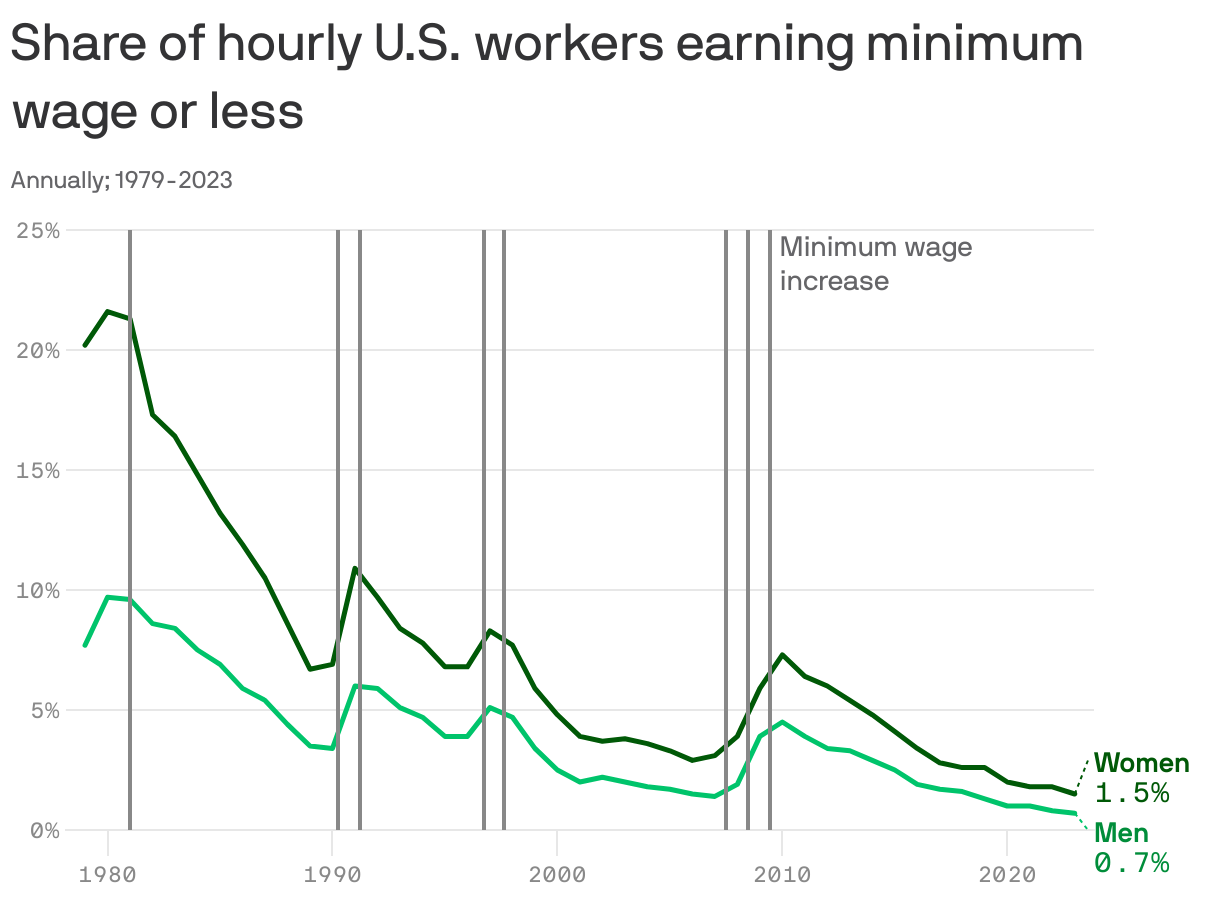
Stunning stat: The number of workers earning $7.25 or less fell by nearly half over the past four years, to 869,000 in 2023 from 1.6 million in 2019, per the Bureau of Labor Statistics.
- Overall, the number of low-wage U.S. workers has decreased.
- Last year, only 81,000 workers earned exactly $7.25 an hour, and 789,000 made less than that (many of them tipped workers who earn a different lower minimum wage).
Do we even need a federal minimum wage? Yes, says Ben Zipperer, an economist at the Economic Policy Institute. "Any increase in the minimum wage is going to sweep up millions of workers."
- About 17 million people are earning less than $15 an hour, according to EPI's low-wage workforce tracker. Raising the wage floor to $15 would give all of them a pay boost.
- Plus, it's likely that a wage rise would also push up pay for those earning more than the minimum. Say, for a manager earning $15 an hour who oversees those making $7.25.
Between the lines: Because more women tend to work in low-wage fields, more than twice as many earn the federal minimum wage than men. 600,000 women earn $7.25 or less, compared to 270,000 men.
- If the federal minimum wage was raised, women and people of color (also disproportionately lower paid) would see the largest wage increases, Zipperer says. "By not raising the minimum wage we are keeping their wages low."