The places where minimum wages are rising this summer

Add Axios as your preferred source to
see more of our stories on Google.
Three states and 16 localities raised their minimum wage this summer, many of them through automatic inflation adjustments, the Economic Policy Institute notes in a new report.
Why it matters: Boosting the wage floor has the downstream effect of raising pay for those who make more than the minimum — as employers have to adjust their wage ladders upward.
By the numbers: On the first of July, Oregon raised its minimum by 70 cents to $14.20 as part of an automatic inflation adjustment. Portland's minimum wage is $1.25 higher, by law, and went up to $15.45.
- Washington, D.C.'s minimum wage also got an inflation adjustment, rising to $17 — an increase of 90 cents.
- Nevada went to $11.25, from $10.50, per legislation.
- Connecticut's minimum wage went up by one dollar on June 1 to $15.00.
- Inflation adjustments also happened in 12 locales in California including San Francisco ($18.07), Los Angeles ($16.78), and West Hollywood ($19.08), which now has the highest minimum wage in the country.
- Chicago and Montgomery County, Maryland, also inflation-adjusted their minimum wages.
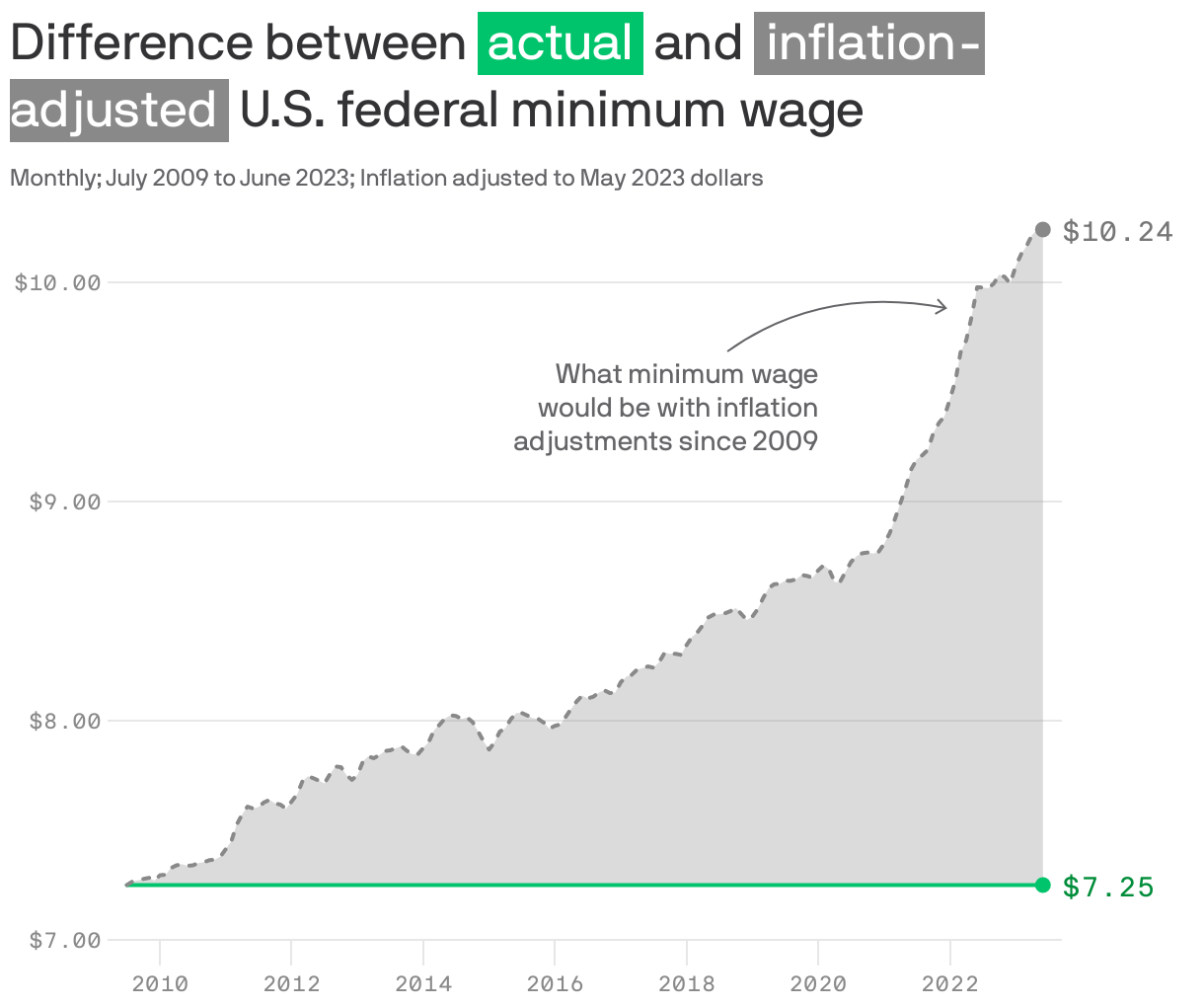
Meanwhile, the federal minimum wage of $7.25 an hour hasn't changed since 2009; if it had been adjusted for inflation since then, it would be up to $10.24 (see chart above).
- More than 10 states use the federal minimum, per a count from the Labor Department, including Alabama, Georgia, Louisiana, Mississippi, South Carolina, Tennessee and Wyoming.
